26 October 2012, Leipzig, Part One

26 October 2012
Leipzig

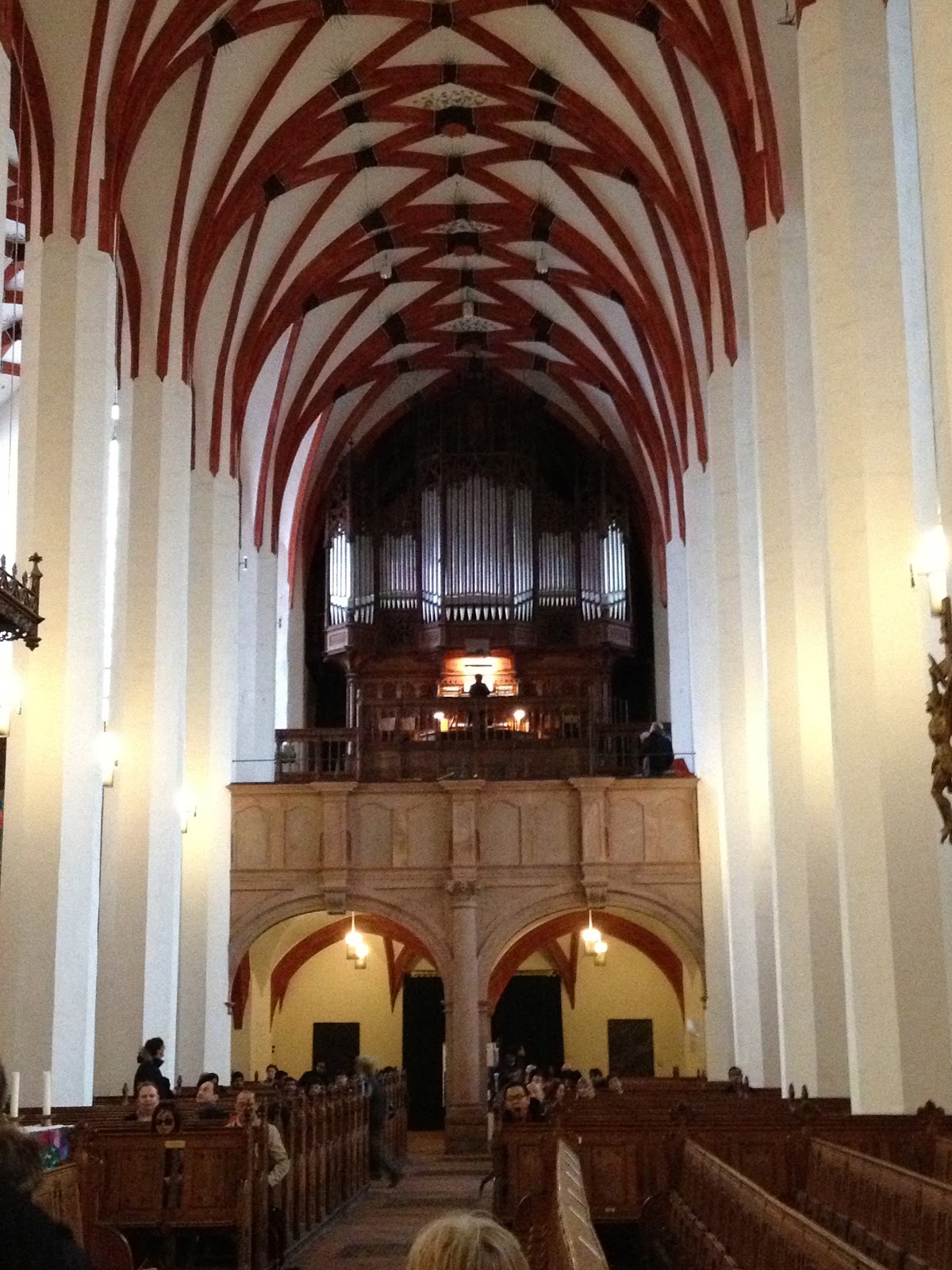
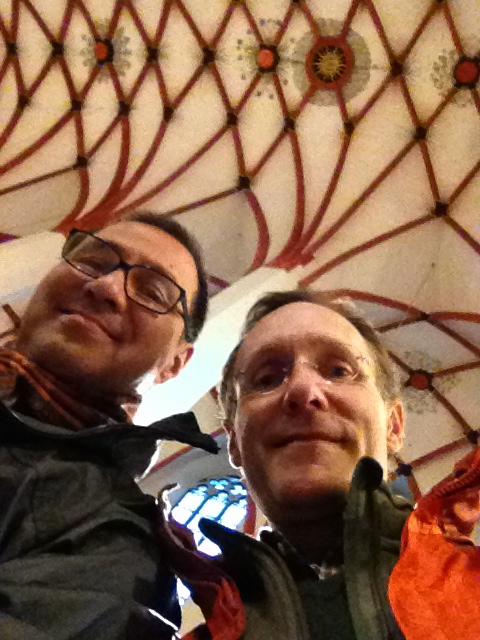
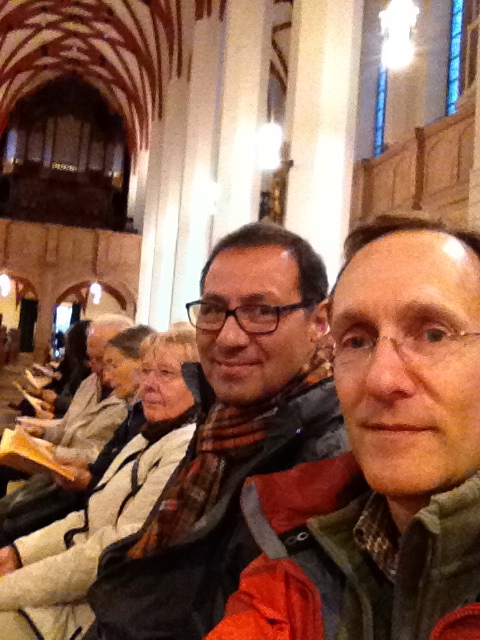
Here we sit. Late afternoon. Inside a warm church. On chairs of bare, uncushioned wood. Outside it is winter in October. Thirty degrees Fahrenheit. We are in a long row that runs the length of the church from the front door to the altar. That is how the seats are oriented, long rows on both sides that face the center aisle.  To see the altar you must turn your head ninety degrees. Otherwise you face, eye to eye, the people in the opposing rows across from you. (Is that a Lutheran thing?)

To our right, over the tall front doors and in a loft is the organ. To our left, reached by three steps, is the altar. Mostly free of decoration, it’s side walls are hung with double rows of large oil portraits of unsmiling men in dark garments.  Beneath the stern faces are double rows of chairs on both sides. I imagine singers will occupy them.

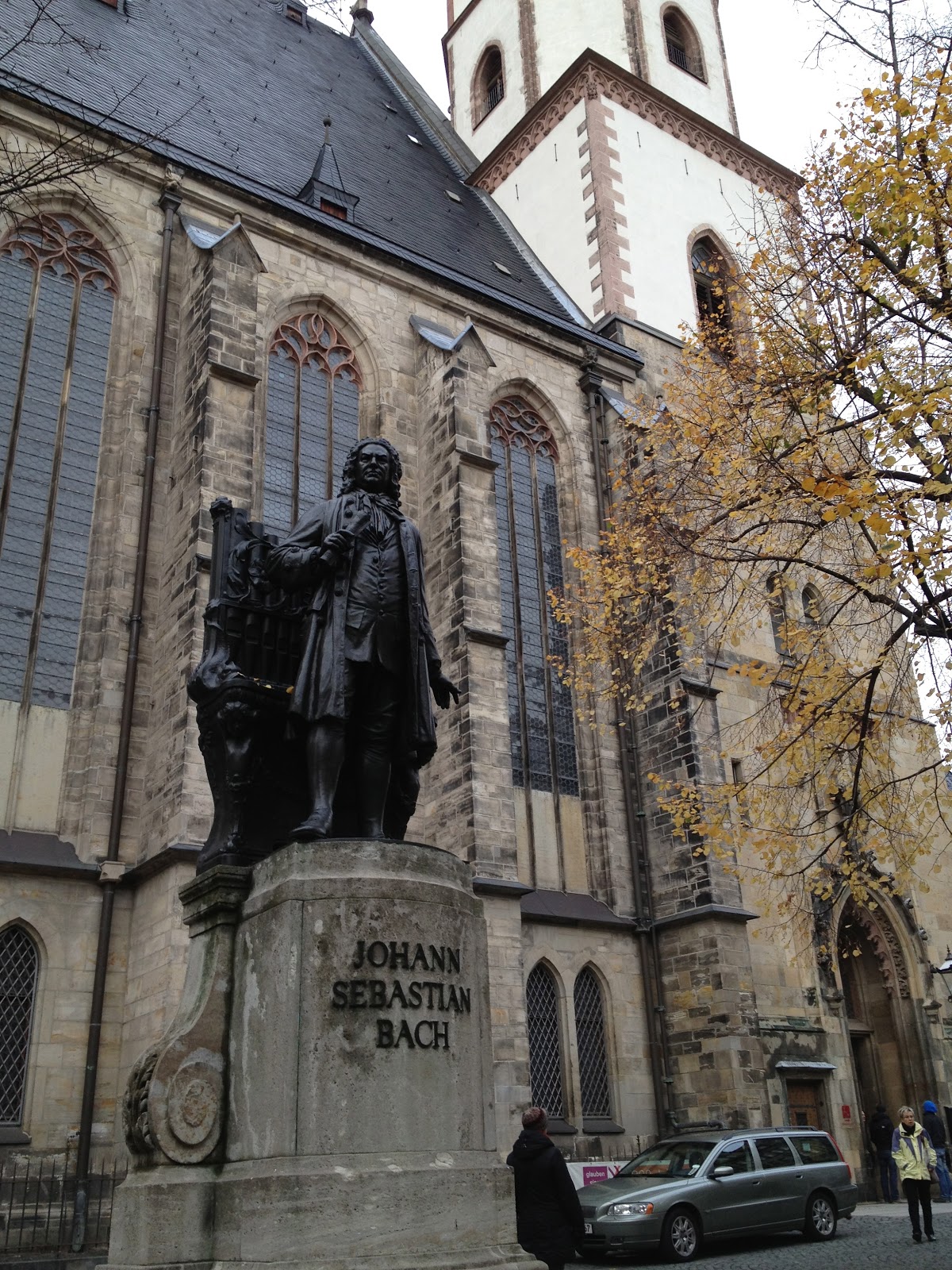
Finally, between the chairs and inlaid in the floor, is a rectangular bronze plaque. It reads: Johann Sebastian Bach, 1685-1750. His remains are beneath the plaque. This is the Saint Thomas Kirche in Leipzig.

Dear Bach, our creative genius, who’s music is a balm for what ails the humans of the world. It entertains, it soothes, it uplifts. Our dear Bach worked long hard hours in Leipzig. Over-worked. Under-paid. He auditioned teenage boys–hooligans, mischief makers–for the choir school then built them into a first-rate ensemble. His boy sopranos grew up fast. Voices changed. So auditions were constant. And he played the organ. And he conducted. And did administrative work for four churches. And it was his job to select music for the Sunday services. Select? Of course not. He wrote it all himself. Every Sunday for twenty-seven years he wrote new music for the Lutheran services.

It was a big job. Modest. Humble. Lots of bosses to please.  He was a city employee with a contract to adhere to. After twenty-seven years of loyal service he died and was buried in an oak casket in a nearby churchyard then forgotten for eighty years until Felix Mendelssohn came to live in Leipzig and began a revival of interest in Bach’s music.

Meanwhile, back in the Saint Thomas Kirche, we have been sitting now for forty-five minutes waiting for the “Motette” to begin. We are unsure if it is a church service or a concert. There is a printed program and it does list several choral compositions. But it also tells us who will give the sermon and when to rise and sit. If it is a church service, I hope we can convincingly pass as Lutherans.

And now, it is show-time. The singers–twelve men and twenty two women–have entered the front door.

Marlow and Wes
26 October 2012
Saint Thomas Kirche
Bach’s workplace
Leipzig
Sent via BlackBerry from T-Mobile

24-25 October 2012, Dresden


24-25 Oct 2012
Dresden

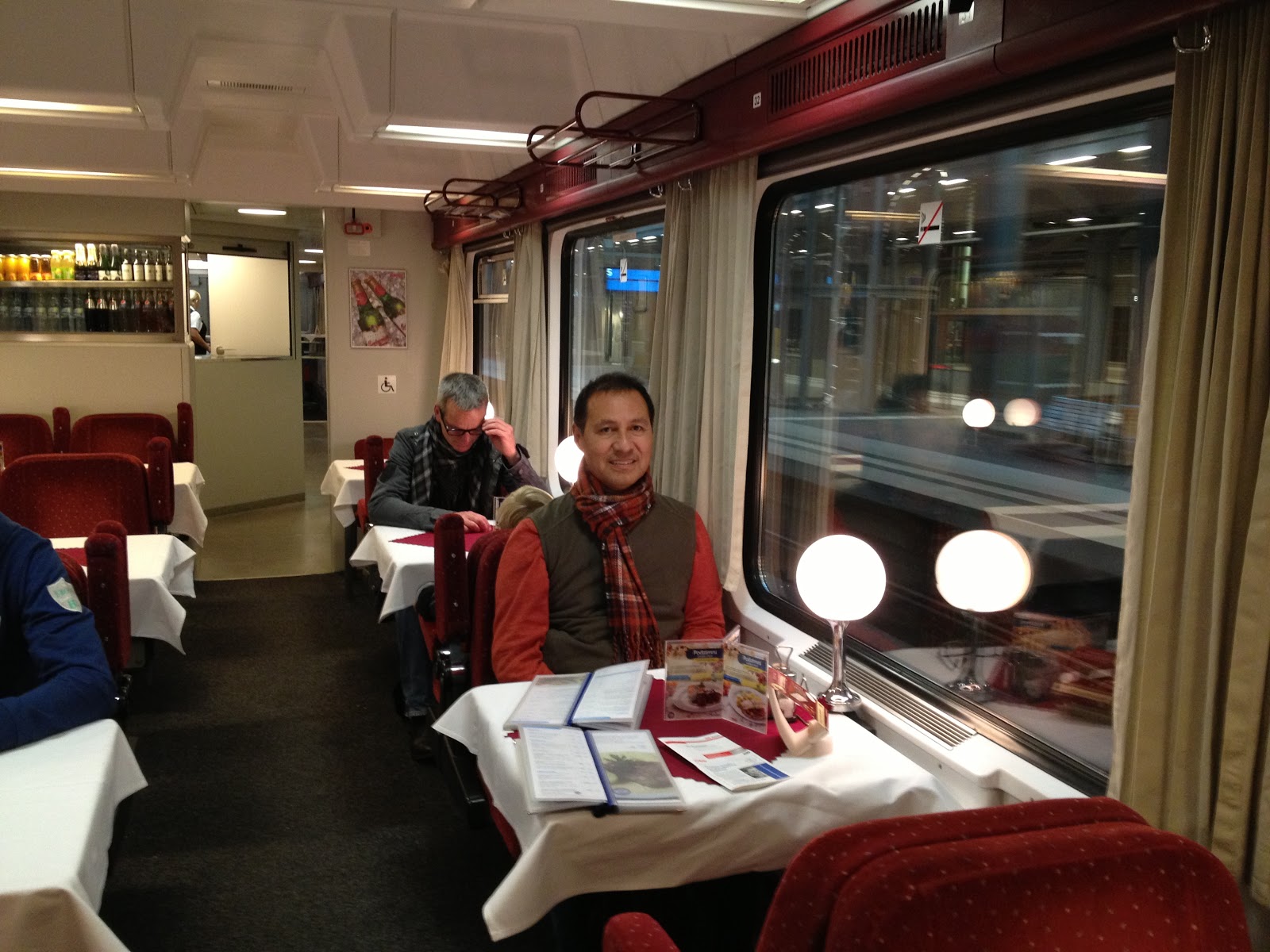
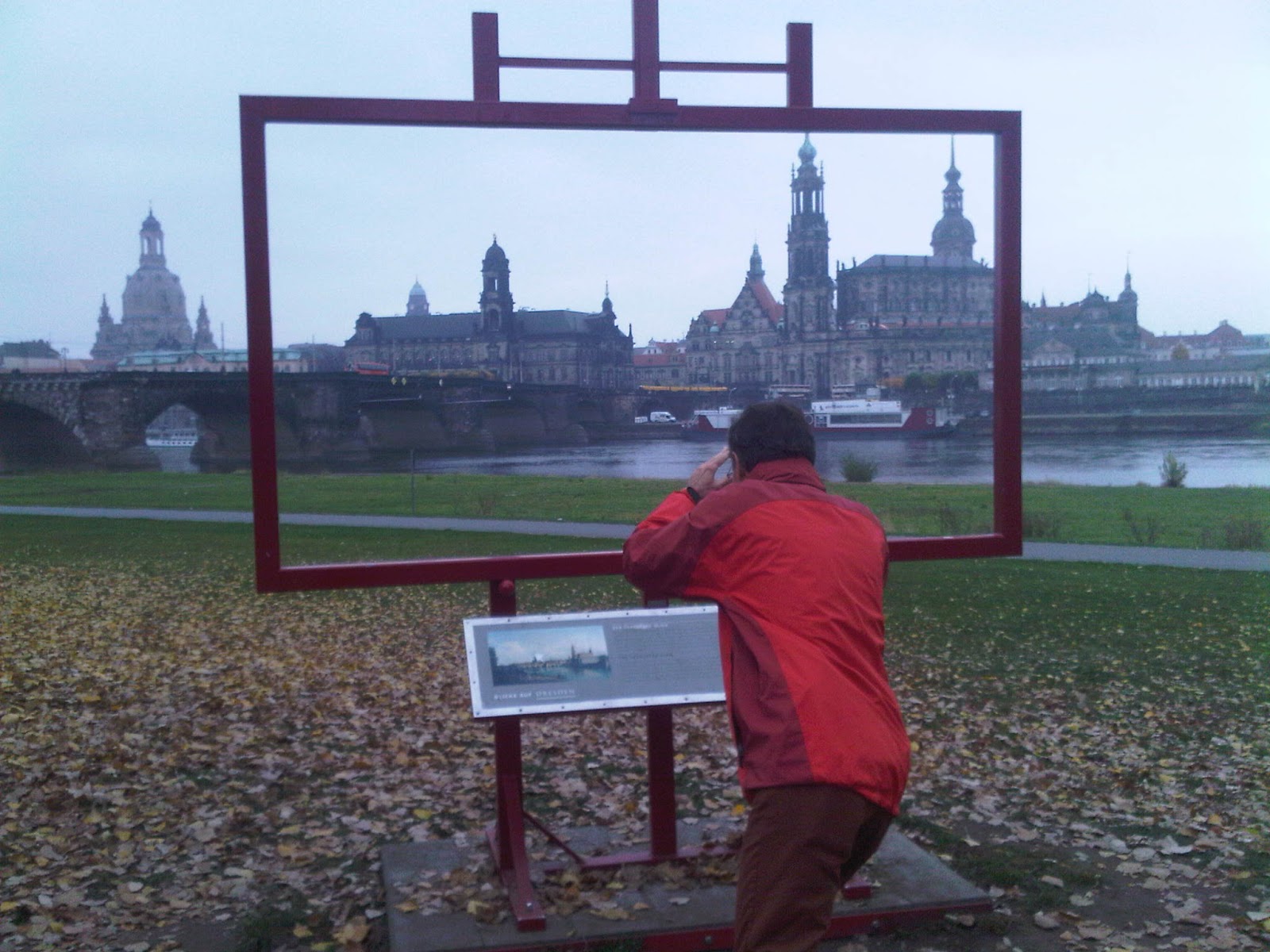
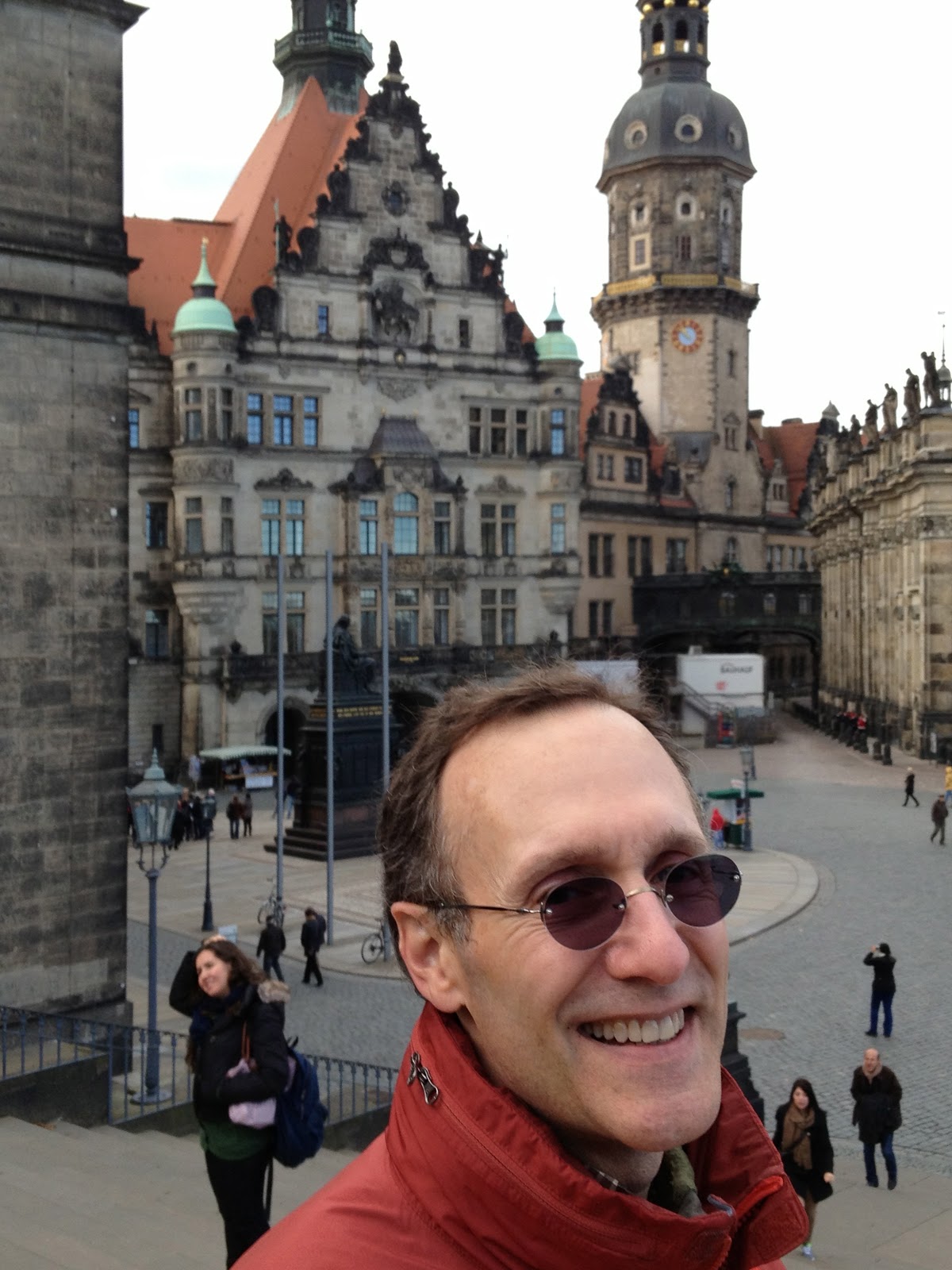
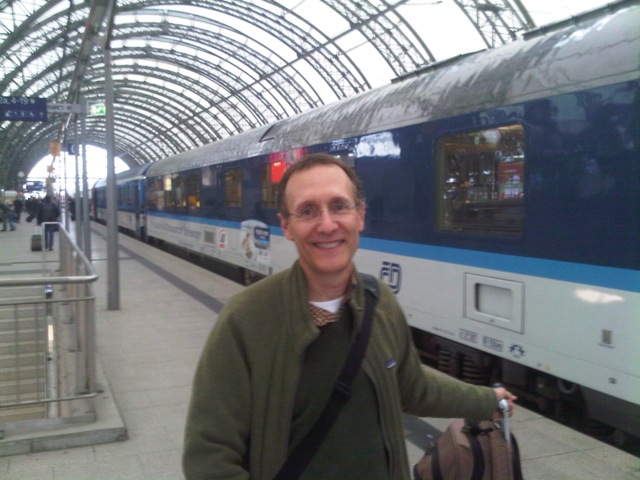
The name of our train from Berlin to Dresden is the “Johannes Brahms”. It seemed a cozier, more intimate train than usual.  It was Czech. We sat in the dining car and ate seasonal Czech specialties.  The day was overcast and chilly when we arrived in Dresden. Our hotel is the Bellevue. (The famed conductor, Hans von Bulow, was born in it.) It is on the bank of the Elbe River. It faces the old city and the bridge to it. Our room has the same view as the Canaletto painting.

Dresden was a short stay occupied mostly by museums visits. Many of the great buildings of the old city were destroyed in the war. They remained piles of uncleared rubble, some for thirty or forty years. They now have all been rebuilt. The before and after photos are astounding.  And the art collections they house are impressive.

Dresden was the home of Augustus the Strong. He loved beautiful objects like buildings, jewels, paintings, sculptures, theaters. He bought and built like a fiend and much of it is on display in various museums. Most everything he acquired still has his initials. The frames of the paintings have his crest below and a crown on top.

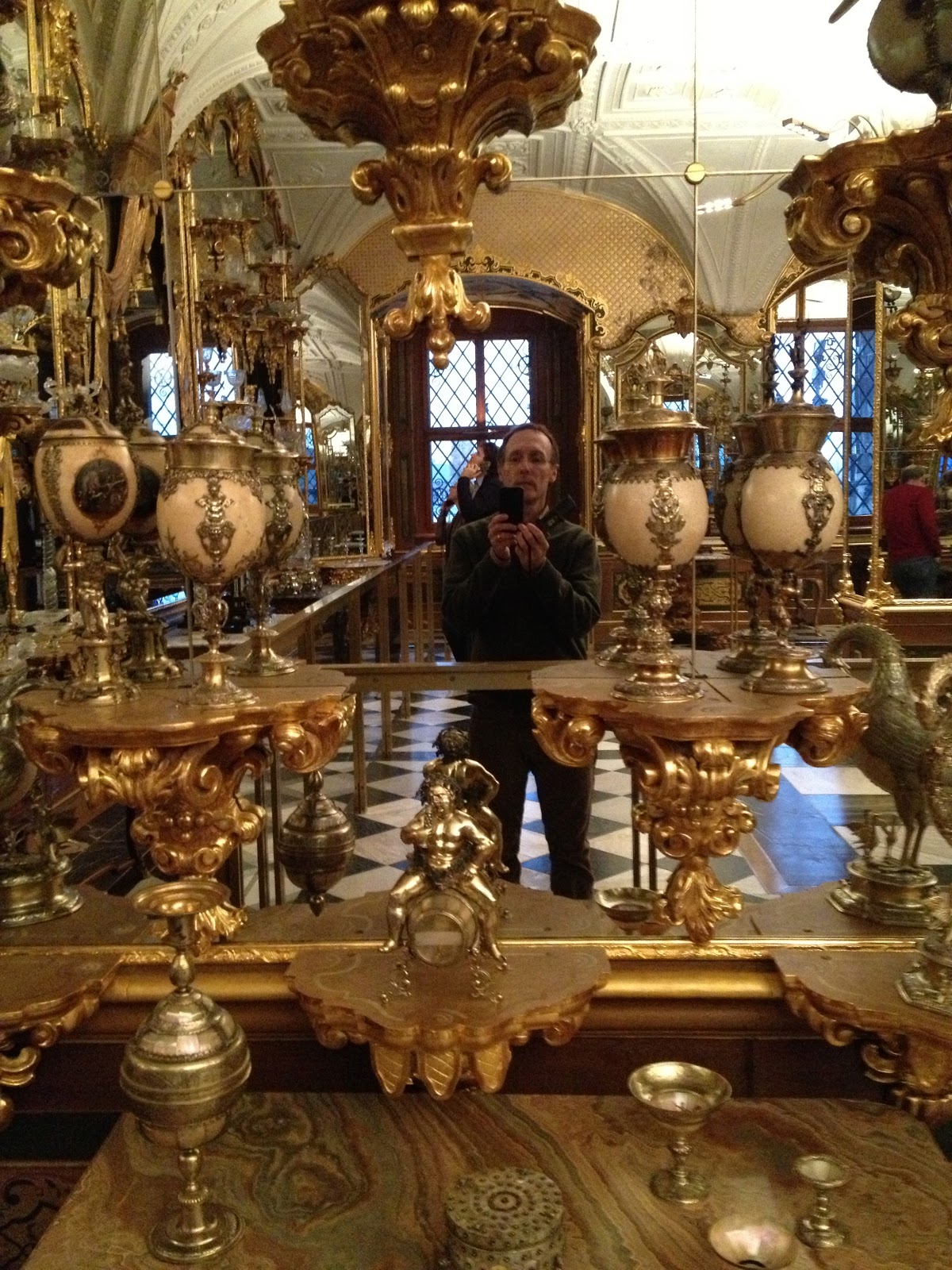
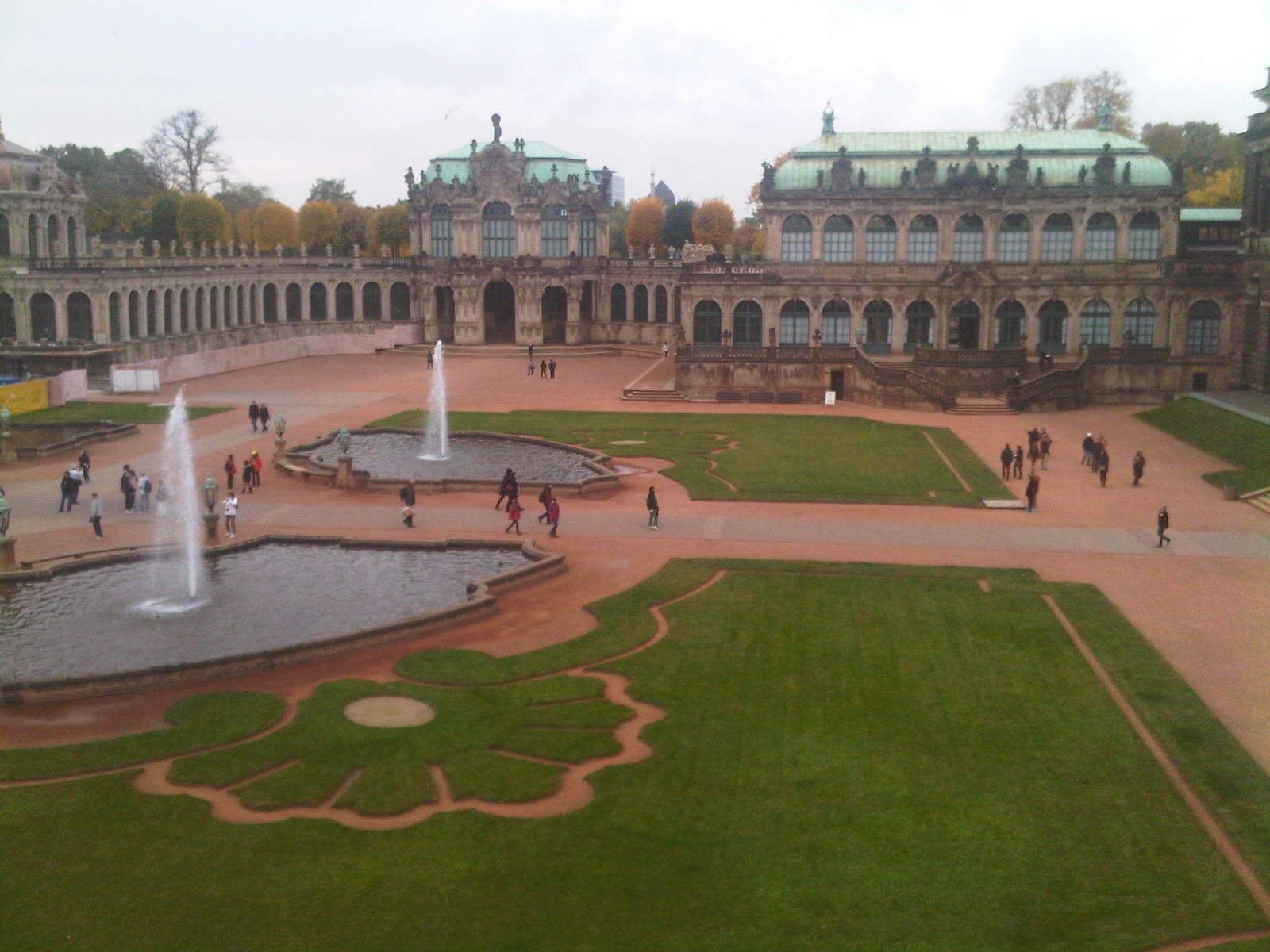
One of the museums, the Grünes Gewölbe (Museum of Treasury Art) was his palace. He had a passion for over-the-top decorative objects.  How about a cherry stone with one-hundred and eighty-five faces carved into it. That is a bit of silliness. But there are, perhaps, eight rooms that were specially designed to hold his collections. Visited sequentially, each room out does the previous in lavish materials, decor and priceless objects. One room has wildly intricate carvings of amber fashioned into platters and cabinets. Another is ivory. Another has bowls and vessels carved from clear crystal. Another has complete sets of jewels. A matching ensemble–buttons, buckles, ear rings, necklaces, pins, a sword handle–of emeralds. Another of rubies. Another of sapphires.  Another of diamonds which include a double necklace with a dozen and a half huge, half-inch, teardrop-shaped diamonds. The Alte Meister Museum holds his painting collection. He bought good stuff. Breughel, Raphael, Vermeer and of course Canaletto. And the building has the best courtyard. Formal lawns, fountains and red earth paths.

Connected to the museum is the Alte Meister Restaurant. It is an elevated stone pavilion with large arches with windows. Comfortable and warm on a chilly night with candle light, soft jazz, good cocktails and great food. Our food begins with a warm tranche of goat cheese in a pool of fresh tomato ragout.  Next up, pumpkin soup with a quail filet on a skewer for Wesley. Coconut-cream, lemon-grass soup with prawns for me. After that, duck breast over roasted parsnips for Wes. And loin and belly of local Duroc pork for me. With the pork, I am drinking 2011 Riesling, (Rothenberg.  Nahe. Weingut Bürgermeister: B. Willi Schweinhardt. “Trocken, fein eingebundene Säure, Pfirsicharomen”.)

In the moment…..while eating…..the first bite of the pork: perfect. Tender. Moist. Rich flavor. In a small pool of a rich pepper infused reduction. My wine, a white, is not at all minerally, it is intensely fruity, but not at all sweet.

(With apologies to Meredith. I know you are not here to slice and eat this delicious pork. To sip and swish this delicious wine. But you would really, really love it.)

The meal is over. It was wonderful. Everything prepared to perfection. The meats, tender, medium rare, juicy. A most comfortable place to land after a day of train travel and on a chilly winter October night.

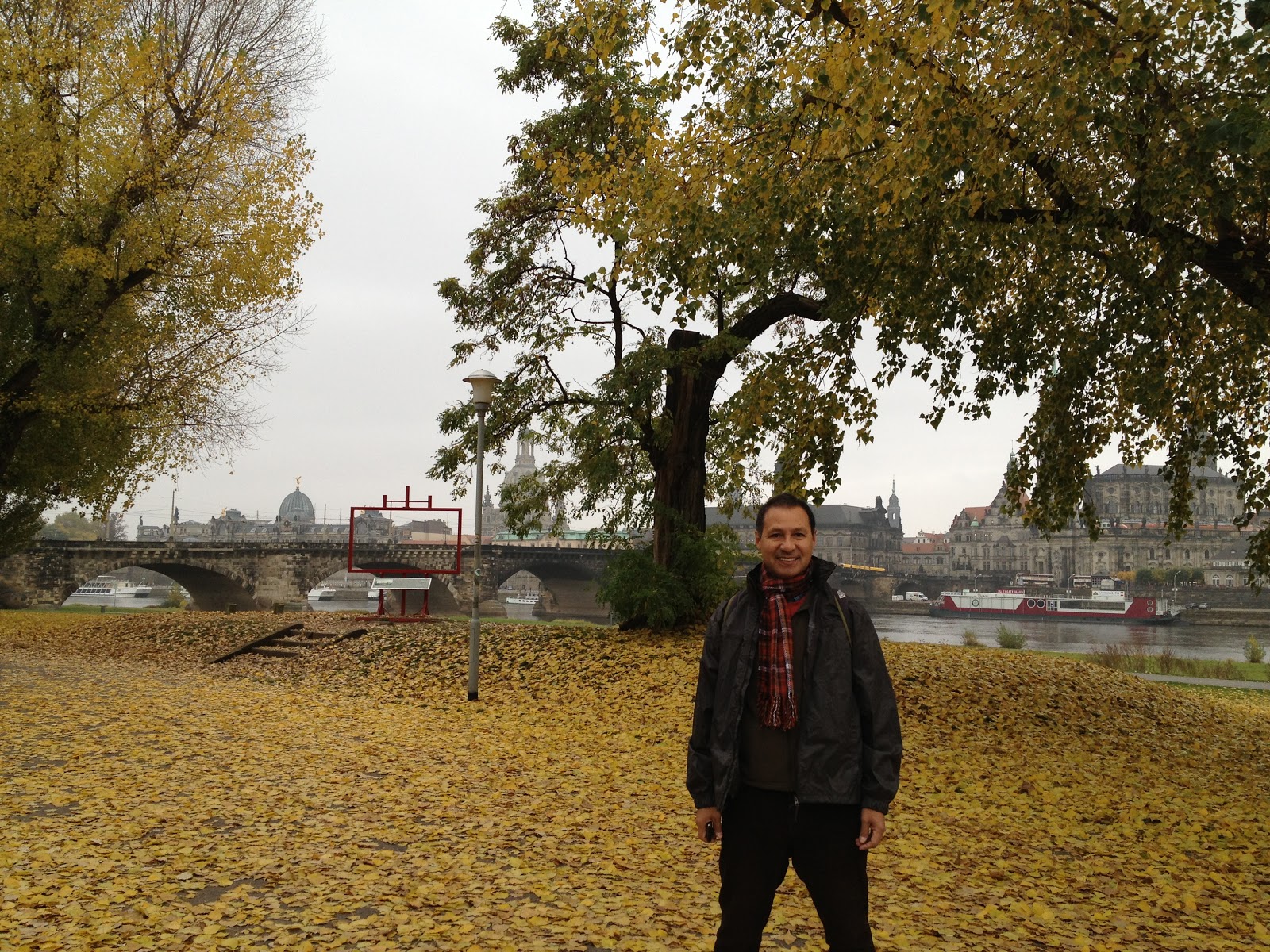
During most of our stay the sky was overcast, but on our last morning the sky was clear and blue. We walked one last time across the bridge to wander in the sunlight. We walked through piles of colorful autumn leaves. We kicked them into the air. It was cold. Winter has come early. And we are excited now to get to Leipzig. To the train.

Marlow and Wes
24&25 October 2012
Dresden
Sent via BlackBerry from T-Mobile

18-23 October 2012, Berlin, Part Two

18-23 October 2012

Berlin, Part Two

I have gotten behind in writing. We have seen and heard and tasted and felt so much it has been a lot for my brain to process. Here is the rest of Berlin.

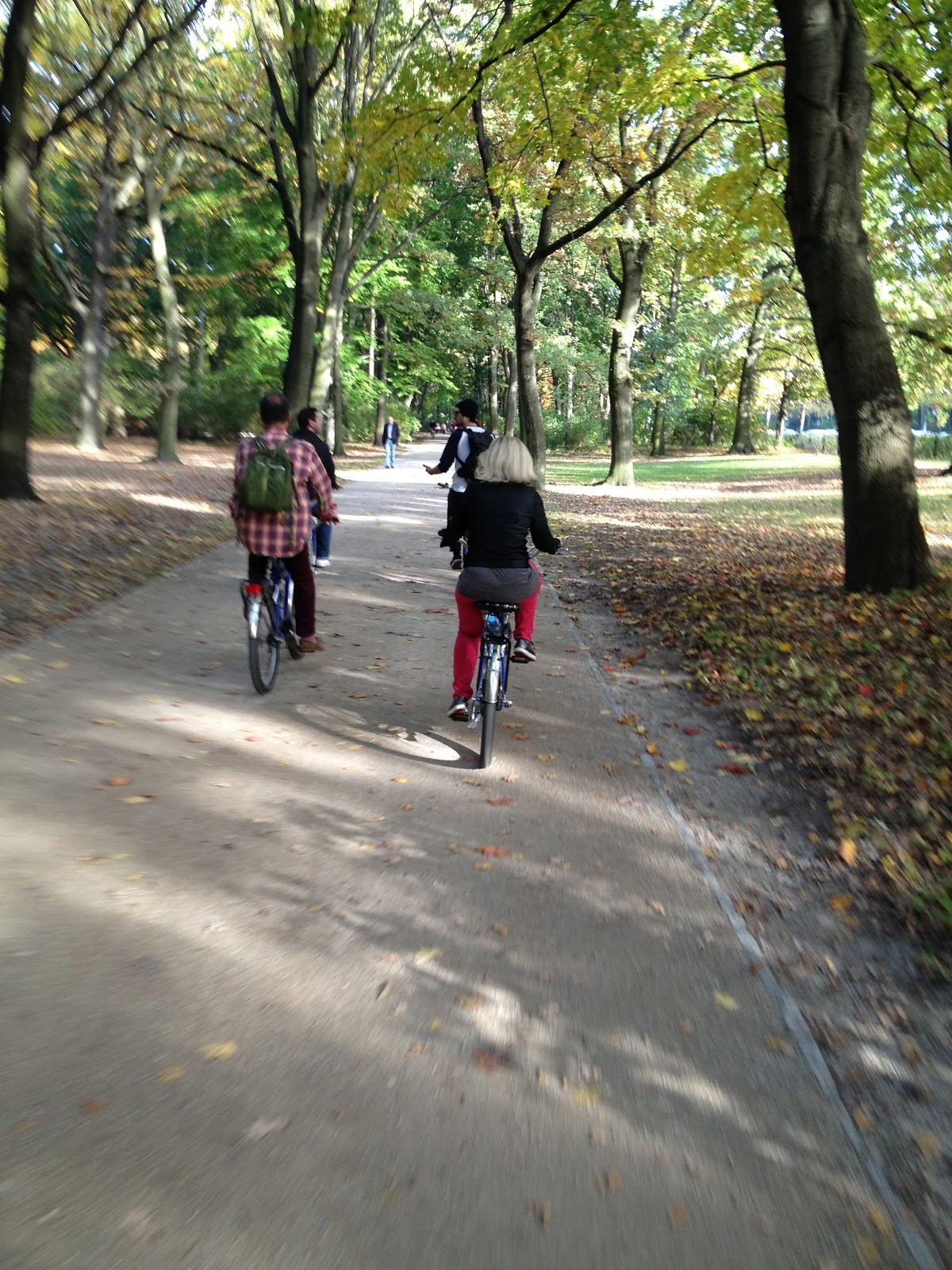
Pedaling in the Tiergarten 
Berlin is the first German city I have ever visited. I was quickly aware that it was going to be a challenge to wallow in it’s history. And it was. We took a bicycle tour. It was six hours long that flew by like a breeze.

The day was perfect. Sunshine and blue skies. We pedaled through the tree shaded lanes of the Tiergarten, Berlin’s Central Park. We learned about the great theater the Deutsche Staatsoper Berlin. It was built in the seventeen-hundreds. One of the first opera houses.  And it was reconstructed in the old style after it’s destruction in World War Two. We pedaled around the Brandenburg Gate. Fully restored and wildly popular. The American Embassy is there. We saw Checkpoint Charlie, a cold war relic. And the Holocaust memorial. Then more great museums and parks.  Much of the modern German history is a dark tale. This is not vacation stuff. I recognize the importance of airing historical dirty laundry. The world should be compelled to remember so as not to repeat. But dwelling in that realm is sad and solemn. I did not dwell. I took note of it and I moved on.

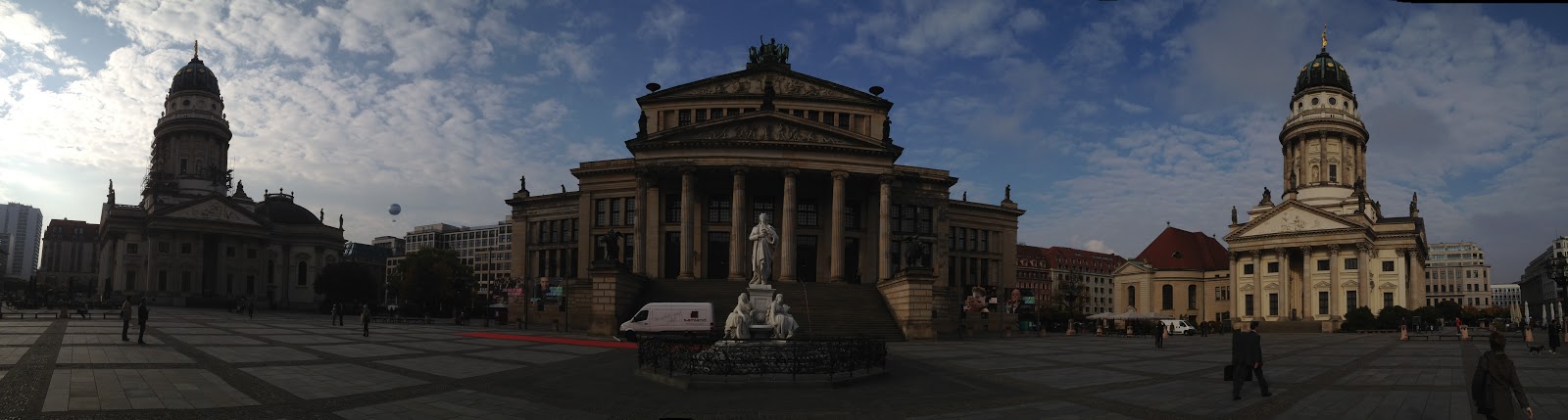
We stayed in a one-bedroom apartment in East Berlin at the Mandala Suites–recommended by a neighbor. After the Berlin Wall fell, parts of East Berlin were flooded with interest and money. It is still in a renaissance period and our neighborhood evidence of it. It was great. Around the corner was the Gendarmen-markt Platz.  It instantly became a favorite place to hang out. It is a large, light, old, cobble-stone paved, rectangular plaza flanked by two identical churches and a concert hall. It is an  elegant and welcoming space with lots of cafes and restaurants to enjoy it from.

Gendarmenmarkt by day

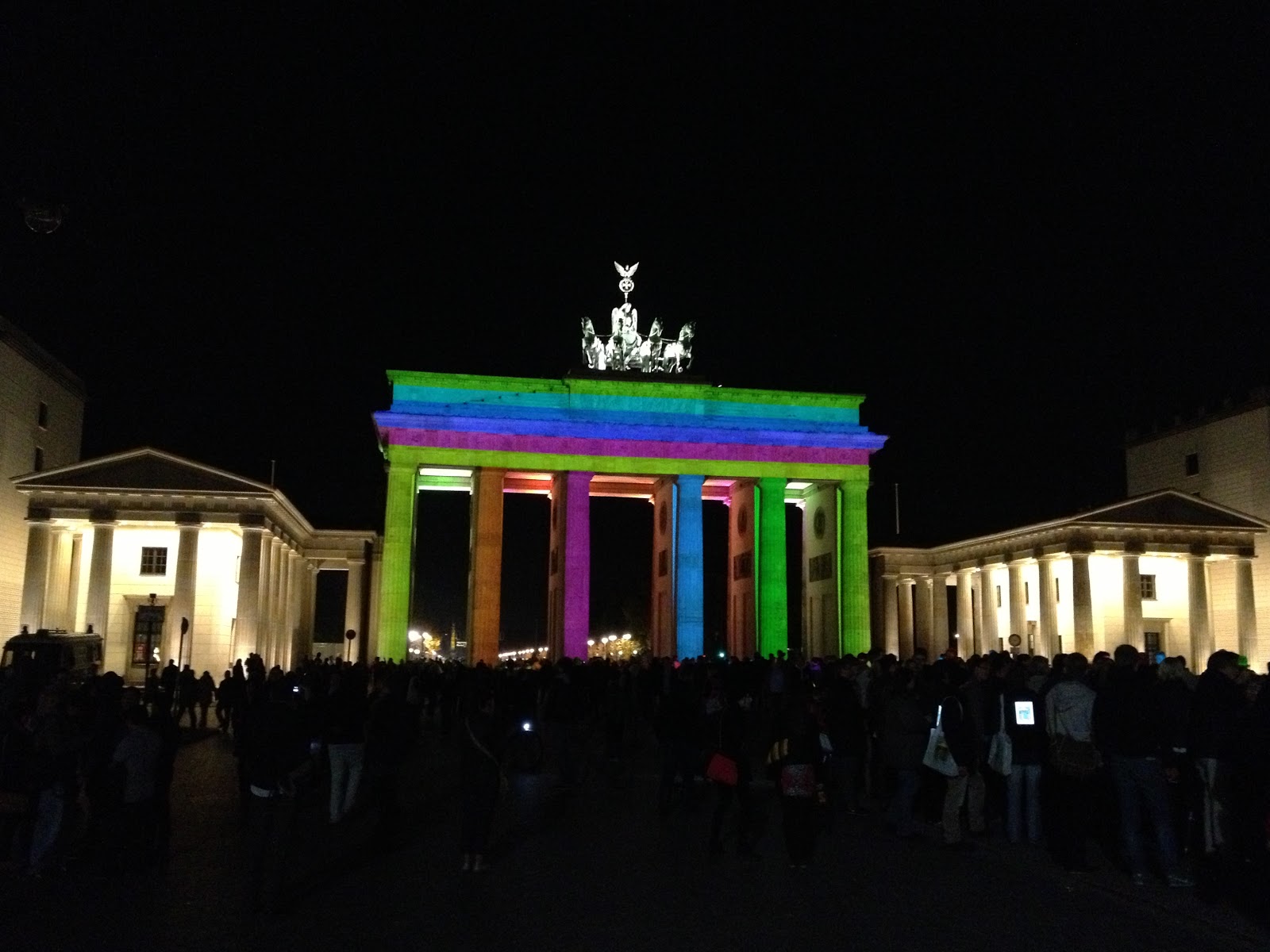
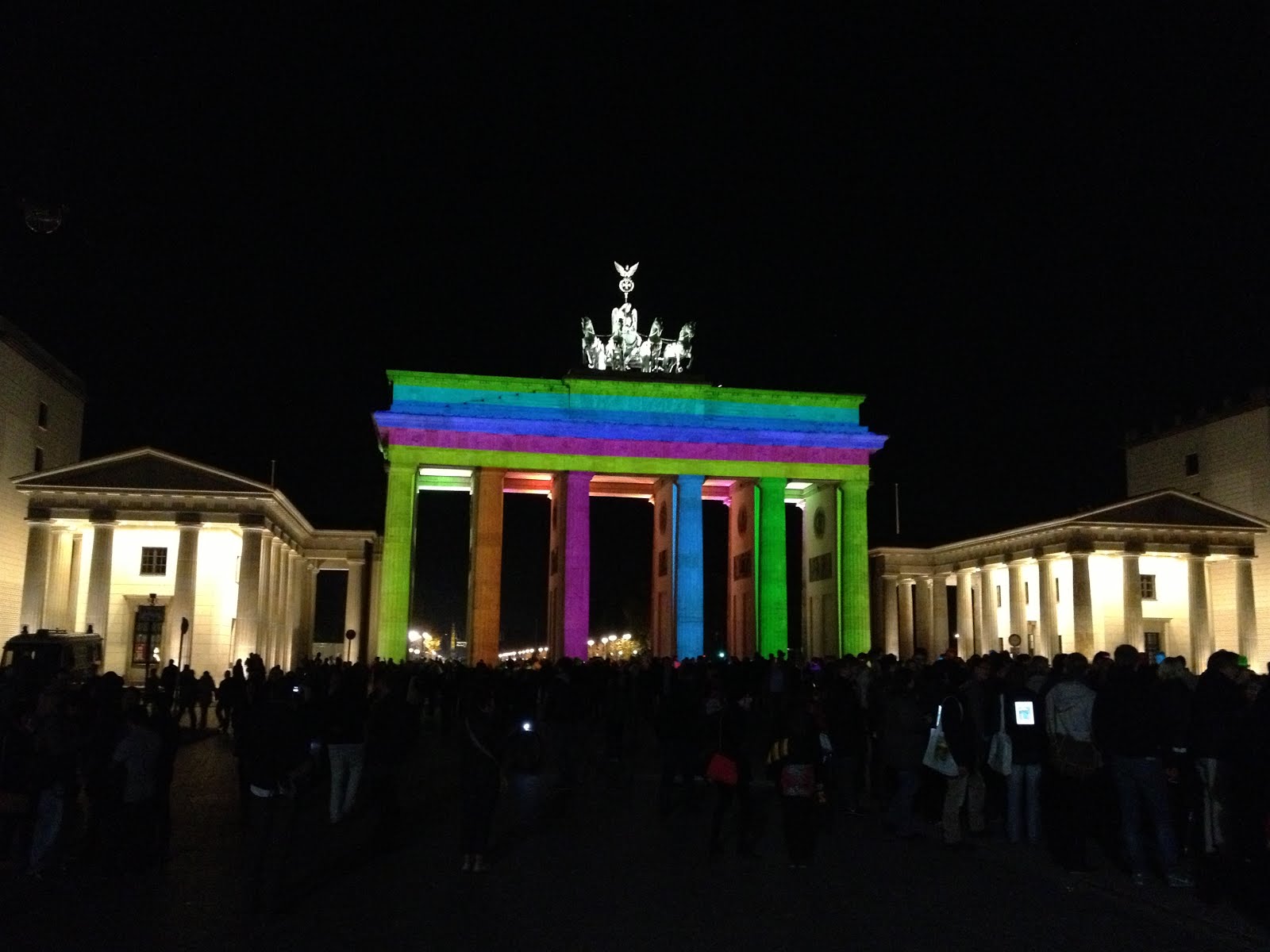
Brandenburg Gate at night

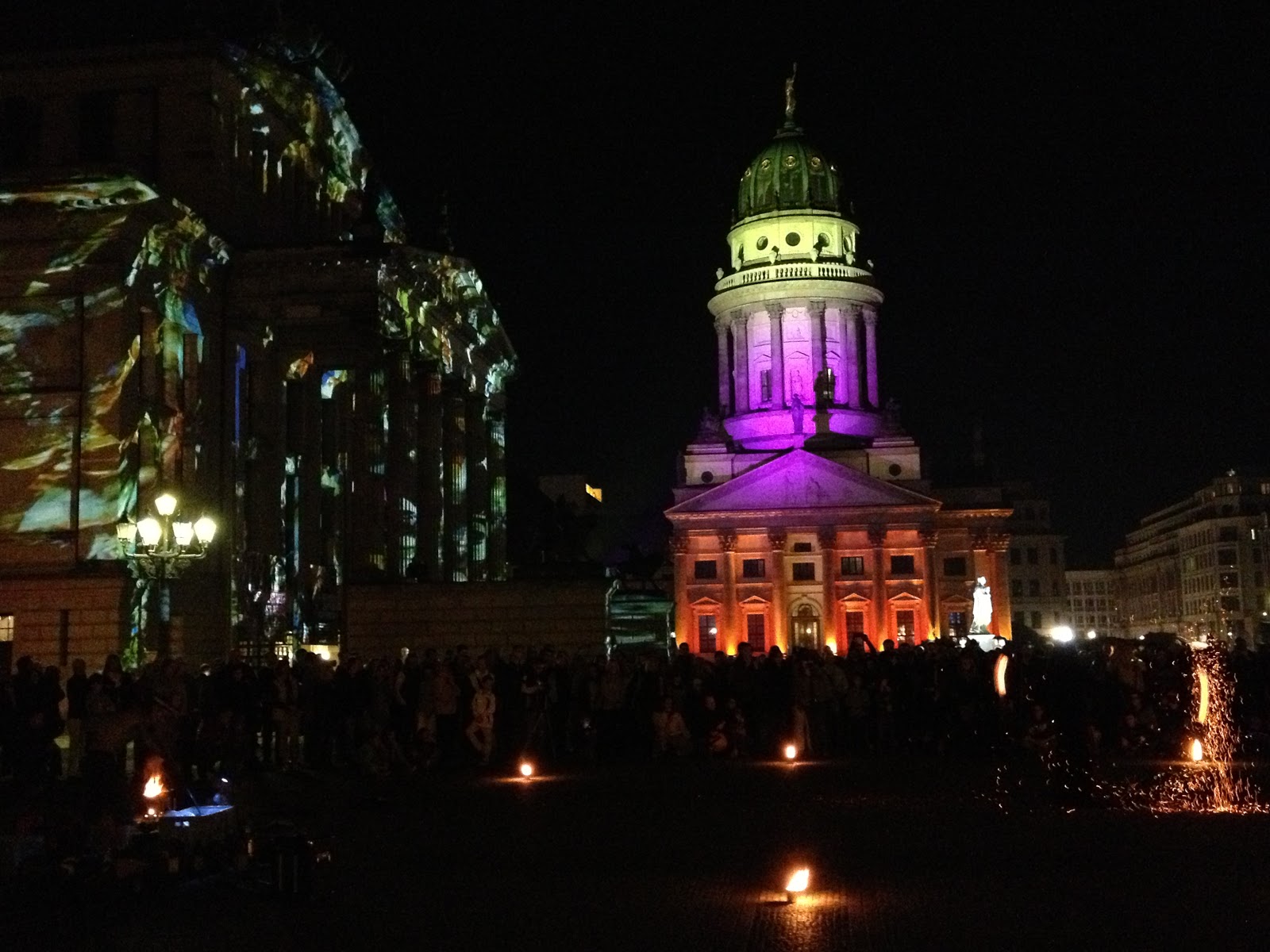
We went there on our first night. The sun had set.  There were lots of people. And they were carrying tripods. Like the city people were on a photo field trip. We learned that people were out city wide. It was for the Festival of Lights. For two weeks artists were invited to illuminate buildings. In this instance the lights were animated images on the move and colorful covering the entire surface of the buildings’ facades. It was great. It brought out the Berliners for a city wide photo party.

Gendarmenmarkt at night

I am new to German food. I have grown–literally–to love their sausages (wurst) and potatoes (kartoffel). The potatoes, they sauté with onion and ham and finish with a sprinkle of fresh chopped parsley. The aroma travels far. In the Ka De We food court we wafted on that aroma like  cartoon characters.  It picked us up and floated us right into two stools at Kartoffel-Acker, a potato restaurant with twenty seats. Their potato pancake is light as a feather, thin, golden and covers the plate. Just add apple sauce. My lunch was sauteed potatoes, ham and onion cooked into a perfect omelet.  The other notable food was at Lutter & Wegner. Wes took us there several times. It is special. Beloved. Old. Since 1811. Artist, creative types, business people. Classic stuff.  I experienced my first Wiener Schnitzel (von Kalb aus der Pfanne mit lauwarmem Kartoffel-Gurkensalat) there. It was a revelation.  It covered half of the large plate. It’s contour resembled South America. Like Wes’s potato pancake it was light as a feather, thin, golden. I squeezed some lemon over, took a bite, tasted and swooned. I am a changed man.  Thank you Wesley for making taking me there. And thank you Lutter & Wenger for making it so delicious.

Marlow and Wesley
18-23 October 2012
Berlin, Part Two
Sent via BlackBerry from T-Mobile

18-23 October 2012, Berlin Music

18-23 October 2012

Berlin

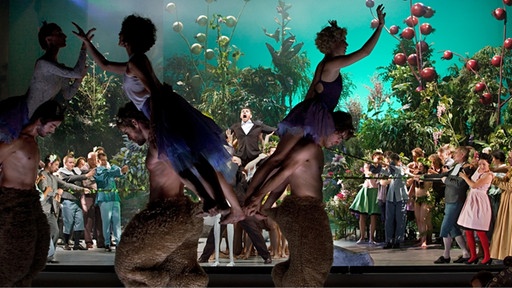
Berlin is a wonderful city for music. The Komische Oper Berlin may be called the Comic Opera, but it is as serious as it is comic and it is passionate about illuminating the story and making the stage come alive for the audience. We saw Orfeo by Claudio Monteverdi. Monteverdi lived to a good old age in Venice. He became a priest and spent his later years pondering life’s great issues and setting them to music. Those compositions from the sixteen-thirties are considered the earliest, if not the first, operas.

The Komische Oper’s theater, on the outside, is an unremarkable stone-clad box. Inside, it is lovely. Fairly intimate. Aglow with golden-hued sconces. Red velvet draperies framing the dozen or so arches on the second of two balconies. Between the arches torsos of large statues burst forth from the plaster. They twirl parasols and wield swords in dramatic poses. Our Orfeo performance began with trumpets playing to each other from opposing balconies. And birds flying overhead, dozens of them, mechanical, but life-like. The chorus descended from the stage, surrounded the audience, formed a ring around us and sang to us. The story of Orfeo is one of love found, then lost, then found, then lost. Along the way there are laments and there are love-fests, orgies. Ecstatic groups of bare chested women with long tresses and flowers in their hair. And men, also bare chested, whose lower halves were shaggy furry cloven-hooved animal legs. There was dancing. It was both classical and  contemporary all at once. The orchestra sounded excellent. It was a mix of traditional string instruments, and the eerie and exotic oud, with an accordion in lieu of harpsichord. The singers were articulate and expressive. If it sounds like I loved it. I did.

On the next day there was more music. We were in the Dussmann record store at mid-day when the principal players from a another opera company, the Deutsche Staatsoper, stood in the atrium and played Mozart’s duet for violin and viola. They were outstanding, especially the violist.

From there we went for coffee to the Gendarmen-markt Platz, around the corner from our hotel. We sat outside. The sound of a street musician was wafting over to our table. He was playing the Mozart Clarinet Concerto. Live clarinet playing with a recorded orchestra accompaniment. He sounded terrific. And it was a special moment as it always is when that concerto is heard.

After coffee, we passed a church. A concert was about to start. Four french horns–the Berliner Horn Quartett–playing Bach fugues. Did we go? Yes, we did.

Was that enough music for one day? No. At eleven o’clock at night  we returned to the Komische Oper Berlin. This time we did not sit in the audience. We sat on stage facing the empty audience and the  amber lit, gold leafed theater interior. Forty of us were on stage–the Orfeo sets surrounding us–and a string quartet played Mozart to us from a dozen feet away with baroque bows and strings of dried animal gut. We turned back the hands of time. The music was new. We were guests of the prince in his elegant, gilded room being serenaded by his musicians playing the music written for his pleasure by his court composer.  What could top that?

How about a lunch concert in the atrium of the Berlin Philharmonic Concert Hall. Ninety minutes before the free trio concert the audience was lined up outside in the cold. When the doors opened they poured in. A flood of people. Hundreds and hundreds.  As many people as there were square feet in the atrium, it seemed. Filling every chair and balcony and stairway. Sitting on the floor and standing anywhere there was space available. It was a lively process. When the music began–Clarinet, cello and piano–there was a hush of quiet and stillness. It was a rapt audience. Soaking up music as if it were needed therapy. Was that enough music for us? No.

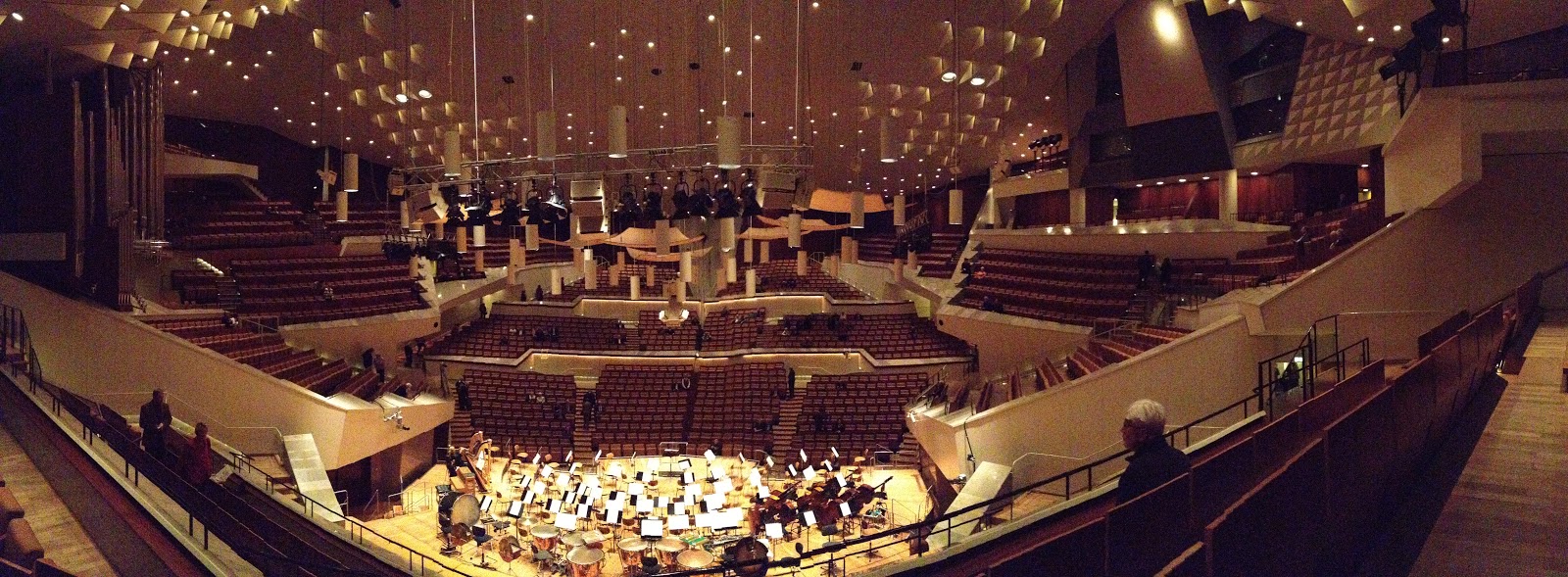
That same night we returned to the Hall for an evening orchestra concert. It was the orchestra of the Deustche Staatsoper (German State Opera) having a night out from the pit. Their theater from the late Eighteenth-Century is closed for renovation. For this concert they were using the Berlin Philharmonic’s home. It is a famous space, noted for it’s great sound and for the audience seats which encircle the orchestra entirely. I expected it to enjoy it. But I more than enjoyed it. It is a sound that is resonant, vibrant, clear, warm and it seduced me thoroughly. Of course, the orchestra had a role in the seduction, as did the conductor, Michael Gielen, and the compositions–Berlioz’s Romeo and Juliet, Ravel’s Scheherazade, Beethoven Symphony No. 8–but the star of the night was the symphony hall. I was elated and satisfied and impressed with the bounty of great music.

Music is a good reason to visit Berlin.

Marlow and Wes
18-23 October 2012
Berlin, Part One
Sent via BlackBerry from T-Mobile

17 October 2012 Basel, Switzerland

17 October 2012
Basel, Switzerland

We were in Basel for twenty-four hours. Our purpose was to visit, Raul, from Maryland. He was there for a concert. We visited with him for a part of an evening which included his sound check in the theater.  He is an impressive musician. Great technique, charisma, an easy-on-the-ear voice, singing about life through his songs. He sounded as great as ever. We last saw him in Barcelona, three weeks ago, with Kathleen, his wife. We went together to Set Portes, the great Catalan restaurant. Before that, we were with them December 2011 in Paris for his wife’s birthday. On that trip we took nephew Chris with us to introduce him to the joys of Paris, travel and uncles.  But back to Basel.

In Basel we stayed across the street from the train station. Often, that would be a scary location. But this is Switzerland. Their train stations are not scary and the locale was great. And the St. Gotthard Hotel was first-rate. It has been run by the same family since 1929. The current generation went to a highly regarded hotel school in Lausanne and is on site, with their parents, to keep everything as it should be.

This is our second city in Switzerland. So far, it seems a very affluent country. The prices are very high. People are generally well dressed, the streets are clean and the train stations are very well maintained, user friendly and free of artful dodgers.

We wandered through Basel on foot in the morning after breakfast in the hotel which was an impressive buffet. It is set up in a large pine-wood paneled room. With chandeliers and leaded glass windows. The furniture is wood fitted with iron. Substantial and hefty. To eat, there were eggs scrambled with cheese, cranberry compote and cut fruit for the plain yogurt. Rich smoked salmon.  Breads with flavor and texture to slather with butter and jam, particularly the kirsche–cherry–jam.

Well fed and with two hours before our train to Berlin, we walked the old town area. In the Münster Platz we visited a large and old church. One thousand years ago when a person of importance died, a life size statue of their likeness was created as a lid for their resting place. Usually with their feet against a dog and a nice tasseled pillow under their head, all done in stone. A man in full armor with his sword. A woman in a fine dress with flowing tresses or hair wrapped with strands of pearls or topped with a tiara. This church is rich with these carved lids. On display are intricately detailed ones from the thirteen-hundreds. And there are some, quite worn, from the year 900. Underneath the altar platform is a smallish chapel with stone columns and iron grill doors that open into an ancient basement. Through the iron grill you can see on-going archaeological digs that are yielding even more ancient materials.

The church is fronted by a cobble stone plaza, a platz. Part of the platz is occupied by parallel rows of poplar trees. A shady glade to sit in on a warm day. On the backside of the church is the Rhine River. To walk across the bridge takes only a few minutes. Or you can take the ferry that constantly crosses back and forth. Spanning the river is a taut metal cable. The ferry, with a rudder but without a  motor, is tethered to the overhead cable and uses the power of the Rhine’s strong current to move itself from one side to the other. It is fantastic to watch this old fashioned solution. Not solar, not gas, not electric powered.  Just the harnessed power of the strong fast current.
Now, for the seven-hour train journey to Berlin. To the north and to the east.

Marlow and Wes
17 October 2012
Basel, Switzerland
Sent via BlackBerry from T-Mobile

16 October 2012, Bernina Express, Switzerland

16 October 2012
Bernina Express, Switzerland


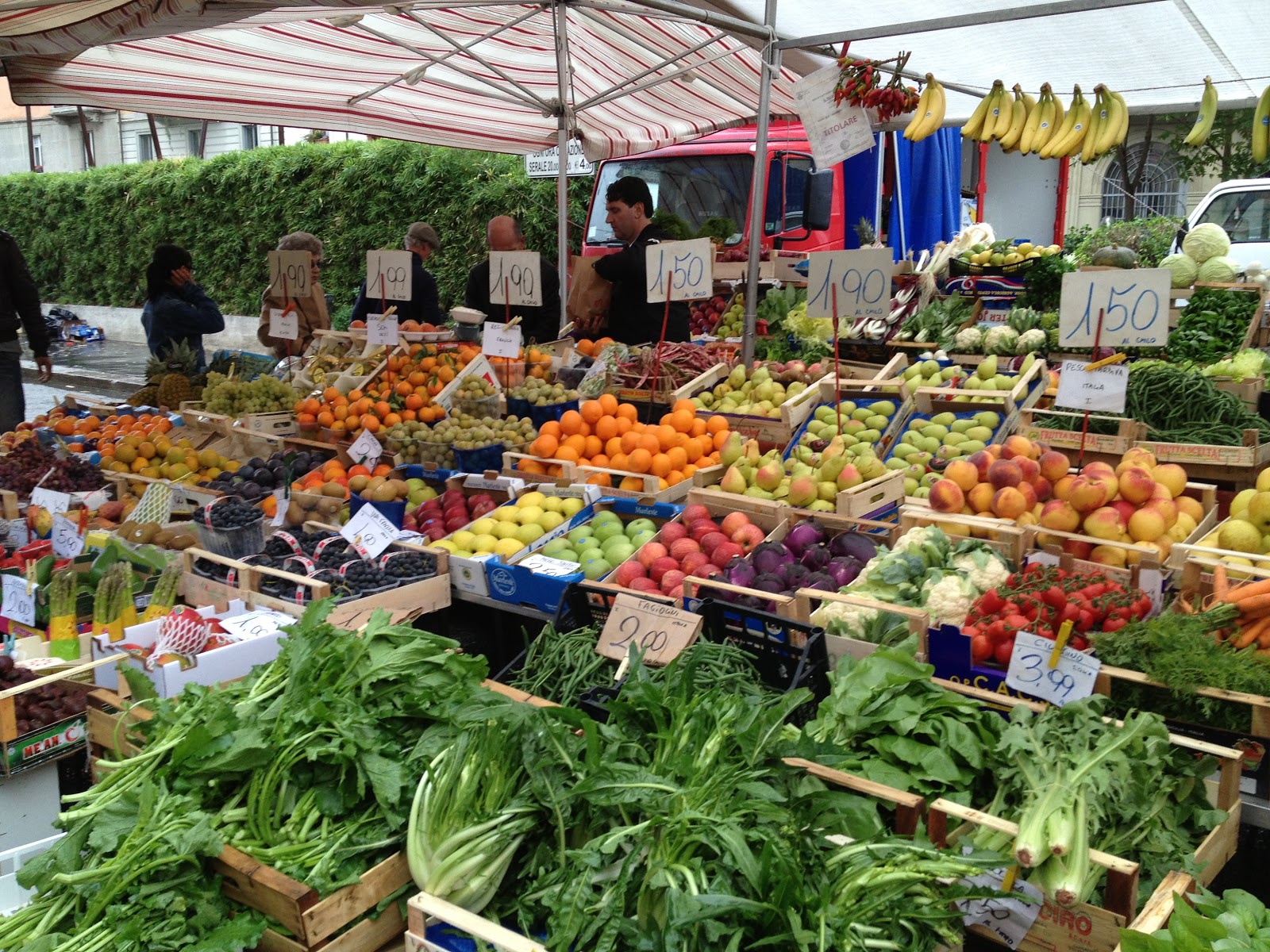
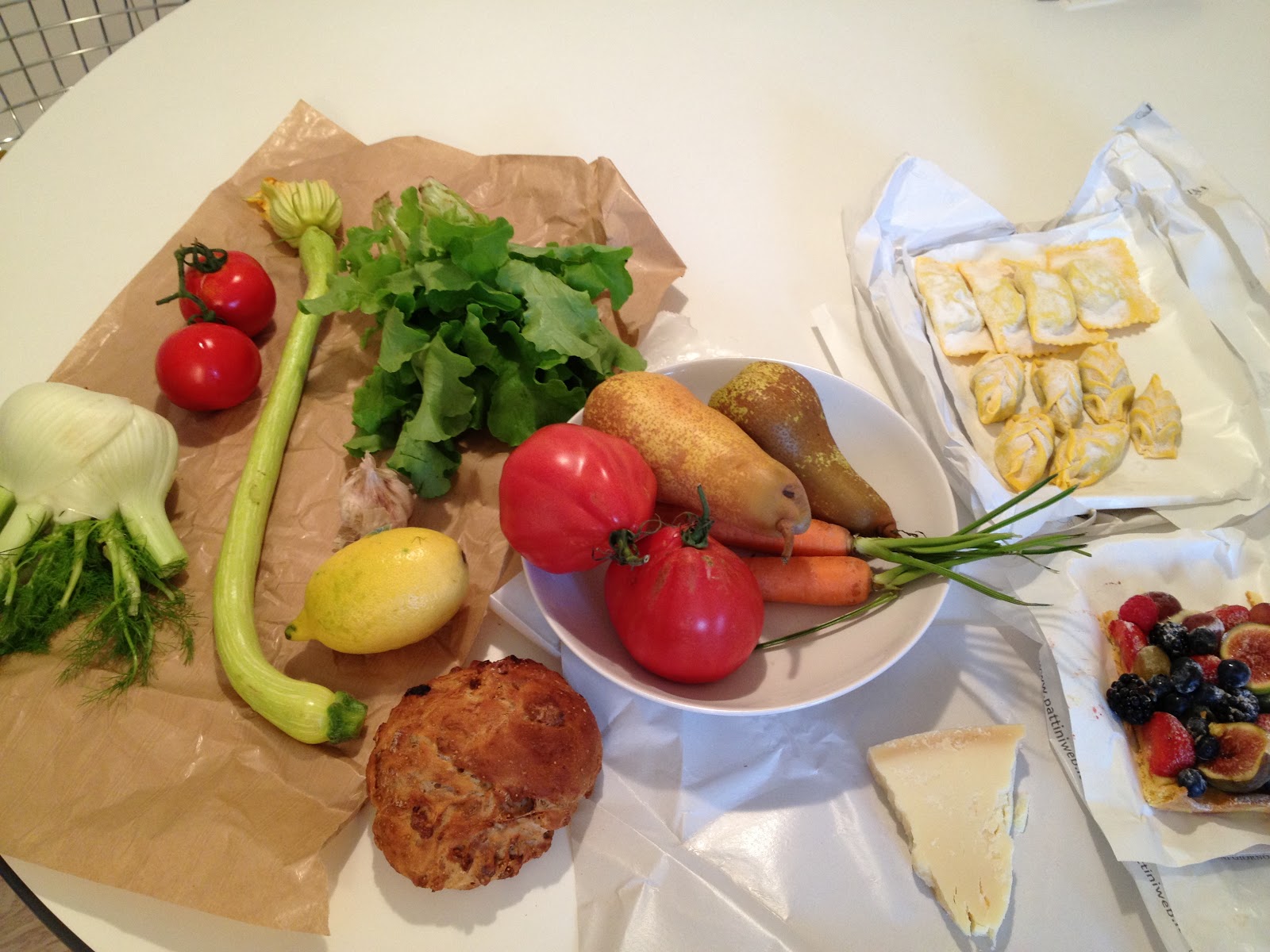
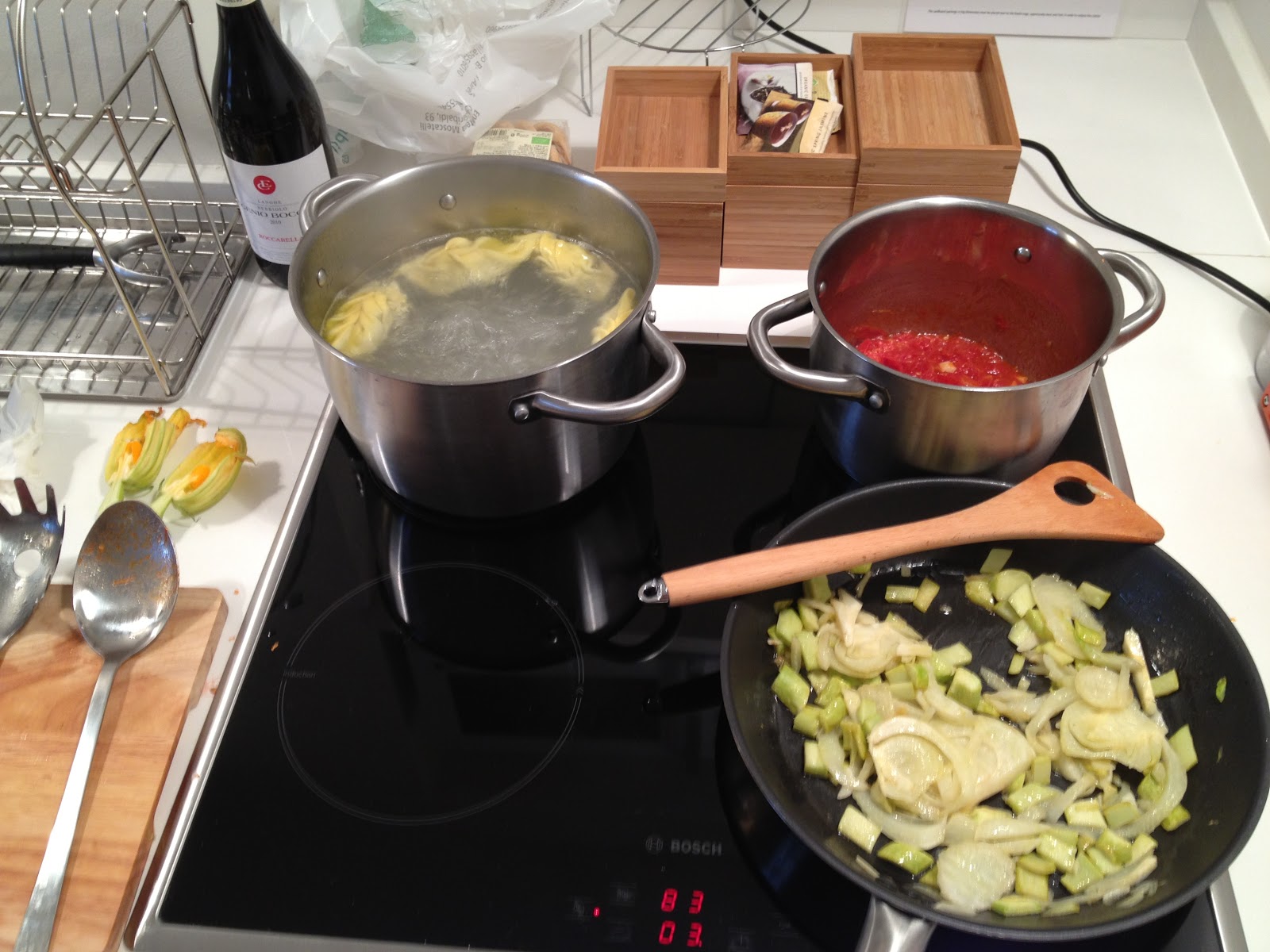
I will add a final note on Milano. We had a kitchen. And where ever we have had a kitchen, Wesley shops and cooks. And when he does, it is the best restaurant in town. He has a knack for blending in quickly with the local ingredients and flavors. At the markets he shops like a native. He wants that zuccha. And those Mallorca prawns. No, not that red pepper, that one. And those chantarelles and that chorizo.

Whether it is Spain, Italy, France or Germany he masters their home-cooking in a flash. In Milano, we ate at home a few times and it was, the best ristorante in town

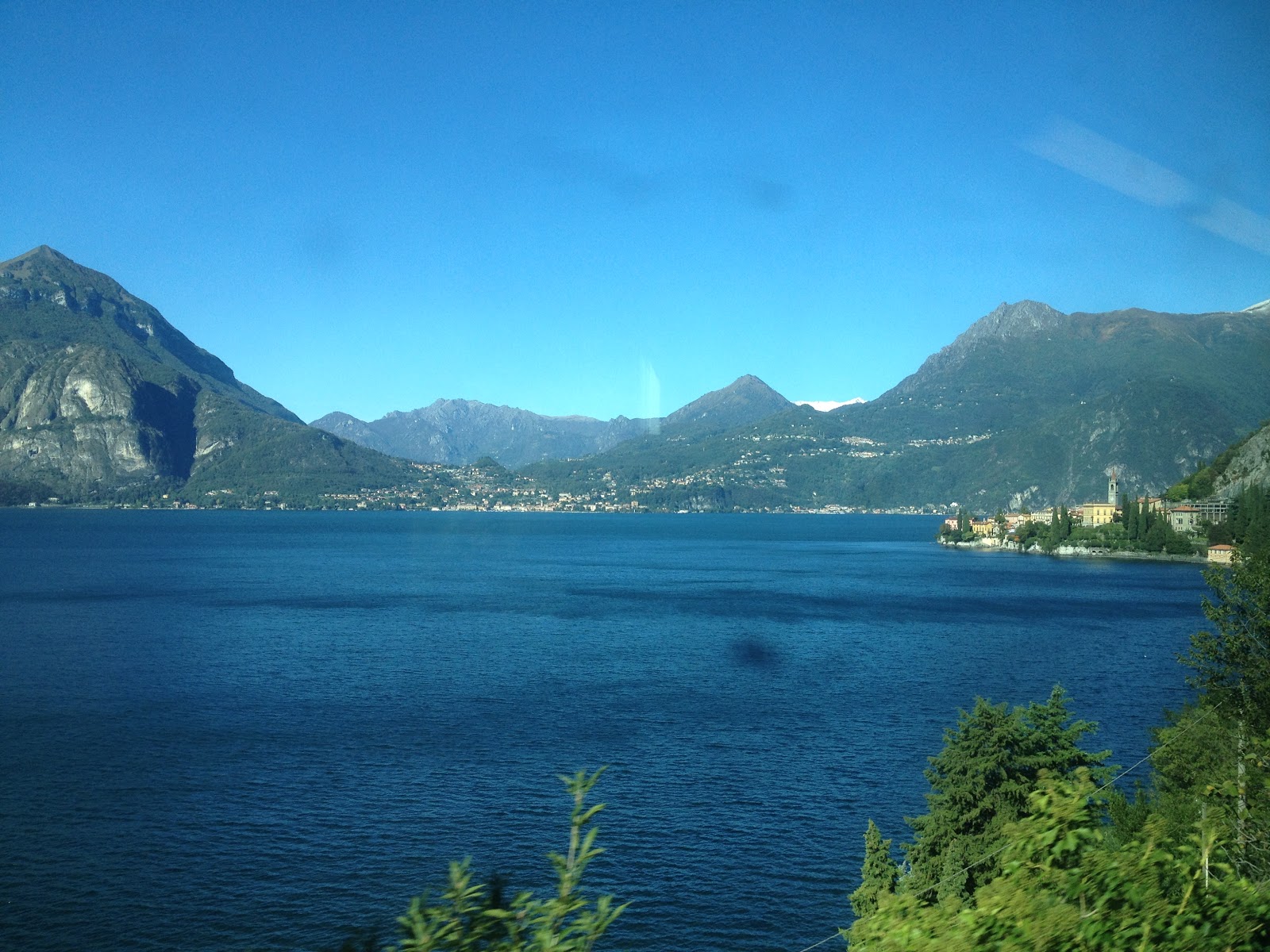
From Milano we boarded a train. It traveled north and paralleled Lake Como for about an hour. Oh, I neglected to mention, while Roland was with us, and since we were so close to the lakes, we thought Roland should experience Lake Como and took him on a day trip to have lunch on a hillside terrace in Bellaggio. The weather forecast threatened fog and rain, and both ocurred, but for a few hours and during our lunch it cleared into a glorious day and we ate ourselves silly, Roland especially so (his three plate prix fixe was like three lunches) and took in the vista of Lake Como and the granite-topped forested mountains illuminated by rays of sunlight.

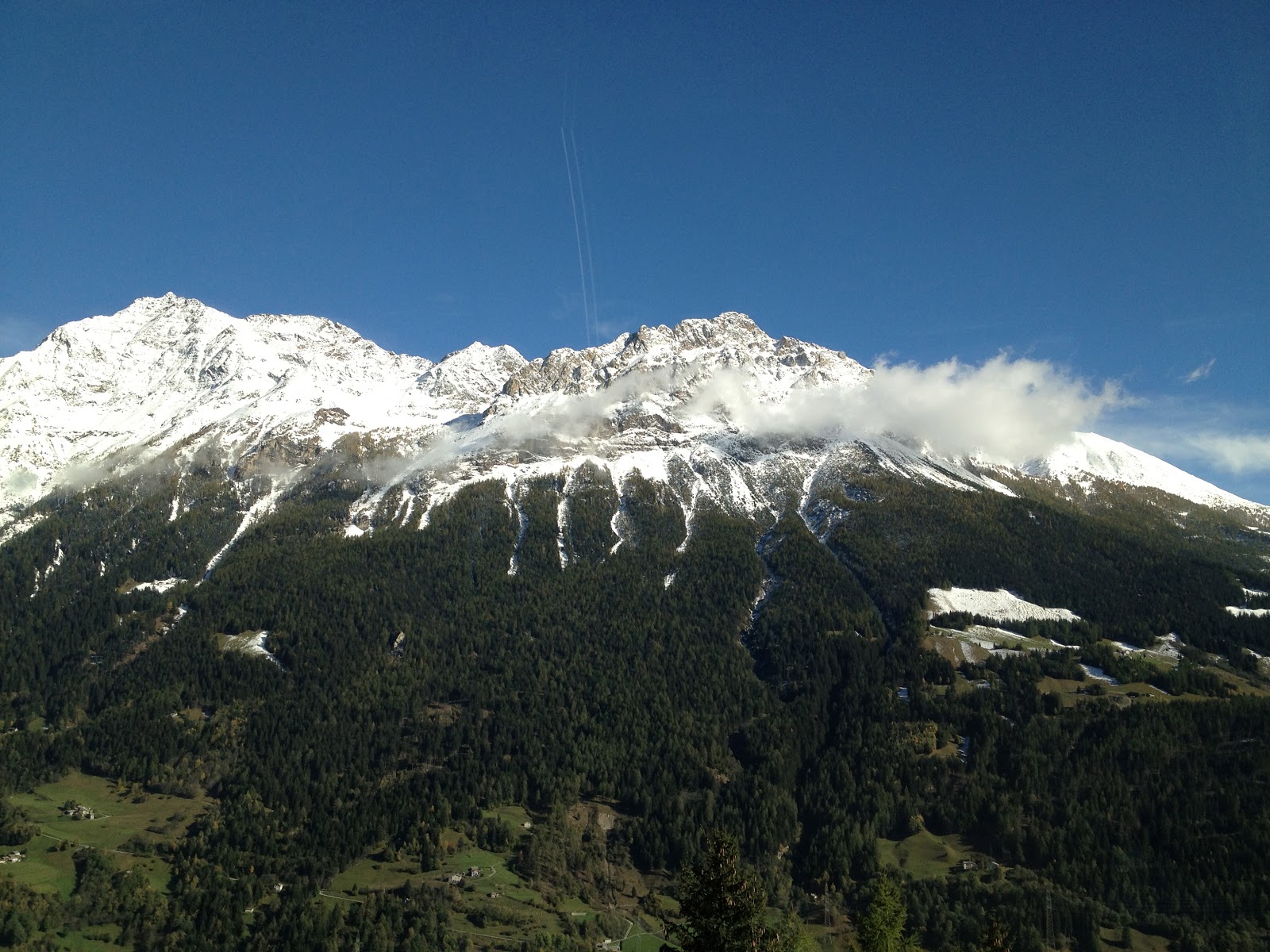
So, as I was saying, we are on our train. Going north. Watching Lake Como through the west windows. At the north end of the lake the train turned to the east. The terrain changed. Now, we are in a long grassy valley. Red terra cotta roofs give way to gray slate whose mica flakes glitter in the sunlight. The color palette of the structures is white, beige and gray. They flow up the hillside and are low profile, except for the village church–seems to be only one per village–which has a wildly tall steeple, without windows or a bell atop. Austere and icy like the snow topped granite above. And there are vineyards. Not vast expanses like in Barolo, but long narrow ribbons, like hiking trails, sidling up and down the mountains. That area, do not hold me to this, is known as the Veltlin.

In we have arrived in Tirano. Lunch time. It is still Italy, but this town speaks German. It is a border of sorts where the Italian train line ends and the Swiss line begins.

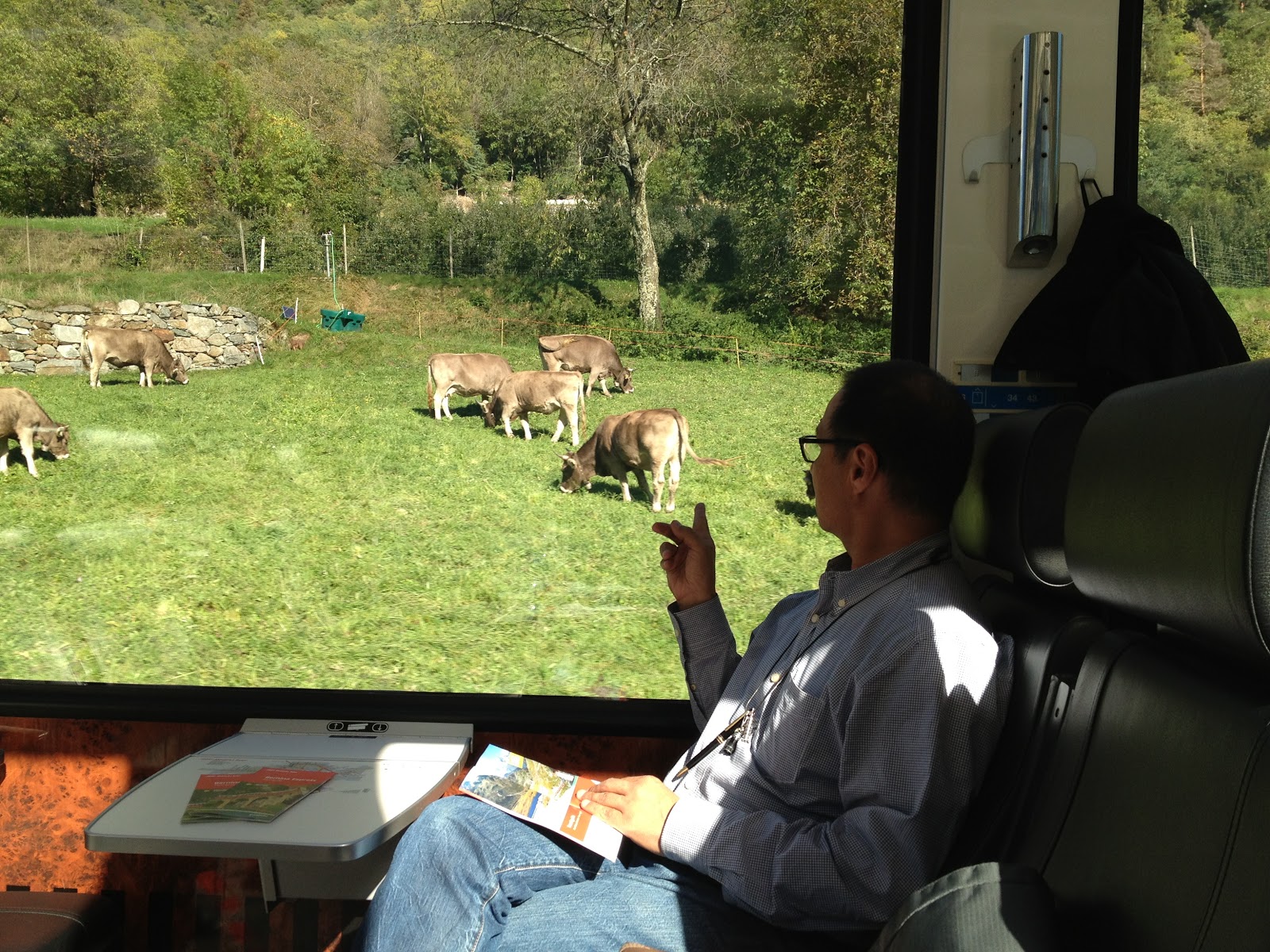
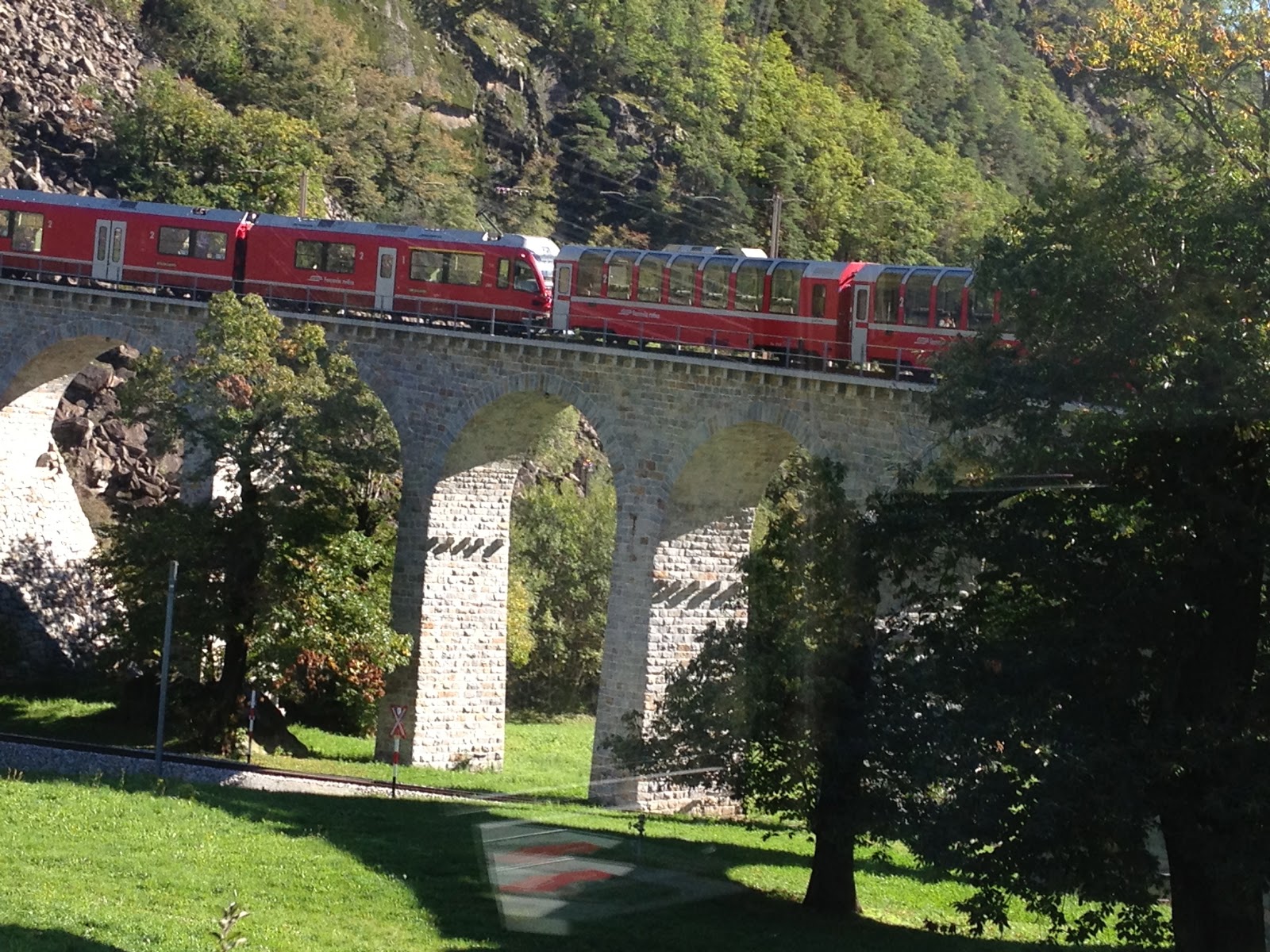
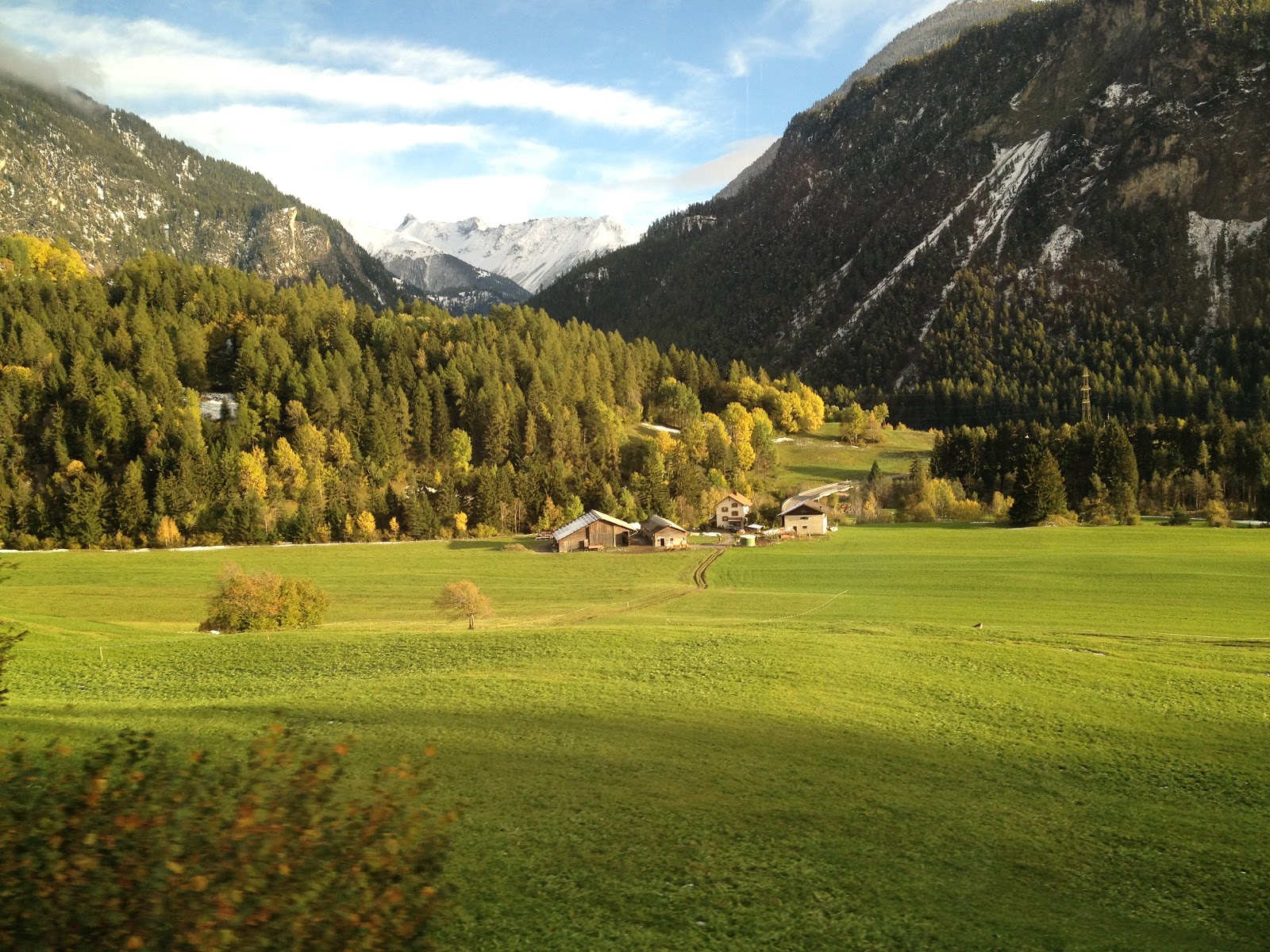
After a quick lunch, we board a Swiss train for a special journey up and up and up, over tall stone-arch bridges, around one-hundred-and-eighty degree turns, past villages so beautiful and green and hilly with cows wearing bells nursing their young and sheep in the meadow and sunshine and blue skies, thatched roofs and the tall church steeple, it is the kind of place that comes to mind when you are little and in bed and a kind and gentle voice reads you to sleep with, “once upon a time…..”

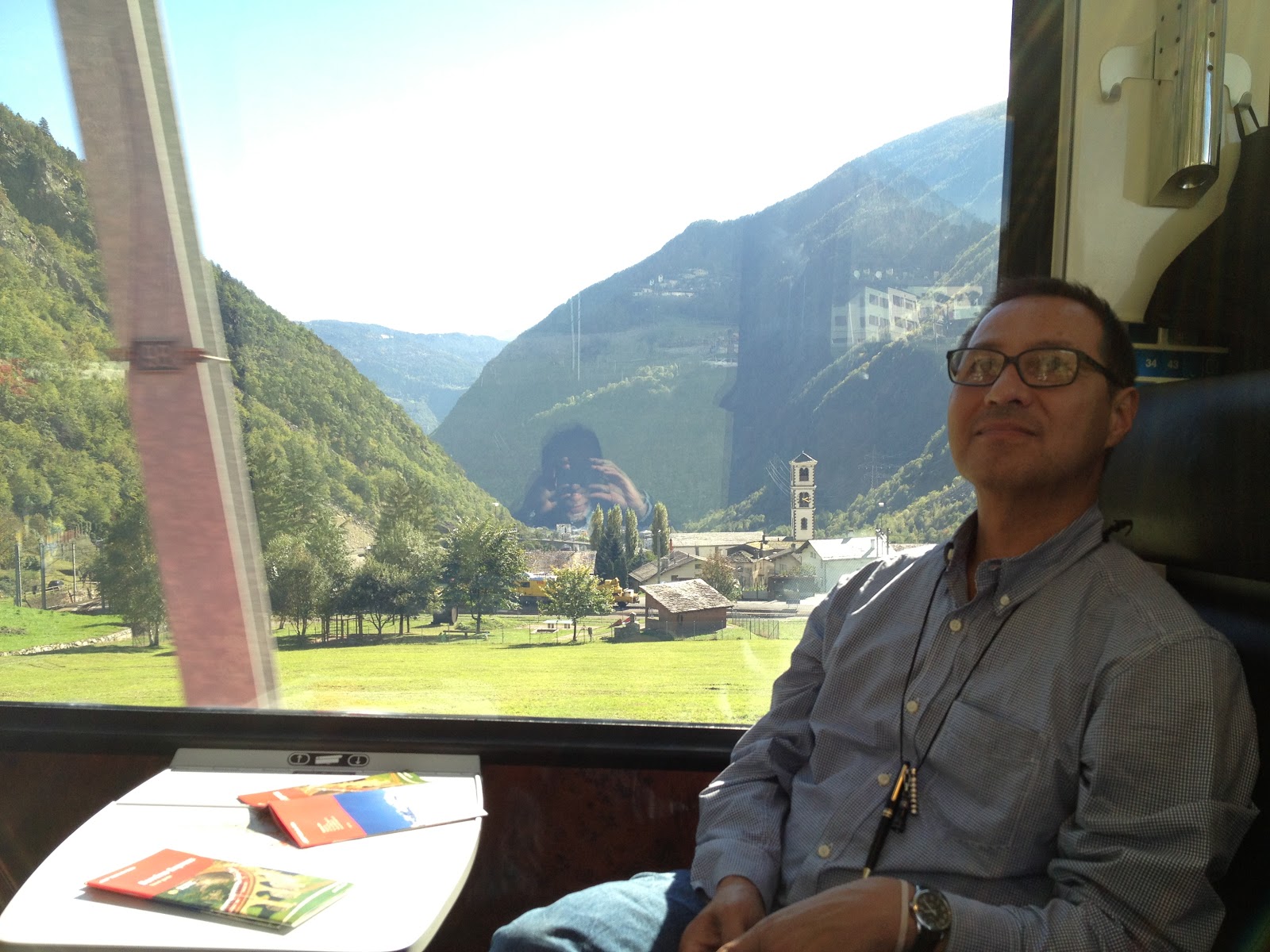
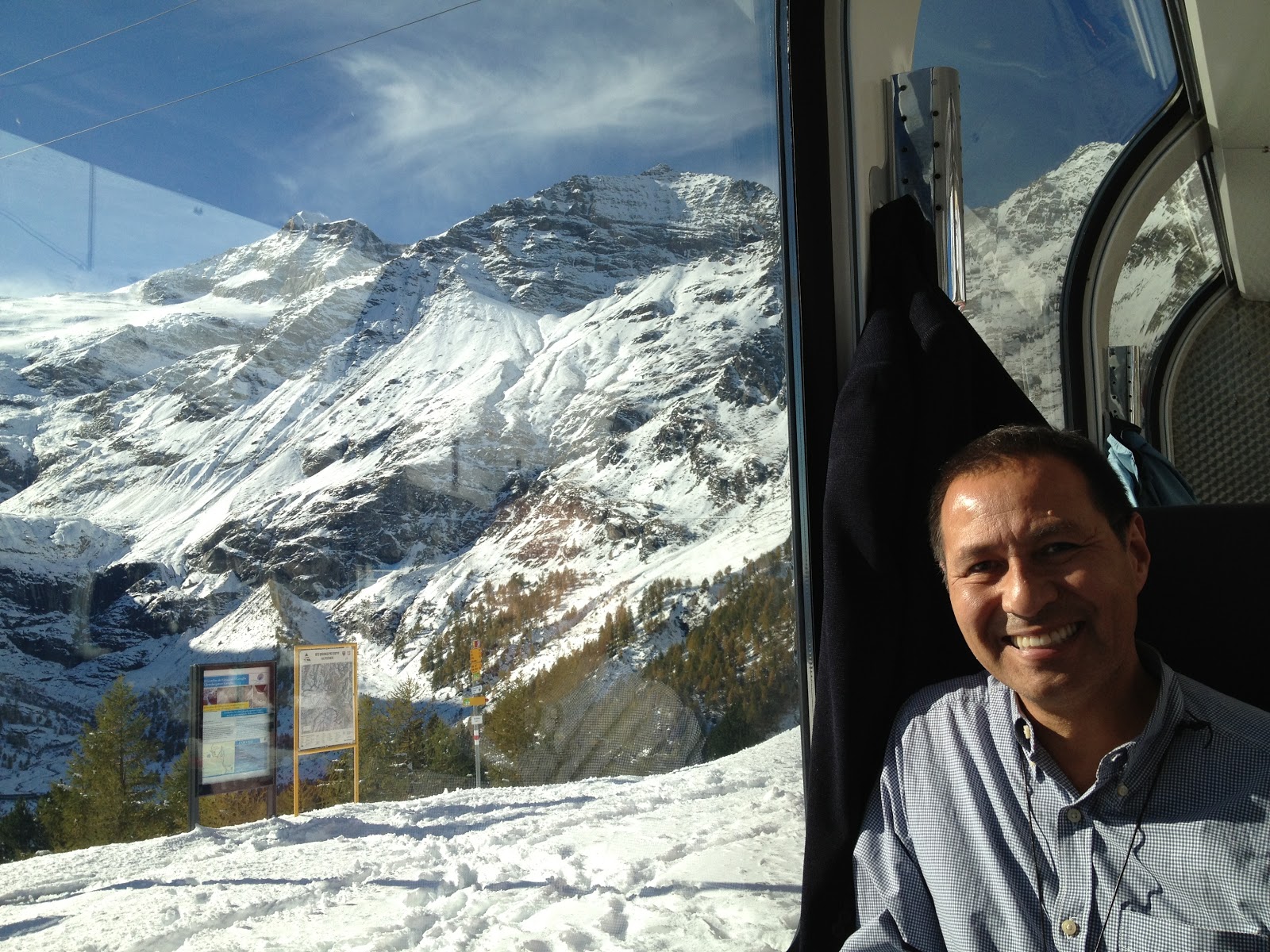
The Bernina Express is a special first-class train with spotless panorama windows. There is so much window, it seems the car sides and half the roof are entirely glass.

Here is an “at the moment” account of the train ascent from 1 one-thousand feet of elevation to seven-thousand feet.

We are on special equipment for challenging high altitude terrain. It is the Rhätische Bahn, the Bernina Express. The route is a UNESCO World Heritage site since 2008. We are approaching Poschiavo. A winding river flows with bottle-green green.

Glacial. Hikers walk on the banks. The grade is, so far, gentle. Now, there are cows in the meadow, mamas and babies. At the Poschiavo Station we are at three-thousand feet of elevation. Continuing on there is an expanse of meadow that rises to forest which rises to granite and snow caps.

Horses in the meadow nursing little ones. High up the steep face of the mountain are occasional houses. They look impossible to access and entirely isolated. Must have tremendous vistas. Our train twists and turns. We are in the back watching the front of the train make turns so extreme like the cat twisting back for it’s own tail. The train is sleek and agile. Around each bend is a new valley with a village. On the left. Then on the right. Back and forth.

 We have reached our apex, two-thousand-two-hundred and fifty-six meters (over seven-thousand feet). The peak above us, Bernina, is 4,049 meters (abt thirteen-thousand feet). It is a Continental Divide. From here the rivers part going to the east and to the west to different seas. The snow is dense. Anywhere else this would be an intense winter scene. Here it is just a normal autumn. Now, on our left are glaciers and lakes and streams and dams and the sun is brilliant. As remote and cold as it is, a Saab convertible, top down just whizzed past us. Otherwise, not many people up here. Three hours into our ride we have stopped in Pontresina for an eighteen minute break. Outside of the train it is winter. Hats, gloves, parkas, snowshoes. Really cold, but sunny and clear sparkling light. Two weeks ago, we were in summer swimsuits dunking into the Mediterranean. Then eating grapes off the vine in autumnal Barolo.

The joys of travel. See the world. Hear the languages. Feel the climates. Eat the food. Drink the wine. Absorb the history. Interact with the citizens of the world. A tremendous education it is. Back on the train, we are entering a tunnel, one hundred and eight years old, six kilometers long–three and a half miles. And now, the prize for greatest vista of the trip goes to Filisur. Flanked by mountains with pines on the steep slopes. All dusted with fresh snow. Green valleys. Plateaus. Narrow, curving lanes. Steeples. Small glacial lakes with emerald water. Speaking of emerald water, the prize for best river goes to the Albula River.

A moment ago as we entered Thusis, the train crossed a stone bridge, quite tall; the river, far below, was a curvy snake of jade-color water. Our destination tonight is Chur (pronounced: kur). We will be there within an hour. We have come to Switzerland, in part, so we can visit with Raul in Basle tomorrow night before his Casino concert. Wes has made this trip before–same train, same hotel–and has been keen on sharing it with me. I am elated. It is all so beautiful. Tonight we will stay where he stayed last time. Aside from the tremendous setting, the hotel has, at breakfast, a meusli station where you spoon your choice of grain into a machine which converts it into flakes which you then dress with yogurt and fruit. I love muesli.

Magnificent is the only word for this day.

Marlow and Wesley
16 October 2012
Bernina Express, Switzerland
Sent via BlackBerry from T-Mobile

11 October 2012, Milano

11 October 2012

Milano

Our wine country adventure has come to an end. Back to the big city, Milano.

Last October, when we were here for six wonderful hours, we visited the fashionable Brera neighborhood and had dinner at La Latteria. We enjoyed it so much that we are back for a longer stay of four days.

Wes found an apartment in Brera (San Fermo, 1). One-bedroom, hardwood floors, all-white, washing machine–quite welcome after four weeks–and an equipped kitchen. We unpacked and settled in very nicely. Roland goes home in two days. He is staying in a hotel two streets away. He came over with his bottle of Barolo Chinato for an aperitivo. We laid out the table with fresh hazelnuts from the Alba truffle festival and two cheeses from “my friend” Bruno in the Torino market. Meanwhile, clothes are  washing and we are heading for dinner.

The next day, 12 October, in the evening.
Tonight, I charmed the corn right off of the husk. I learned the phrases that I wanted to deliver to Arturo and Maria Maggi in their ristorante and I delivered them like an Italian boy wooing his sweetheart. We entered fifteen minutes before opening time. I said “molto buona sera Signora Maggi, ha un tavolo per tre?”–very good evening Mrs. Maggi, do you have a table for three? They gave us “our” table. The one we occupied last night. Arturo pushed aside the kitchen curtain and came out, I thrust my arms out to him and said, “cosi ci consiglia, Maestro Maggi?”–what do you  recommend Maestro Maggi? He smiled. He was somehow pleased at the silly American, me, that was effusively spouting Italian phrases. A moment later three bowls of soup arrived on our table. Puree of fennel bulb topped with melting sheets of emmenthal cheese and fine bread crumbs. It was perfect. And it was a gift from Arturo. A little respect and a little effort at Italian communication was appreciated. We ordered a glistening, purple eggplant, baked whole, injected with anchovies and cheese, drizzled lightly with olive oil and thick sweet balsamico. We ordered orrechiette (little ears) pasta with broccoli. We ordered polpettini–flattened meat balls of veal sauteed in butter with the pan’s brown bits deglazed with lemon juice and poured over the patties. We ordered thick short hand hewn noodles mixed with eggplant and mozzarella. It was perfetto. The freshest vegetables–home grown by Arturo–and meats prepared in the simplest manner with the most delicious results. The ristorante had many children tonight. I do not know if they are Arturo’s relatives. Everyone seemed to know everyone. A blonde boy of about ten was eating with his father who arrived on two crutches. They were both handsome. The boy in less than a minute gulped down two thick slabs of fresh buffala mozzarella. Then a full dinner plate of prosciutto. His dad gave him a glass to drink from, rosy liquid–half water, half wine–the boy sipped, scrunched his face, tossed his head side to side, no, no, no, no, no and pushed the sloshing glass across the table back to his father. The son grabbed pasta bits from his sister’s plate and ate them with his fingers and poked his bread rolls with his knife trying to slice them open. His father exhorted, wagged his finger, implored the boy to act civilized. It was sweet entertainment for us.

On our subsequent days in Milano we had morning caffe lattes and evening aperitivos at our corner florist. It’s an odd combination: flowers, caffe and bar, but it works. We went to the Pinacoteca Art Academy Museum. And the Opera Museum at Teatro della Scala where we peaked into the hall from a balcony box. The museum had a lock of Mozart’s hair and a fabulous collection of dozens of elaborate music boxes, huge contraptions with moving figures and elaborate features. We walked through the Vittorio Emanuelle Arcade. Long, cross-shaped, hundred-feet tall with mosaic floors and covered with a glass lid on it’s sides and a glass dome at it’s center. You enter it from La Scala. Your exit is at the Cathedral. We climbed the two-hundred and seventy-some steps to the Cathedral rooftop. We were literally, on the roof of the center of the building. Up top and not visible from street level are hundreds of friezes. They are hand-carved in stone. Intricately detailed. Hundreds must have worked on their design, creation and installation. Yet, for centuries, they are visible to no one except us lookee-loos in the Twenty-First-Century who opt to walk on the roof for the novelty of it. I loved those freizes and gave alot of thought to their creators. Like “cookies, salami and cheese” the sculptors toiled selflessly at something they devoted their lives to and took great pride in. 

Marlow (on behalf of Wesley and Roland)
11 October 2012
Milano
Sent via BlackBerry from T-Mobile

10 October 2012:Verduno, Barolo, Canale and Torino. Also Cookies, Wine and Cheese


10 October 2012
Italy: Cookies, salami and cheese.

I am running low on prose. I am getting repetitive. There is so much stimulation here. My senses are overloaded. My eyes, my ears, my nose, my mouth are all busy. My little brain is processing as fast as it can all the data. Noting as many details as it can. It is all fascinating to me. But if you tire of reading, I am okay with that. This writing mostly serves as an answer to people who ask “how was your trip? It is a question that I cannot answer in a word or two.  But it is not intended as required reading.

That said, to describe the natural beauty, all of the details of grapevines with the purple clusters hanging. The chestnuts, thousands of them fallen to the ground and the leaves of the chestnut trees whose edges turn yellow and brown to say, we are done for this season. The fragrant night blooms. The chalky brown dust of the soil that sticks to your shoes and rides up your pants legs when you tromp down the steep descent of a vineyard. The Milan cathedral rooftop, home of thousands of intricately carved bas reliefs that no one ever sees because they are in no way visible from down below.  If someone were to ask “how was your trip? and I simply said good. I guess I should learn to give a short answer, but as I said in an earlier entry, why use one word when you can use one thousand.

Meanwhile in Verduno, we have  arrived to eat dinner at Trattoria Dai Bercau. In this trattoria you sit down and food is brought to the table for you to accept or decline.

The first plate to arrive, and I accept it, is a plate of chopped and rare veal dressed with olive oil and salt and topped with thin strands of marinated red onion.

Next up is filetto maiale (I have some incorrect spellings, please look past that flaw).  It looks like three thin slices, two-inches in diameter, of moist pink pork loin with tonnato (smooth tuna puree) sauce between the slices and an olive on the top.

Followed by a slice of prosciutto wrapped around a grissino (a house made breadstick).

Our wine is in a pitcher. It is a house wine called Pelaverga. Five euros for the pitcher.

We had arrived at the trattoria too early tonight, before they had opened. While we waited we walked around the block. Not really blocks in this area. More like an ancient, winding, cobblestone lanes.  On a down-slope, below a cobblestone street and in a basement, an upscale basement, we stopped in for a glass of wine. The place is called, Ca Del Re. It is a winery with a small ristorante and a few rooms. The place looks old, but I think it is new and modern constructed to look old with coved exposed brick ceilings. Twelve tables. We were tempted to jilt our Becau reservation. The weather has turned cold autumn and we were comfortable in their warm room. The wine we drank was young. An almost transparent rose color when held up to light. It was “Basadone da uve Pelaverga piccolo” made by Castello di Verduno, 2011. We paid our bill of eight euros for three glasses and walked around the block for our dinner reservation.

So, back to the Trattoria Dei Becau. The starters were delicious. And they were followed by frittata de funghi e rizzo. A delicious mushroom risotto cooked into an egg  omelette. Wonderful. It was followed by “Toma con tartuffo nero”.  Toma is a cheese whose makers must earn the privilege to use the name. In this particular preparation it is half of a disc. Four inches in diameter and a half-inch tall.  They drizzled it with olive oil and minced black truffle then ran it briefly under the broiler for a toasty and creamy aspect. It was a special treat.

An adjacent table requested a sample of small hot red peppers. Smaller than a pinky.  They were grown by the owner.  I am a copy cat. I requested a sample, too. They have arrived. On a plate. They look pretty and serious.  Are we brave enough?  I will tell you in a moment.

A few minutes later. It was a hot chili. Very hot. I put the remnants in my pocket. I do not want our host to see I could not eat them.

Next dishes offered. Risotto and ravioli. We each opted for a fifty-fifty split of half ravioli and half risotto. The risotto made with local red wine. We have passed on the offer of white truffles. The local wisdom is that it is too early. They need another month of cool foggy autumn weather, until mid to late November, to develop the full, famous, pungent aroma.  
When the risotto came we could request just a spoonful–an amount to suit our appetites–instead of an entire plateful.

Another course is to come. I have passed on it.  It is roasted rabbit. And pork ribs braised in the wine we are drinking. Both are served with roasted potatoes. I just got a taste, a forkful, and they are both sumptuous, especially the pork ribs. They have a smoky aspect that I love.

Is there room for dessert? No. But that will not stop us.

Pears poached in barolo wine. And semi-freddo with mint. Moments later, we have not licked our plates, but we should have. Especially the pears.

At the top of this entry I mentioned the words cookies, salami and cheese. I love the ristorantes and the trattorias here. But I especially love the individual food sellers. Some of them make the products they sell. They have indescribable, immeasurable pride in their work and their products.

In Barolo–the town not the wine–today, I passed a shop. Clearly, according to it’s layout and glass display cases it should have been a butcher shop. But the entry door was ringed with large scraps of paper, written on with a large, crooked childlike scrawl. They seemed to describe cookies. I could see a man in the back room was working dough, cookie dough with his hands. I entered the shop. The cookies looked handmade and there were a dozen trays, a dozen different cookies. Some made with Barolo. Some made with honey and truffles. Some made with hazelnuts. I asked, are your cookies delicious. His eyes widened. He reached into various trays. He gave me samples of this one, then that one.  I ordered a half-kilo and paid. In the end he gave me a kilo. I loved his pride and integrity, his hard work, his lifetime of experience. He did not speak english. I did not speak Italian. We talked through cookies and my ooh-ing and aah-ing.  That was “cookies”.

In Canale, yesterday, before dinner, we walked down a long arcade of arches. I passed a butcher shop. On display, were salami crudo, large and small. A few days earlier, I experienced my first salami crudo–in the Truffle Festival tent–and loved it with the passion one has at the first-taste of something familiar, yet unusual, and finding it appealing and delicious. So there I was, at night, on a sidewalk, under an arch standing before a butcher shop with only a window between me and a plate of salami crudo. Did I go in? Of course I did. Inside stood the butcher and his wife. I said “buona sera”. I pointed to my sausage. I asked “delizioso”?  For his answer he stood more erect, drew his shoulder blades together, pointed both fingers at himself and said “I made these salami. With these two hands.  Delizioso? Certo! Delizioso!”  I loved his pride and integrity, his hard work, his lifetime of experience. He did not speak english. I did not speak Italian. We talked through salami and my ooh-ing and aah-ing. That is “salami.”
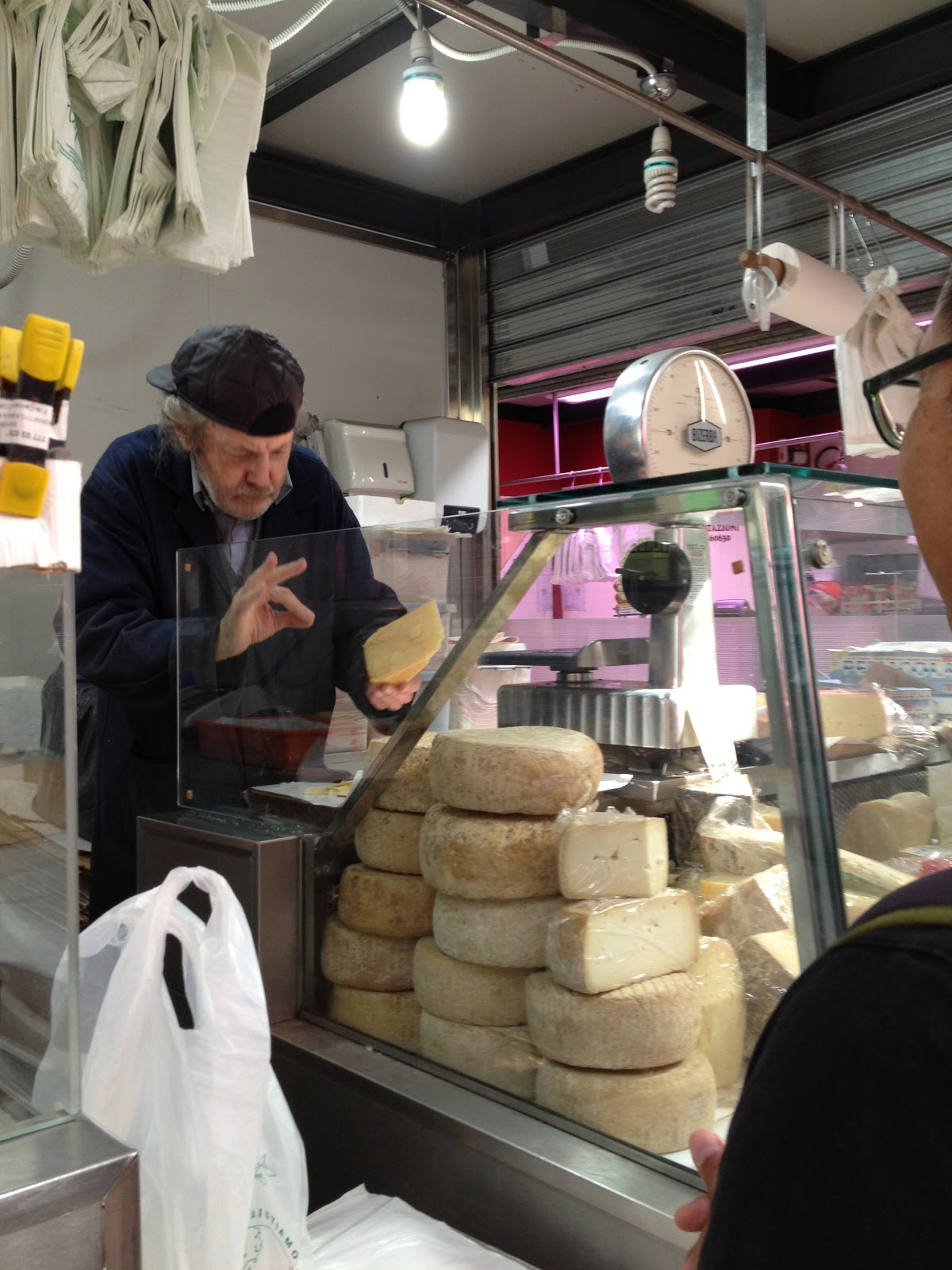
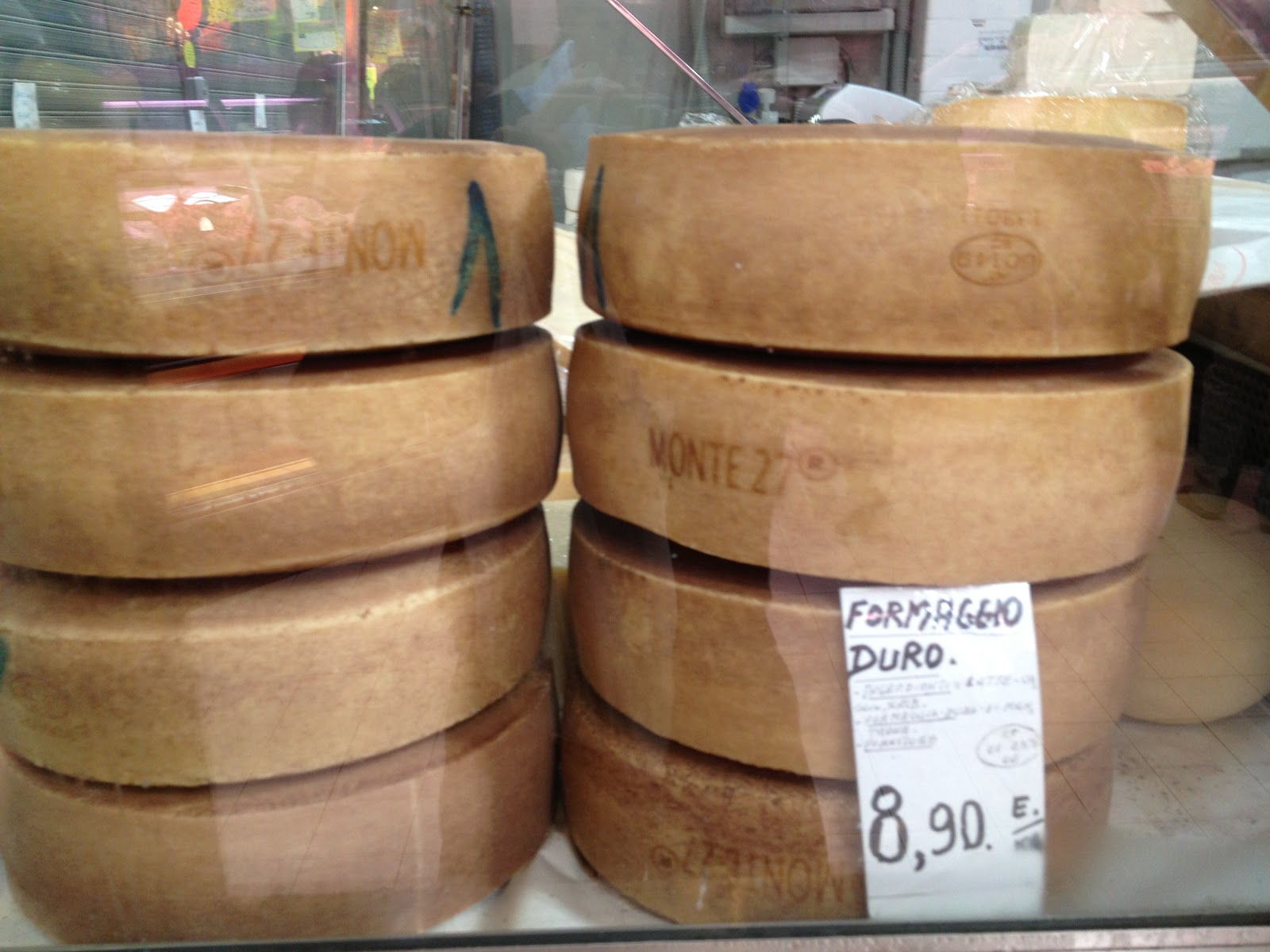
Finally, in Torino, last week, we went to the food market. It is enormous. It is outdoor and indoor. The outdoor market sell fruits and vegetables. Fragrant, perfect, colorful specimens of peak-of-deliciousness edibles. The indoor market sells. Meats and cheeses. We went inside. We passed a cheese vendor. He was different from all the others. His stall was more elevated. He was older. He could have stepped out of a da Vinci drawing. Wise. Old. White hair. Sparkling blue eyes. Pale skin. Dispenser of wisdom through cheese. His stall had a line. It was slow moving.  Before I stood in it, I walked around the three sides of his stall. He took note of me. He gestured toward a specific wheel of parmesan cheese.  He smiled at me. I smiled at him. I felt I had known him a long time. At that moment his entire life flashed before my eyes. He began helping his father, as a teenager, intending to work with cheese until his true destiny called. Years passed. He married. Had children. His cheese business afforded him the means to provide for his family. He came to appreciate it, even to love it, to find it noble. His sons grew up in a modern world and had no interest in helping with the family business. He continues his business now, not for his family, but because he values the honest important work of keeping alive the foods of his parents and their parents.
So I joined the line.  And when my turn came he, again, smiled at me. I was nervous.  He put me at ease. Not with language, but with cheese. Without words, he determined my taste. He gave me one very strong. And another very mild. And some in between. Then he said, “prefiero piu forte or dolce?” Do you prefer more strong or sweet? We tried more cheeses until he selected three pieces for me. It included the parmesan we first met eyes over. As I turned to walk away, he looked me in the eyes and with intense seriousness he told me, do not put them in the refrigerator.  So I did not and over the course of several days they tasted better and better. He was kind and gentle. I loved his pride and integrity, his hard work, his lifetime of experience. He did not speak english. I did not speak Italian. We talked through cheese and my ooh-ing and aah-ing. And that was “cheese”.

Cookies, salami and cheese.

Marlow on behalf of Wesley and Roland
10 October 2012
Verduno, Barolo, Canale and Torino
Sent via BlackBerry from T-Mobile
Design a site like this with WordPress.com
Get started