9 October 2012
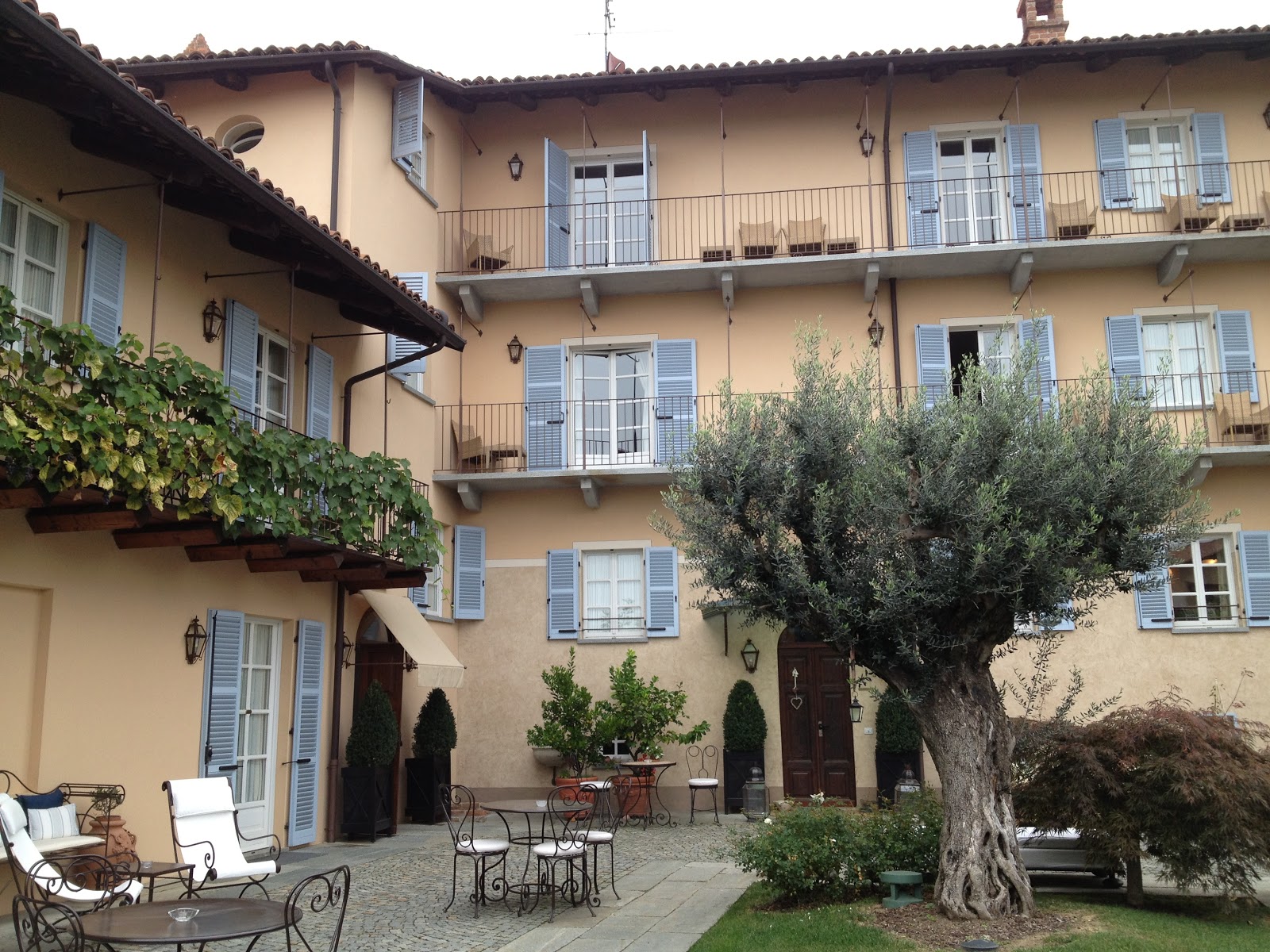
Pollenzo, Bra and Canale.We are staying in La Morra at the Conde Gondina. Our days begin at eight a. m. when we open the french doors, then open the shutters, and walk outside on to the stone balcony and feel the chilly, morning dew. The vista includes rolling hills–green with vegetation–and roofs clad in the typical tiles made from terra cotta–“baked earth”–and topped with pointy-capped, small, brick chimneys. In our few days here the weather has transitioned from warm to cool. The leaves are changing color from green to yellow to orange to red, preparing to fall. There is a recurring veil of mist, not quite fog, that makes the each vista seem hazy like a beautiful dream.
We pull ourselves from our balcony reverie and swap our pajamas for proper clothing to make our descent from the third floor. We shuffle across the hallway on tile floors of polished red-clay. Then we descend the heavy stone stairs and enter the breakfast room where the center table is arranged with pastries large and small and frittatas. Hand-crafted cheeses. Dried ham and beef–prosciutto and bresaola. Cereals, yogurt, fruit salad and five-minute eggs. To drink, we are offered whatever preparation of coffee or chocolate or tea we desire. The Conde Gondina is run by virtuosos. The place is alive with fine details and comforts.
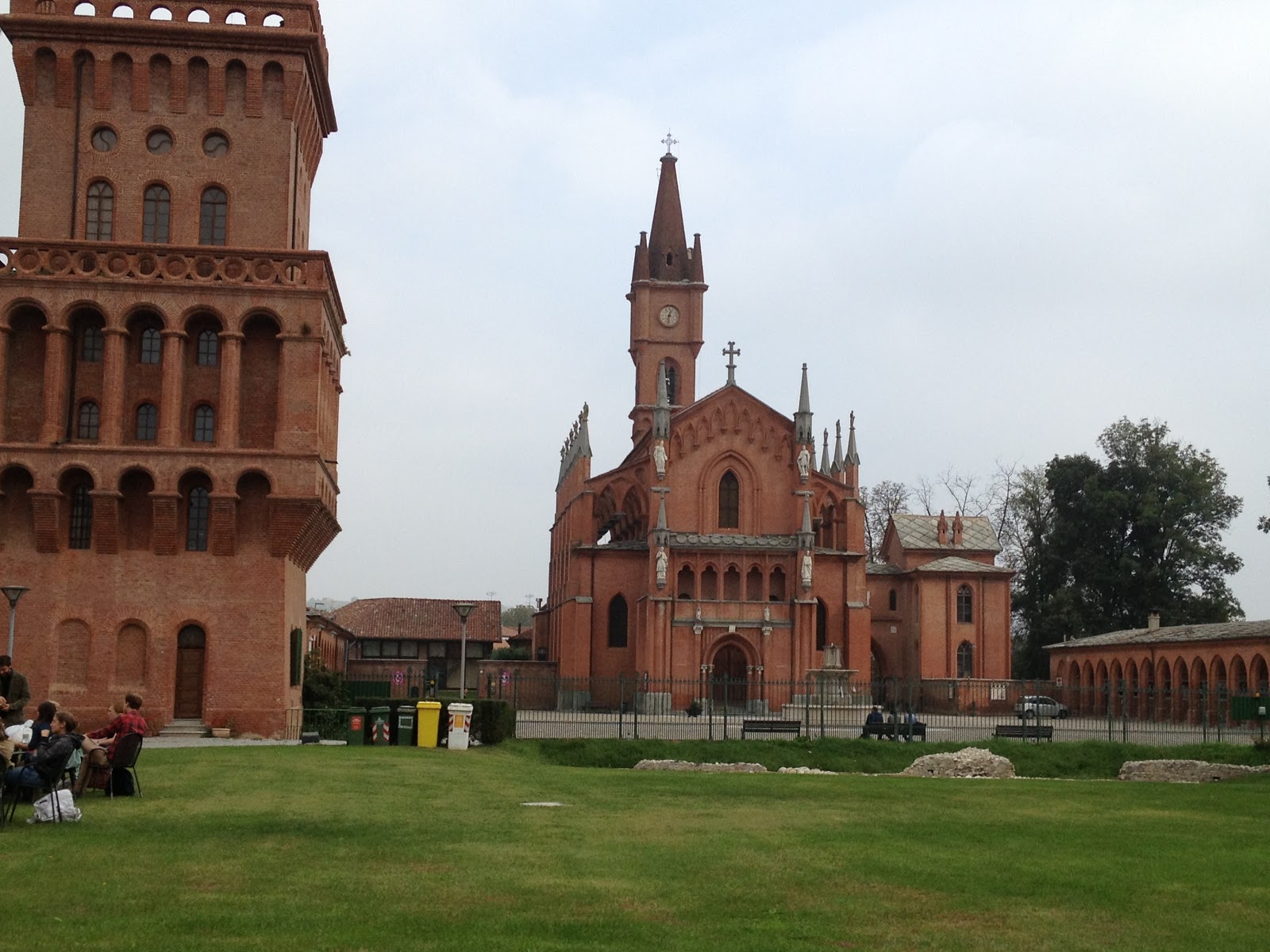
After breakfast we go exploring. On this day, we drove twenty minutes to the city of Pollenzo. Pollenzo may be tiny, but it is abuzz with important activity that is of international importance. It is the home of the Università degli Studi di Scienze Gastronomiche. That is: the Gastronomic Sciences University. It was founded by Carlo Petrini. Mister Petrini is also the founder of Slow Food which is dedicated to the integrity of what we eat and drink. When we go to the market and we are presented with a vast array of tomatoes, apples, artisanal cheeses, grass-fed beef, free-range chickens all without pesticides and anti-biotics, much of the credit for that bounty of outstanding edibles goes to Mister Petrini. Long live the Gastronomic Sciences University.
In conjunction with the school, there is a parallel project, La Banca del Vino. Here is a little back story. Settle into a comfortable chair. With a glass of red wine.
The king of grapes in our region of Italy, the Piemonte, is the Nebbiolo. Nebbiolo is the grape responsible for the wine called Barolo. Wine connoisseurs consider Barolo to be a tremendous and superior product. The local and state and federal authorities do to. To earn the right to call a wine barolo there are daunting hoops to jump through. Which is all to say, Barolo wine and the Nebbiolo grape a big deal. But there was a time, two centuries ago, when the Nebbiolo grape was in trouble and a particular estate, in Pollenzo, came to it’s rescue. The estate invited specialists. And they researched. And they nurtured. And they succeeded in reviving the important grape. Today, that particular estate is the site of the Gastronomy University and the home of La Banca del Vino–The Wine Bank–where each year, every wine of note produced in every part of Italy is deposited for research and archival use.I would love to be a student at the University because the campus is in a remarkable setting. The old estate that it once was included a castle, a church, fountains, roman ruins, underground cellars, all situated around a vast flat rectangle that is planted with grass on one side and laid with gravel on the other. But I gave up my fantasy of enrolling as a student so we could get on with day and drive to Bra.
Bra is larger than Pollenzo, but not much. We went there to eat lunch at Boccondivino. It is beloved by many for good reasons. We ate upstairs, ordered the menus of the day and washed them down with six different wines. The exciting wine of the area is, of course, the red Barolo, but there are whites also. One I particularly liked was from Roero. (That word is hard for me to say. Ro. Er. O.) It is made from a grape called Arneis. It does not age. And in front of me, a glass did not age for more than ten minutes. Accompanying all of the wines was gnocchi in a sauce of Raschera, an artisanal cheese. And there was roast rabbit breast. And a spiral pasta with cabbage and cheese. And torta de nocciola: crushed hazelnuts, eggs, butter, sugar, vanilla. What’s not to like? And Bonet, which is, more or less, at least in this version, and a chocolate egg custard with pulverized amaretto cookies blended in. From Bra, we lumbered back into the car to drive to Canale for aperitivo and then for dinner.
From meal to meal we went. Days and days of eating. I conclude that on a trip with massive eating, a hotel with breakfast included is not a good thing. How can I not gorge at the breakfast buffet when everything on the table is calling out to me, pleading with me to try it. Then to go to lunch. And then the cocktail hour with hors d’ouevres. And then the dinner meal with an anti-pasto, followed by pasta, followed by a main course, followed by dessert and with two or three wines. How much can I contain before I pop like a balloon. No. Breakfast should be small. One needs discipline. I do not have self-control.
But I digress–as I always do–we made our way to Canale and arrived near sundown. En route we passed a fire. Intentionally set. It was a busy grape farmer who finished his harvest, delivered his grapes for the squeeze, pruned his vines and finally was burning the trimmings at the hillside vineyard. Back in Canale, we found our way to a great street that is a long low-slung arcade. Arch after arch, running for several streets somewhat like a long tunnel and lined with small cafes and bars. I say bars, but they are special bars where one goes for a drink with snacks before dinner or, if the snacks are substantial enough, in lieu of dinner. Our particular “aperitivo” came with several small plates. Toast with a white cheese sprinkled with lavender. House made cheese straws. And to drink, we had my new friend, Roero Arneis, the young white wine from lunch and we had Aperol with soda. Aperol is an orange liqueur with eleven per cent alcohol, less than most wines. Our cocktail hour was ending and our dinner hour approaching. Were we hungry? Absolutely not. Were we still going to eat? Absolutely yes.
We went for dinner at the Ristorante Enoteca. It is an attractive space. Spare and old, yet modern. A floor of diagonally-laid bricks covered with an asian carpet, white plaster walls and arched doorways rimmed with unpainted wood. The tables were covered with white cloths and had a candle in a white paper bag slit with butterfly outlines and a scalloped top. Overall the lighting had a warm glow. It was flattering. The kind of light that makes you look younger. The menu had fascinating things on it. Crispy frog. Pigeon crusted with black truffle. The chef has a Michelin star. We did not order those dishes. As we were not much hungry, we opted to share several dishes and have a bite of lots of things rather than too much of one thing. But a funny thing happened. For every one thing we ordered, two free unordered small plates arrived. It must be their thing there, to flood the table with gifts of food. The free dishes alone were enough for dinner. (Is there ever a way to go there, order nothing at all and just receive the free food?) These were some of the unsolicited items. Into a cube of olive wood, smooth and dense, they drilled holes and inserted tiny cornets filled with creme fraiche and topped with thin shreds of scallion. Delicious. On a small rectangular olive wood plate were gougere (cream puff pastry) filled with gorgonzola cream and sprinkled with chopped pistachio. There was a dish of marcona almonds. And small sweet buttery hazelnut mini-biscuits, like a sandwich cookie with paté cream in between. There were small glistening spheres filled with of a tuna pureee garnished with one drop of red bell pepper reduction. Oh, there were breads, too. Outstanding ones. Chewy ones. Crusty ones. Olive. Coarse grain. And there were the–ever present in this area–grissini, the homemade bread sticks. So that was some of the free stuff.
We were glad we ordered lightly and this is what we had. Porcini cotti in fondo. In a word, it was delicious. It was porcini mushrooms, two ways. Raw, sliced and paper thin. And porcini braised in veal stock. Apart from the porcini and in a shiny, empty, six-inch,
aluminum pan with two-handles sat a lone marrow bone, free of marrow, with a sphere resting on it that was a crumb-coated, round croquette. It too was outstanding. That was our first ordered dish. Our second dish came in a large, white, round, off-centered, lidded bowl, slightly flying-saucerish. When the lid was removed, with a flourish, I gave the expected gasp. Inside was a Guinea fowl egg atop foie gras. When pierced the yoke burst and became a sauce over the foie gras. Delicious in a breakfasty way. Next up was Agnelotti sugo arrosto. All I recall is it was a finely wrought stuffed pasta lightly dressed and very good. Our finale was Gnocchi ripieni di herbe. The gnocchi were stuffed with spinach and on a plate strewn with two slivers of carrot, two discs of radishes, two zucchini rounds and four-fifths of a snow pea cut in two. I drank my new friend, Roero Arneis. There was also Barolo on the table. We made it through our final meal of the day. We asked for the checkWe sat at the table. Satisfied. Looking forward to bed. Then, instead of the check, a tray was brought and placed before us with six mini-pastries. Three pieces of each. Plus a dish of sugared hazelnuts. (Wes thought we may have received more food for free than we have paid for.) Did we eat the sweets? You bet. And we continued to wait for the check to arrive. Instead, another olive wood tray was brought with steaming, hot, glistening apple fritters. Loudly, not softly, they were crying, eat me, eat me, eat me. I resisted. Then I relented.
In forty-five minutes we will be back in La Morra. In bed. Resting for another day of adventure. And overeating. Good night.
Marlow on behalf of Wes and Roland
9 October 2012, Tuesday
10:20 p.m.
Canale, Italy
Sent via BlackBerry from T-Mobile
Torino, 5 October 2012
5 October 2012
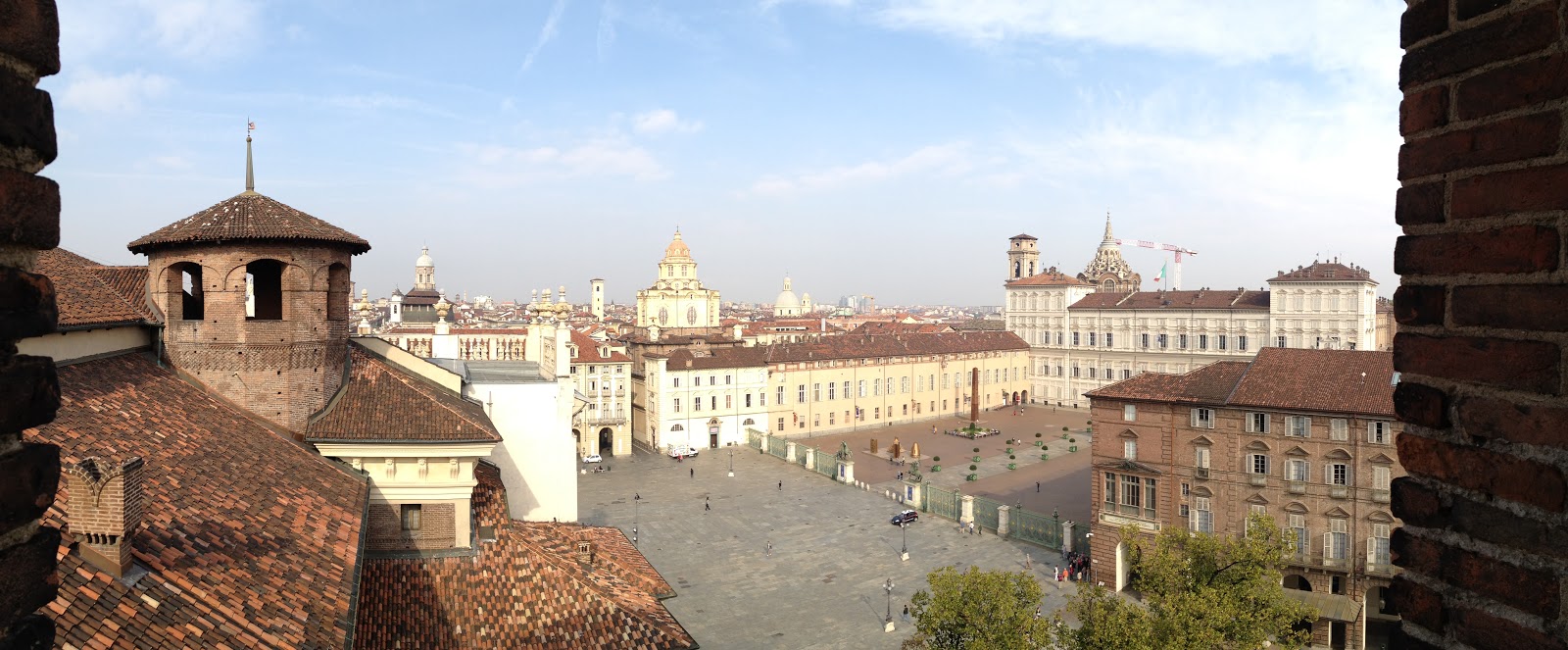
TorinoBefore we got to Alba and the Langhe, the paradise of grapevines, we were in Torino (Turin) for three nights and the Townhouse 70 was a great place to stay. It is around the corner from the Piazza Castello, the site of at least a dozen major historic structures. There is the Palazzo Madama. There is Baratti e Milano with it’s silky gelato and hazelnut chocolates and old-world, gold and crystal, Nineteenth-Century elegance. There is the Shroud of Turin, at the far end of the Piazza, if you are interested in such things, but it is kept in a fifteen-feet long, leaden, ceremonial box behind bullet-proof glass. There is the Teatro Reggio, the opera house, steps away from the Piazza and adjacent to the Royal Palace and the Royal Library which houses important Leonardo da Vinci drawings.
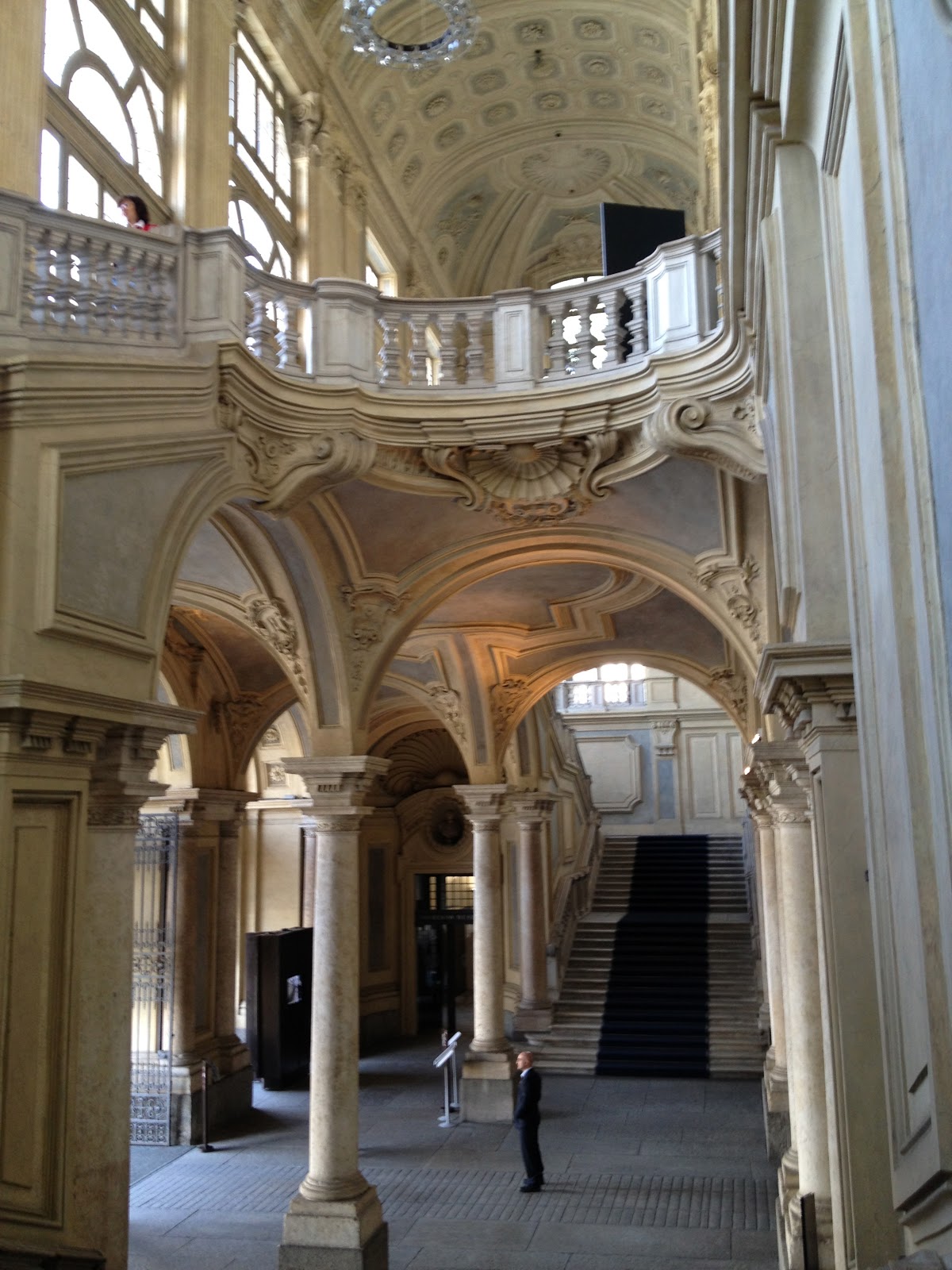
We did not visit the opera, their season has not yet begun. We did visit the Palazzo Madama. I noticed it from a distance when we first arrived into Torino. From the front it is a baroque palace of stone and marble. But it’s backside is medieval and poking out of it’s roof are four medieval, tall, round, brick, pointy-topped towers. The juxtaposition is so odd. It reminded me of Steve Martin with the Indian arrow through his head. My little brain thought, “Who shoved those pointy medieval towers through that baroque palazzo roof.” Sometimes an addition, restoration, or remodel looks good, smooth, inevitable. I am not saying it looks bad, but this remodel is a pretty startling. So far, we have medieval and baroque. How about some Roman ruins. The Palazzo Madama is built over the remains of an ancient Roman gate that is two-thousand years old. You can see excavated portions of it through glass floors. There it is Roman ruins remodeled into a medieval castle remodeled into a baroque palazzo. In the late-seventeen-hundreds it was the residence of Madama Reale, the royal widow. She put the Madama in the Palazzo Madama. In 1721, she desired and ordered up the construction of a grand foyer–a gigantic rectangle–to be added to the front of the existing structure. It is two-stories tall and they are tall stories, about seventy feet in all. The lower thirty feet are occupied by the two marble stair cases, on the right and on the left. They ascend to the second level atrium whose ceiling soars forty-feet high with continuous tall frames of windows that allow people outside on the Piazza pavement to look up and into the high grandeur, the frescoes, the chandeliers, the larger-than-life-ness of the Royals.
In our time, the building is open to the public. On the ground floor and out back is a recreation of the royal food garden. It is currently flourishing with edibles and wooden cut-outs of chickens and pigs. It is pretty as a picture and camera ready. On the Palazzo roof and through the arches of one of those pointy medieval towers, is an exceptional vista of significant Torino rooftops. The floor below the roof is occupied entirely with glass cases displaying royal ceramics and porcelain. Some of the pieces are as old as six hundred years. The pieces I love in particular are the ones painted with scenes of everyday life or illustrations of folk stories. They are like snapshots in ceramic. On the floor below the ceramics is a very grand ceremonial room suitable for the Senate meetings that occurred there in the nineteenth-Century. Now it is used as a gallery of ancient and avant-garde art. The smaller rooms on either side were once bedrooms. Their old decor is in a perfect state of repair. The walls, floors and ceilings and windows are decorated with wall paper, gold-leaf, mosaic, stained glass, wood inlay, life-size portraits in oil and chandeliers, all in a manner appropriate for the Madama Reale. That one building alone encapsulates two-thousand years of life in Torino. It is a must see.
We walked continuosly in Torino. Aside from the Piazza Castello there are hundreds of other Piazzas of varying interest. And there is the Po River. And the University. And there is food.
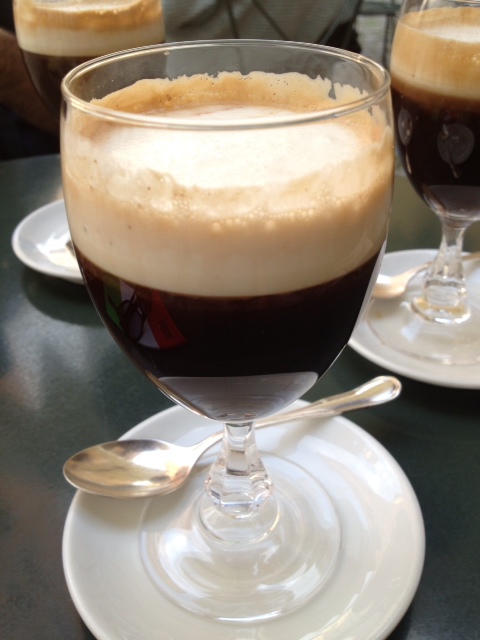
On our first night we took advantage of what is called, Aperitivo, which is the cocktail hour. With the purchase of your drink you are provided with free snacks. The snacks vary from place to place. We went to Pastis where the snacks, the stuzzichetti, were one-inch pizza squares, a variety of bruschettas, cubes of artisanal cheeses and salamis, olives, and on and on. At times, the snacks are so excessive that you do not need dinner. That did not get in our way. We went to dinner anyway. We walked continuously and we ate continuously. For instance, I rarely passed a gelato shop without getting a scoop, a piccolo scoop.
Italian food products and restaurants arrived to New York City last year in the form of a franchise from Torino called Eataly. The concept is to bring together, under one roof, individual vendors of high quality products from Italy. In New York City it is a fantasy land of the best of Italy. We visited the Torino branch and for me it was not magical. It was good, but high quality Italian groceries and ristorantes are common in Torino and the puppy-like enthusiasm and zeal present in New York City’s Eataly is just not present in Torino. Also, Eataly in Torino just opened a shop serving “the best of America”, hamburgers and hot dogs. I guess I prefer the food Italy imports to the America over what America imports to Italy. Just my opinion.One place name comes up alot when researching Torino, it is Bicerin. We visited the Piazza della Consolata where Bicerin is located. The piazza is small and cobble-stoned with a few apartment buildings, two caffés, a church and a campanile–a bell tower. Bicerin is tiny. It is a sweet shop with eight tables and has been since the seventeen-eighties. They serve a namesake coffee drink that goes like this: fill a small wine glass (a bicerin, pronounced bee-chair-een) two-thirds full with hot expresso, stir in some cocoa powder, a dash of sugar and top with unsweetened whipped heavy cream. That is the “Bicerin”. The Bicerin is good. From there we walked a few feet to the Consolata church. It is an over the top baroque extravaganza.
Our Turin hotel, in addition to having a good location and great bed linens was stylish, modern, spotless, and comfortable with a good breakfast eaten around a large table that seated about five stools on each side with international newspapers folded here and there.
That is about it for Torino. Loved it. We would go back. And you can not beat the fact that is a short ride to the greatest wine area.
Marlow and Wes
Torino, Italy
5 October 2012
Sent via BlackBerry from T-Mobile
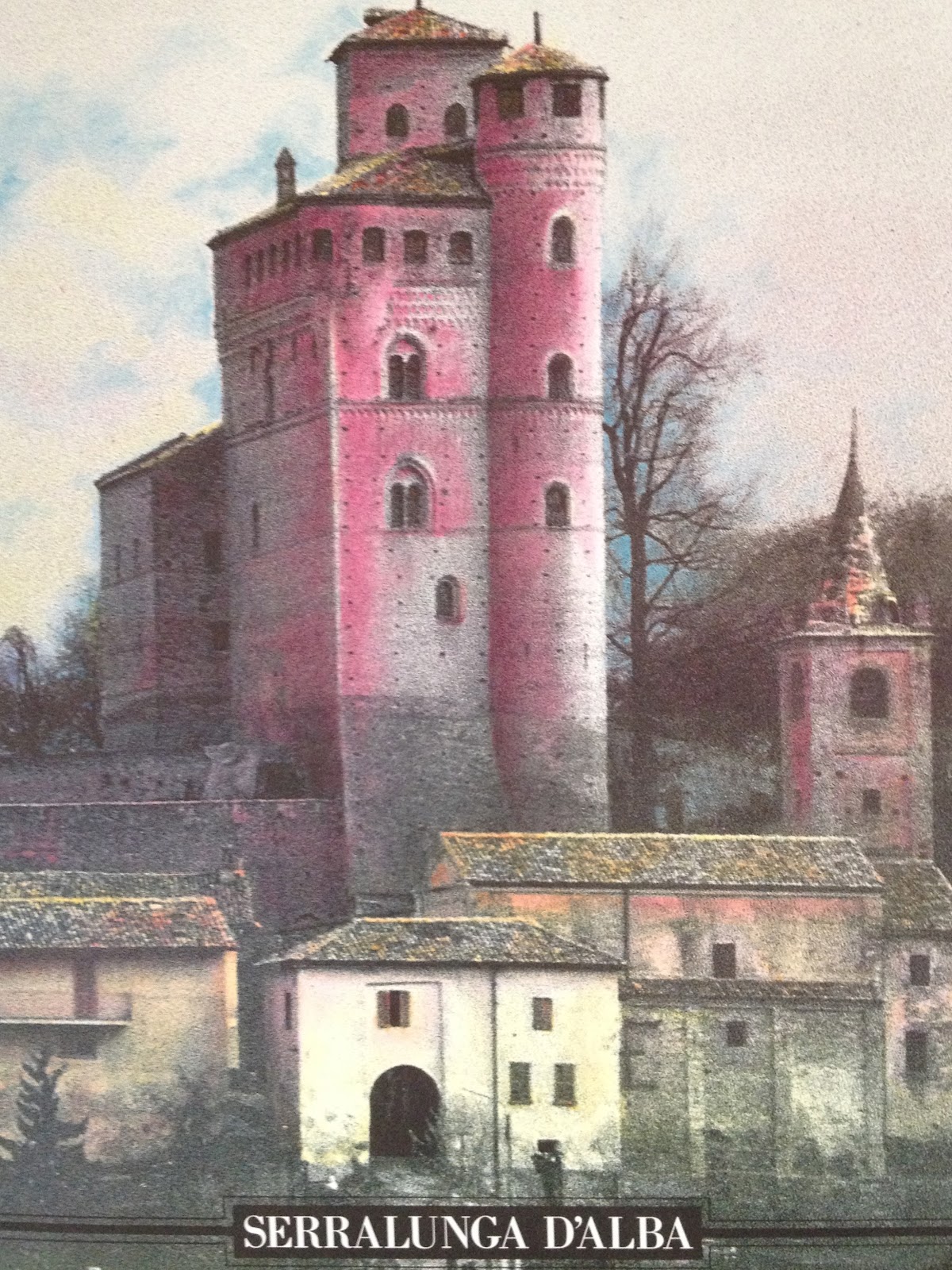
Serralunga, 8 October 2012
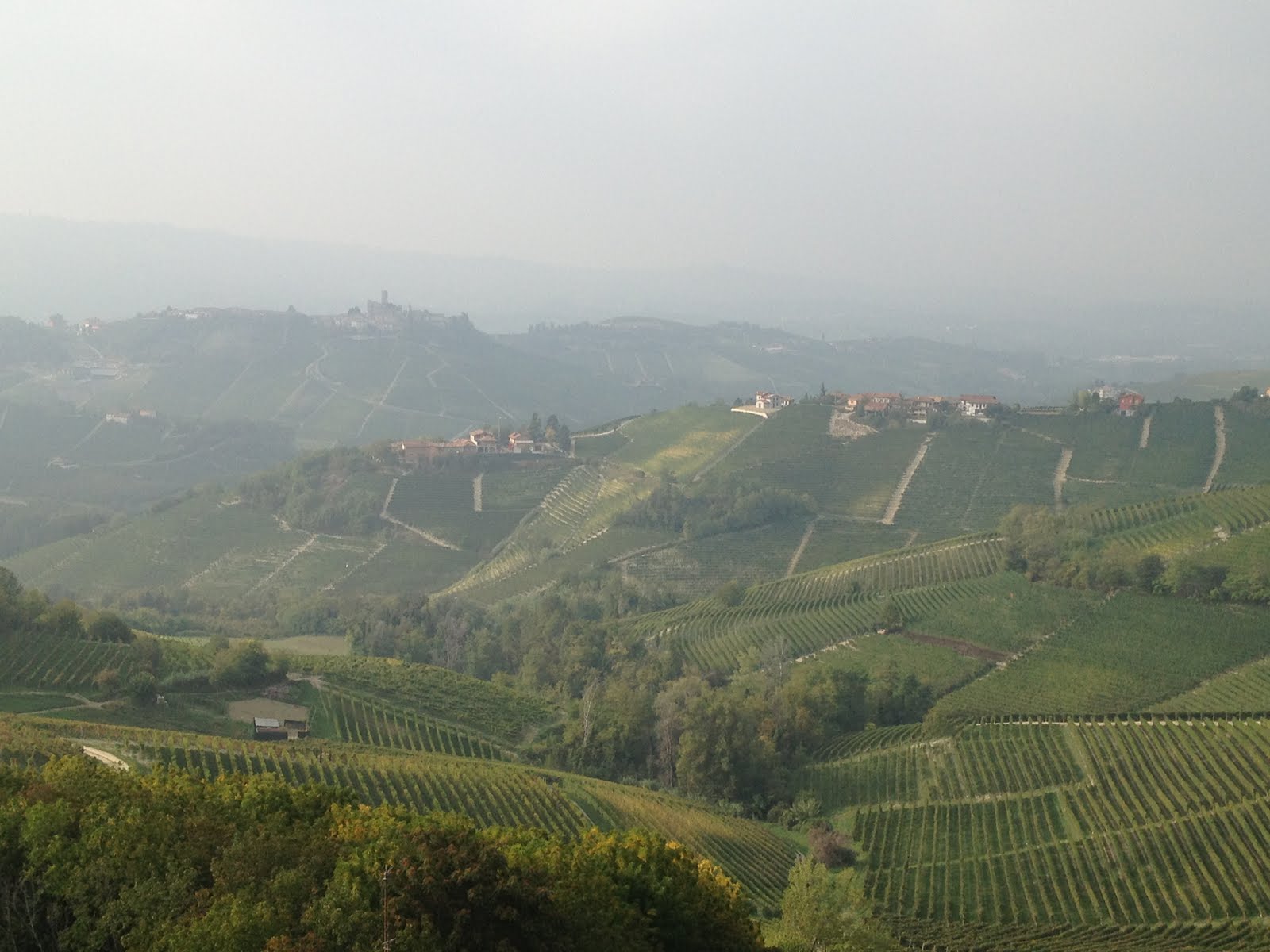
It is 1:30. The sun shines warmly on our terrace. Where we are seated, to our left is a tall impressive old castle and to our right are valleys with rows of grapevines creating a geometric crazy quilt.We were in Serralunga yesterday. Our hike began here. Our long hike. Our six and one half hour hike. Thirteen kilometers. It was total immersion. At our final footstep we were covered from the knees down with the precious dirt that enables the flourishing of the nebbiolo grapes that produce the extraordinary wines. By tromping up hill and down hill, steep ascents and descents, over and over and passing through oak groves laden with truffles and past the prune plums and the hazelnuts and the walnuts and the quince and the apple and the pear and the fig and the on and on we feel that we physically know the smell and feel and taste of the area. By taste, I do not mean wine–I am a wine ninny, I love it, but know nothing–I mean the fruits we “stole” from vines and trees along the route. Lest you worry, we did not sample the unusually mushrooms growing in the boggy shade.
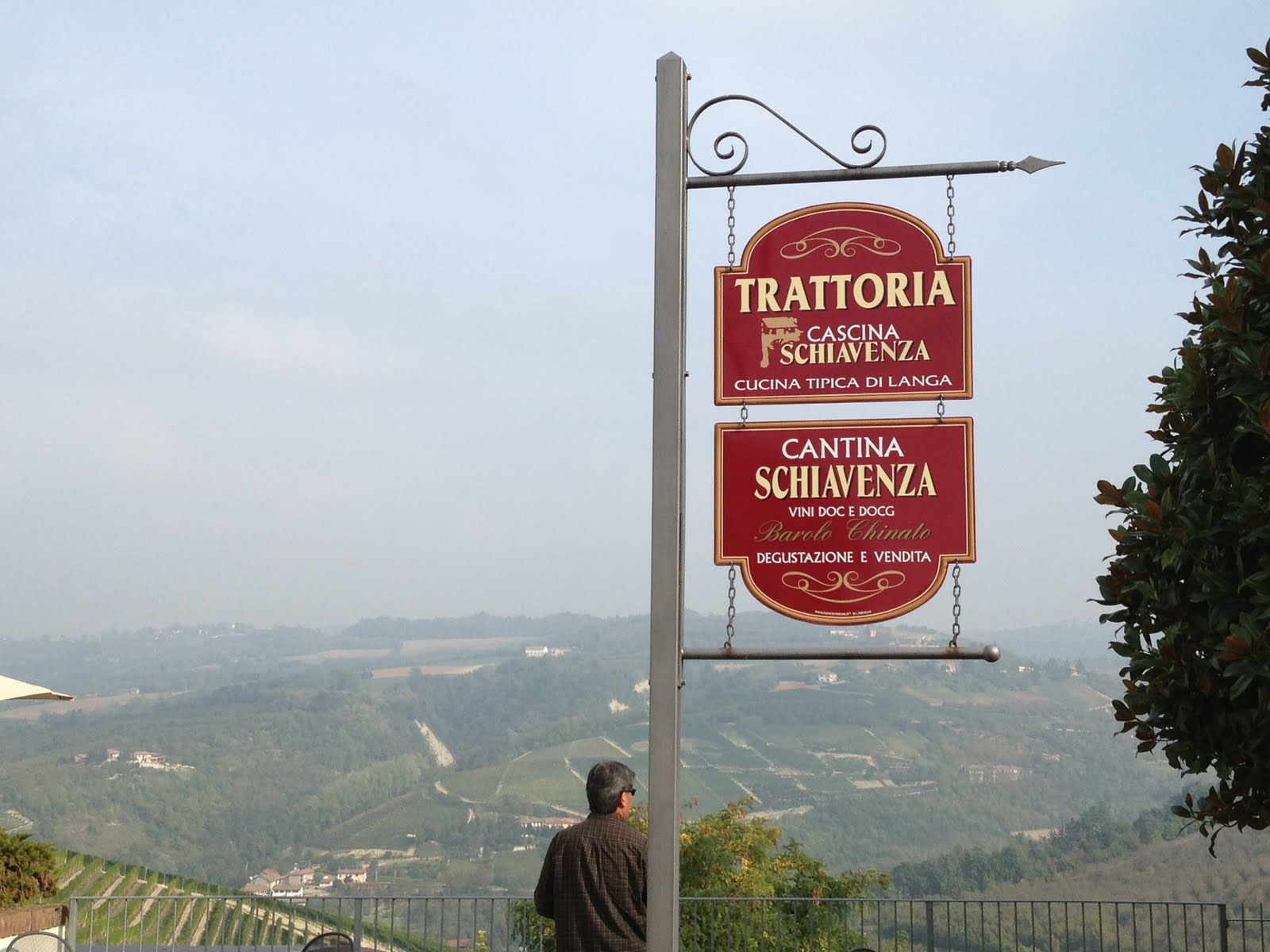
Our first course is a sampler plate consisting of veal two ways (chopped crudo and vitello tonnato), a crepe filled with cheese and mushroom and roasted peppers, their innards spooned with olive oil soaked chopped anchovies. It was a plate worthy of superlatives and I will spare you my gushy prose. Our wine is made by the Trattoria Schiavenza. It is Dolcetto d’Alba, Vughera, 2010. We thought, it is a young wine. Crisp. Light. Low alcohol. It is intense, inky and a 14.50% alcohol. It is fabulous.
We await our second course of Piemontese beef cooked in Barolo. And a ravioli of some delicious sort.
The Alba restaurant from my last entry was La Libera. Like a virtuoso, they made everything look easy and delivered a sparkling performance which was our food and eating experience.
Back to our second course. Wes’s pasta is a “plin”–stuffed pasta–with veal, spinach and parmigiano filling dressed simply with butter infused with sage leaves and parmigiano. Roland–or as I have lately called him, Ba-roland–and I opted for Piemontese beef braised in Barolo wine. The juice over it is absolutely tasty in the extreme. And the beef, sliced half-inch thick is tender. But. The nature of braised meat is that it is fully, fully cooked and not at all pink. Maybe it is a childhood thing. When I remember back on mom’s beef roast, that is the texture of my beef today. I guess when it comes to beef and ovens I am more a steak guy than a braised guy. We finished our meal with “Barolo Chinotto” a “digestivo” red wine fortified with sugar, chinotto and herbs.
Nocciola in shell (hazelnut) Our hotel, Corte Gondina in La Morra, feels like our own private villa. A courtyard is planted with a small center lawn planted with an ancient olive tree. The lawn is bordered with rectangular stones which in turn are bordered with cobblestones laid in a fan shape. On the cobblestones are tables. The tabletops are stone with silver mica flecks that glitter in the sun. On two sides of the courtyard is the three-story inn. The rooms have a continuous stone balcony with an iron railing–and chairs and tables–that overhangs the courtyard. The third side of the courtyard descends by steps to an infinity pool. The fourth side is tall hedges. Today while sitting in the courtyard the owner/proprietor removed the umbrellas and the chaises. He looked at us and said, “summer is over”.
Marlow on behalf of myself, Wes and Roland
Serralunga, Italy
8 October 2012, Monday
3:20 p.m.
Sent via BlackBerry from T-Mobile
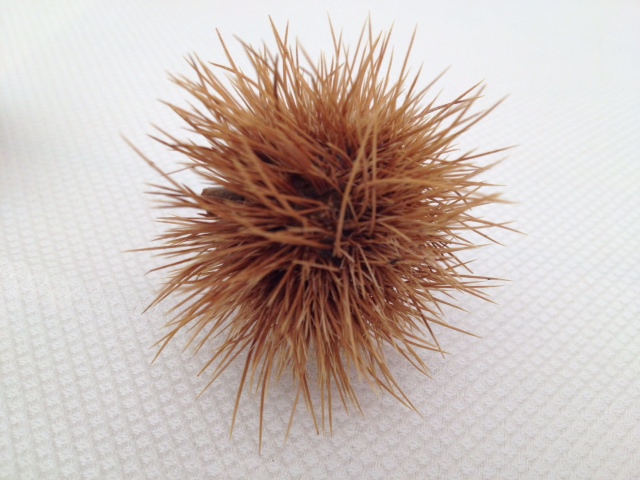
Barolo (near Alba, Italy in the Piemonte)
Sunday, 7 October 2012
Cauliflower cream topped with a caramelized scallop topped with freshly shaved white truffle.
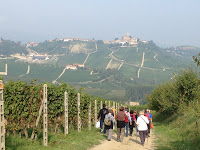
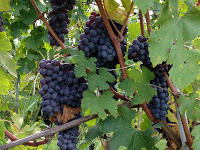
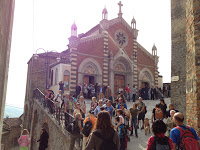
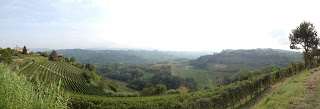
Route of our hike in the Nebbiolo Vineyards
Roasted and browned rabbit beside a potato topped with shavings of smoked foie gras.
Very rare leaves of veal with a large dollop of a cream composed of pureed tuna and egg and oil.
Paper thin slices of fresh porcini mushrooms over a small bed of coarsely grated cheese and dressed with olive oil from Sicily.
Silky, fine, golden egg noodles combined with chopped porcini mushrooms cooked in their own juice.
We ate those things, and more, last night in Alba.
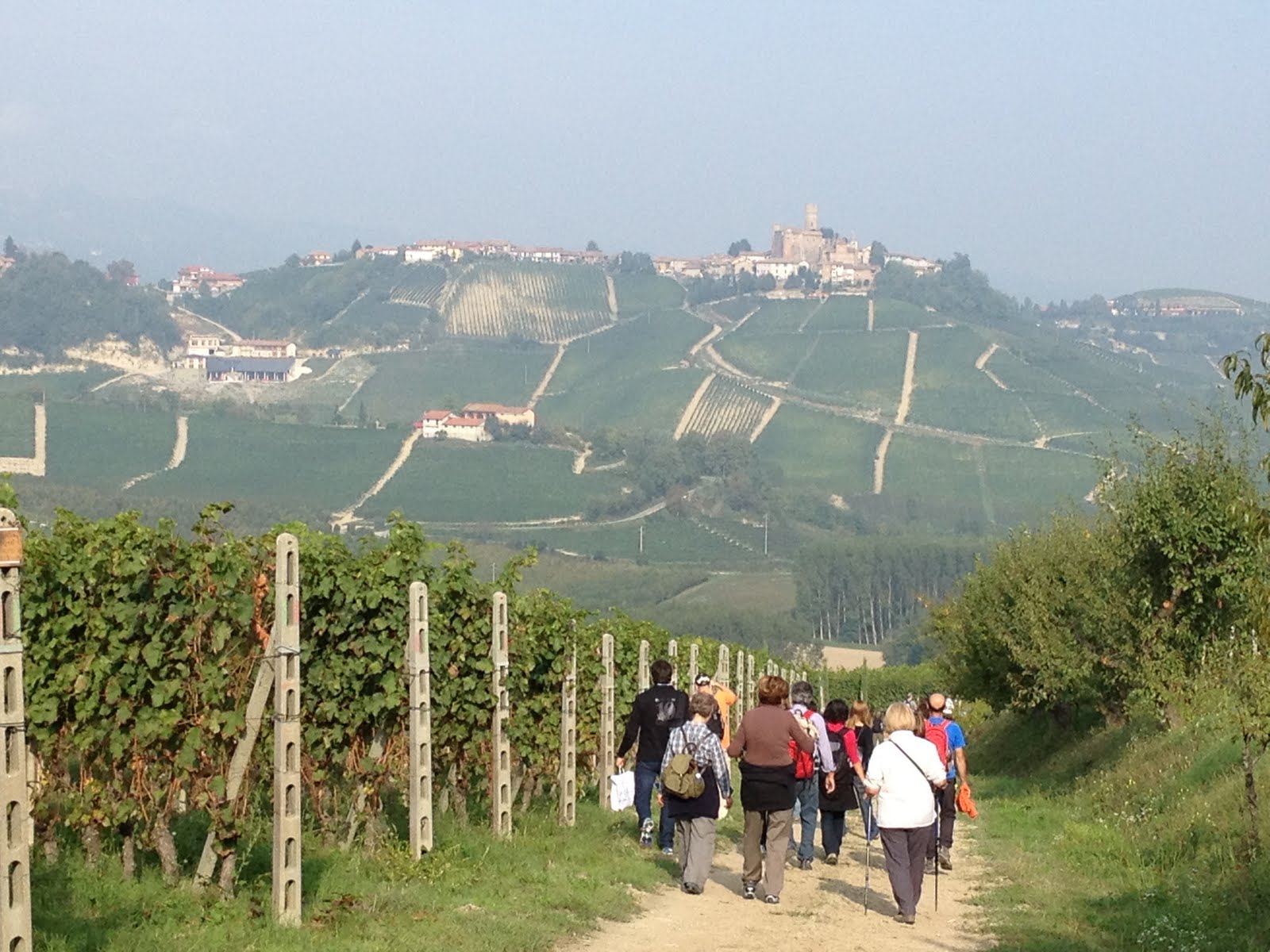
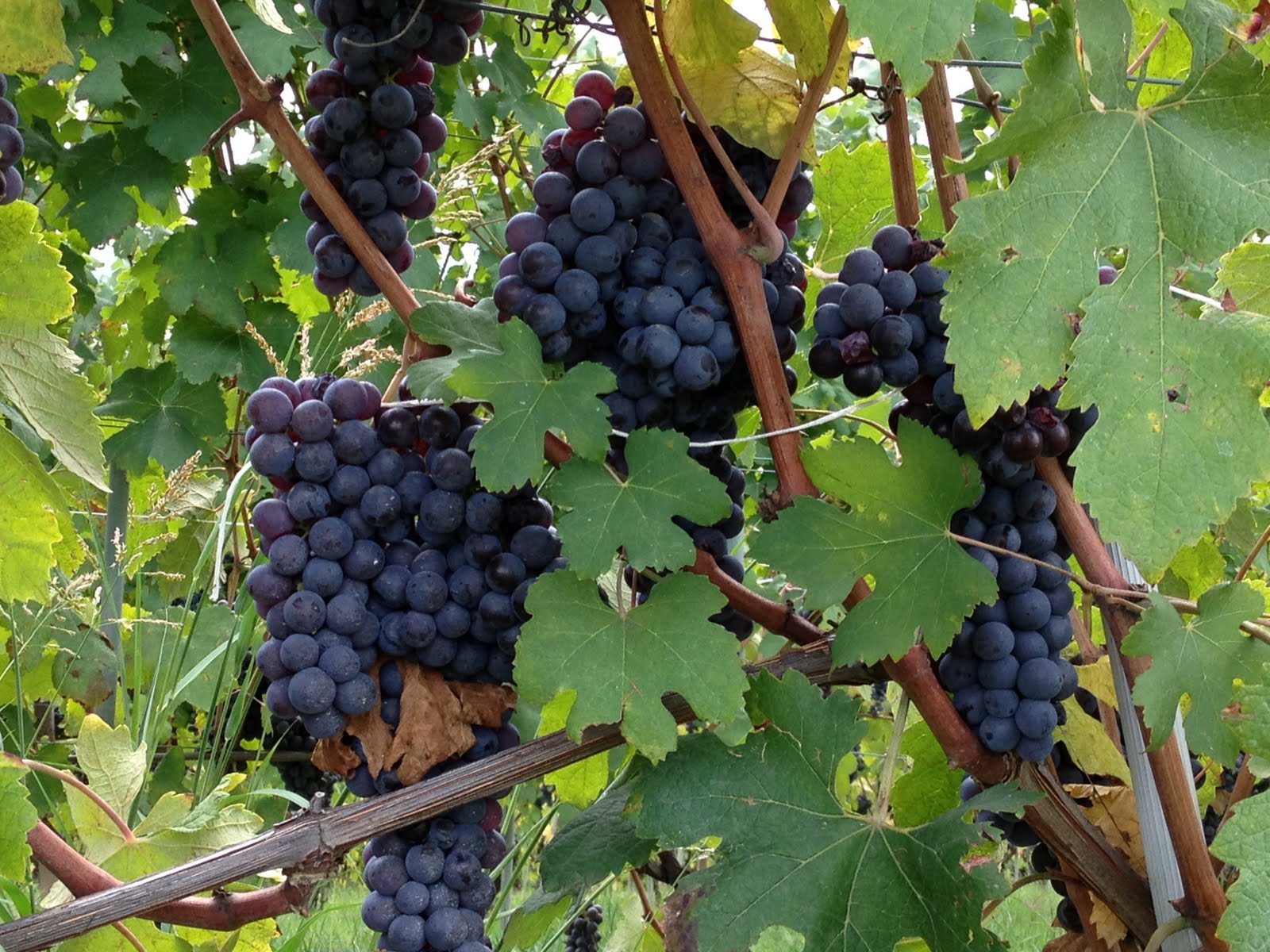
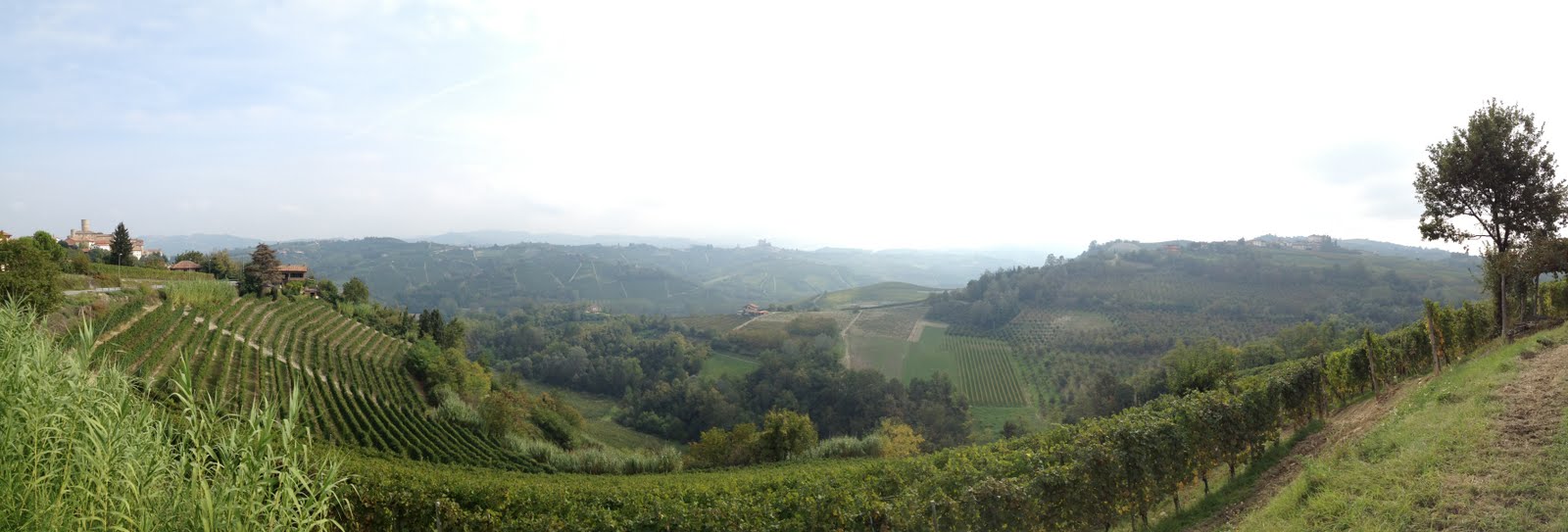
But at this moment we are walking downhill from the vineyards of Serralunga and across the border into the Barolo vineyards. There are grapes galore. They hang at the bottom of the vines where the leaves have been trimmed away for maximum light exposure to create maximum flavor. I just picked a grape. The flavor was extraordinary.
Our path twists and turns. Shading the path are hazelnut, walnut and pear trees. It appears the grapes will be hand-picked. That is rare in our era.
The morning began with a drive. The countryside is a fairy tale come to life. Every hilltop with a castle. A layer of fog blanketing the ground. Slight mist in the air giving an effect of viewing the vistas through a veil.
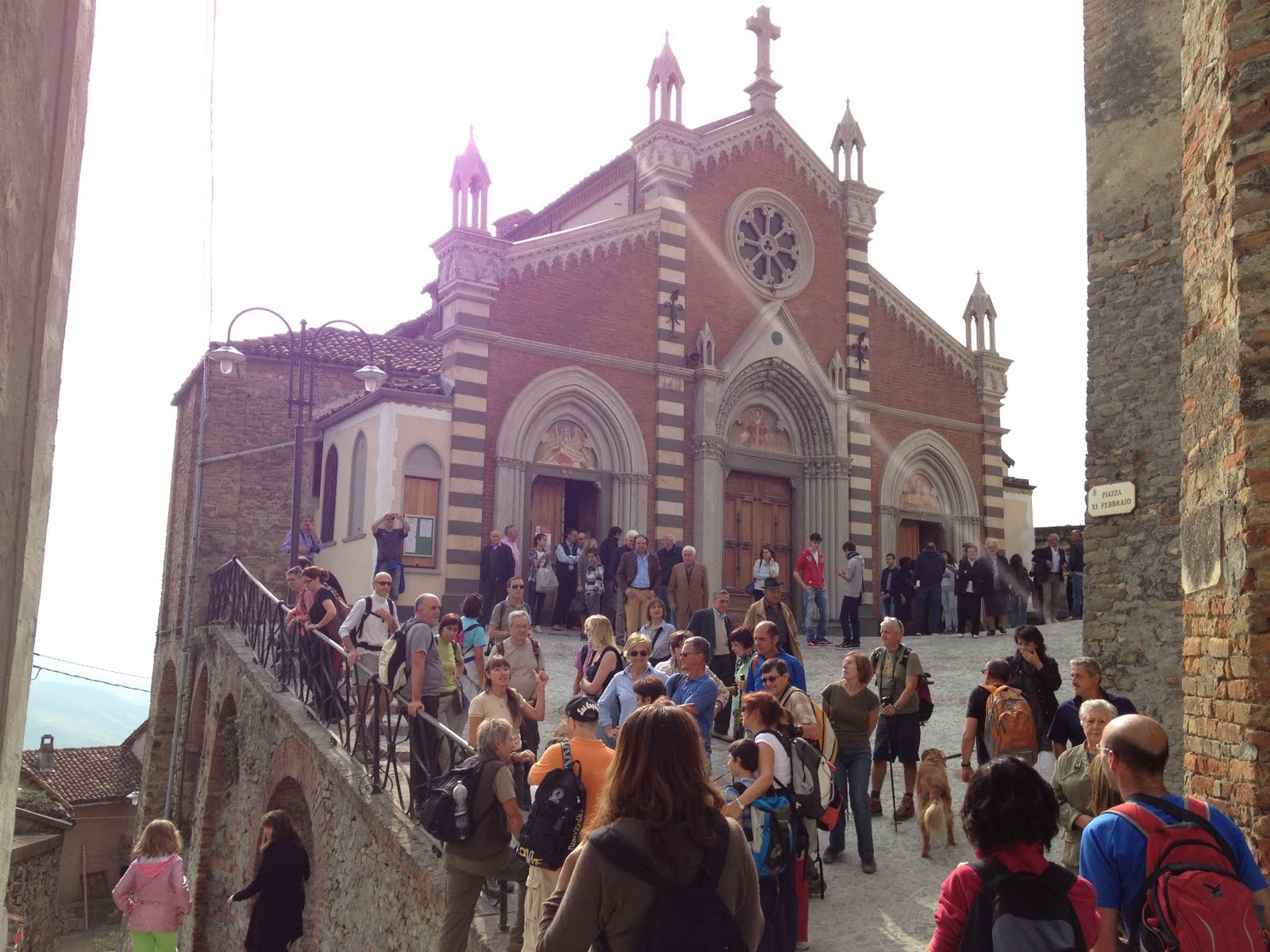
Our vineyard walk has arrived at the Barolo hilltop. There is a medieval castle. And a tower, round and old with every repair and remodel, from the past thousand years, visible. Beside the tower is the small local church. The service is ended. The noon bells are chiming. The organ music wafts through the door and down the cobble stoned spiraling path. The congregation is pouring into the small piazza. There are very old and very young people. On a bulletin board are posted the recently deceased from the community.
We are in our third hour of our walk. Our group is more or less thirty-five people. Mostly Italians on visits to the countryside. Just as in opera we have had a crisis. A twelve year old boy who began with us went missing. His mother went into emotional crisis mode. A policeman took her into his car to go on a search. The group was unsmiling and concerned. Then, voilá, the boy appeared. The mother was about to grab him by the ear, then instead burst into tears and hugged him. Resolution. I expected, as in opera, we would gather in the village piazza for a feast and a six-voice aria and a toast to the re-united and final happily-ever-after bow.
I should be listening to our guide. But she is addressing the group in Italian. I understand every tenth word. The scenery speaks for itself. There are hills in every direction. They are terraced with rows of grapevines neatly spaced. There are rows facing absolutely every direction. It stands to reason, different orientations produce different results. We continue to snitch grapes, nebbiolo, from the vines.
A half-hour later……we have descended into an oak forest. The leaf canopy is very high. On the ground amid the debris of fallen tree limbs are mushrooms. Beautiful. Spooky. Tempting. Unusually sculptural and colorful. Approach with caution, if at all.
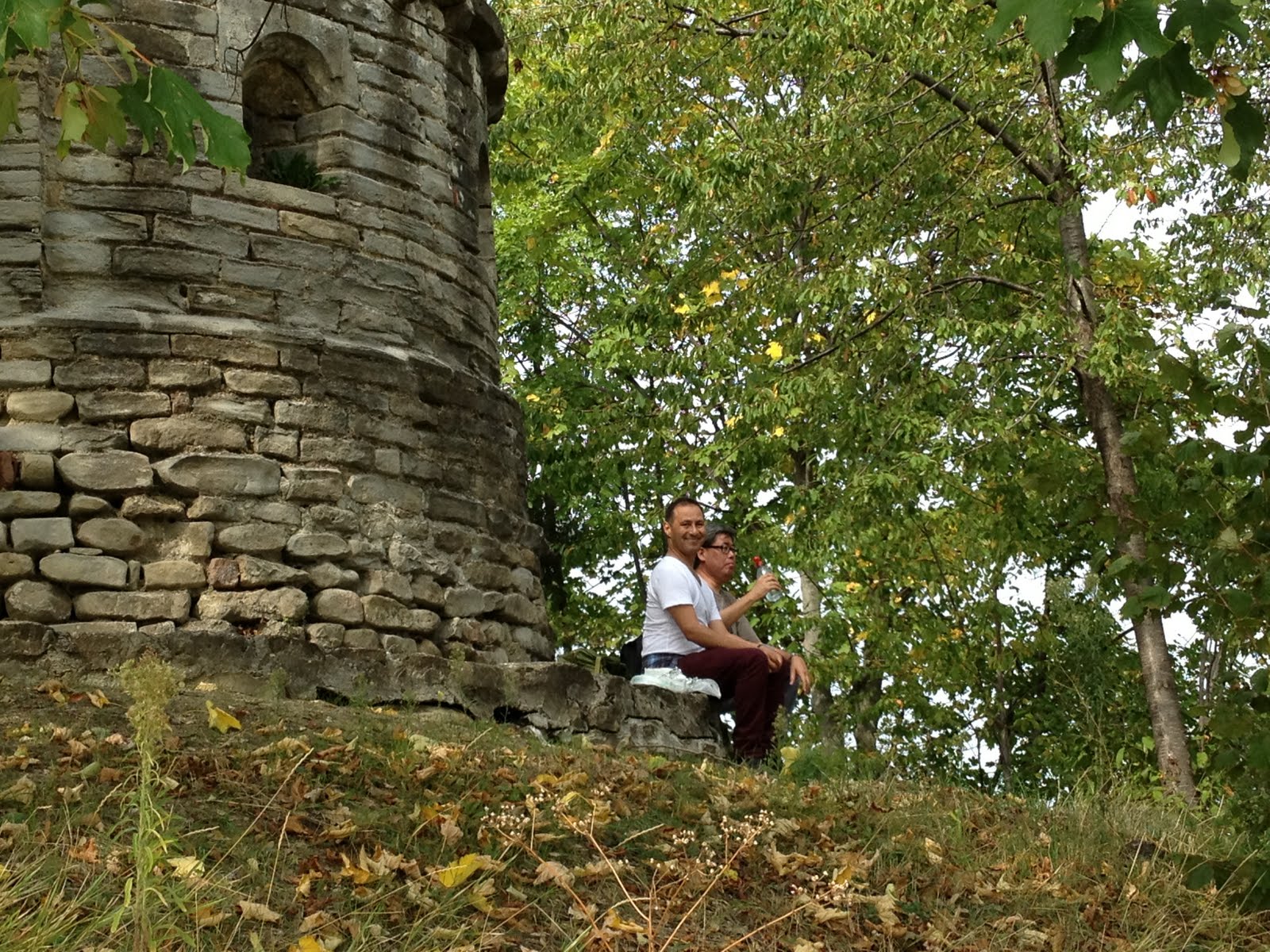
Three and a half hours into our walk we have stopped on a knoll with a tiny romanesque chapel, eleventh-Century. We are sitting on a low stone wall under trees eating our sandwiches of salami crudo and tangerines with green skins, more sour than sweet. A few feet away is our dessert hanging on vines, sweet, plump, bursting with juice grapes.
We also have a cake made from five ingredients: ground hazelnuts, sugar, eggs, butter and vanilla. What more does one need.
Route of our hike in the Nebbiolo Vineyards
Signing off from Barolo
Marlow on behalf of myself, Wes and Roland
7 October, 2012
Sunday (day of rest)
1:45 p.m.
Sent via BlackBerry from T-Mobile
Adios Barcelona, 1 Oct 2012
1 October 2012, Monday.
We are on the train.Goodbye, Barcelona. Hello, Girona.
The ride is about an hour and a half.
As we ride the rails out of Barcelona here are bits and pieces about unmentioned Barcelona adventures.
FOOD
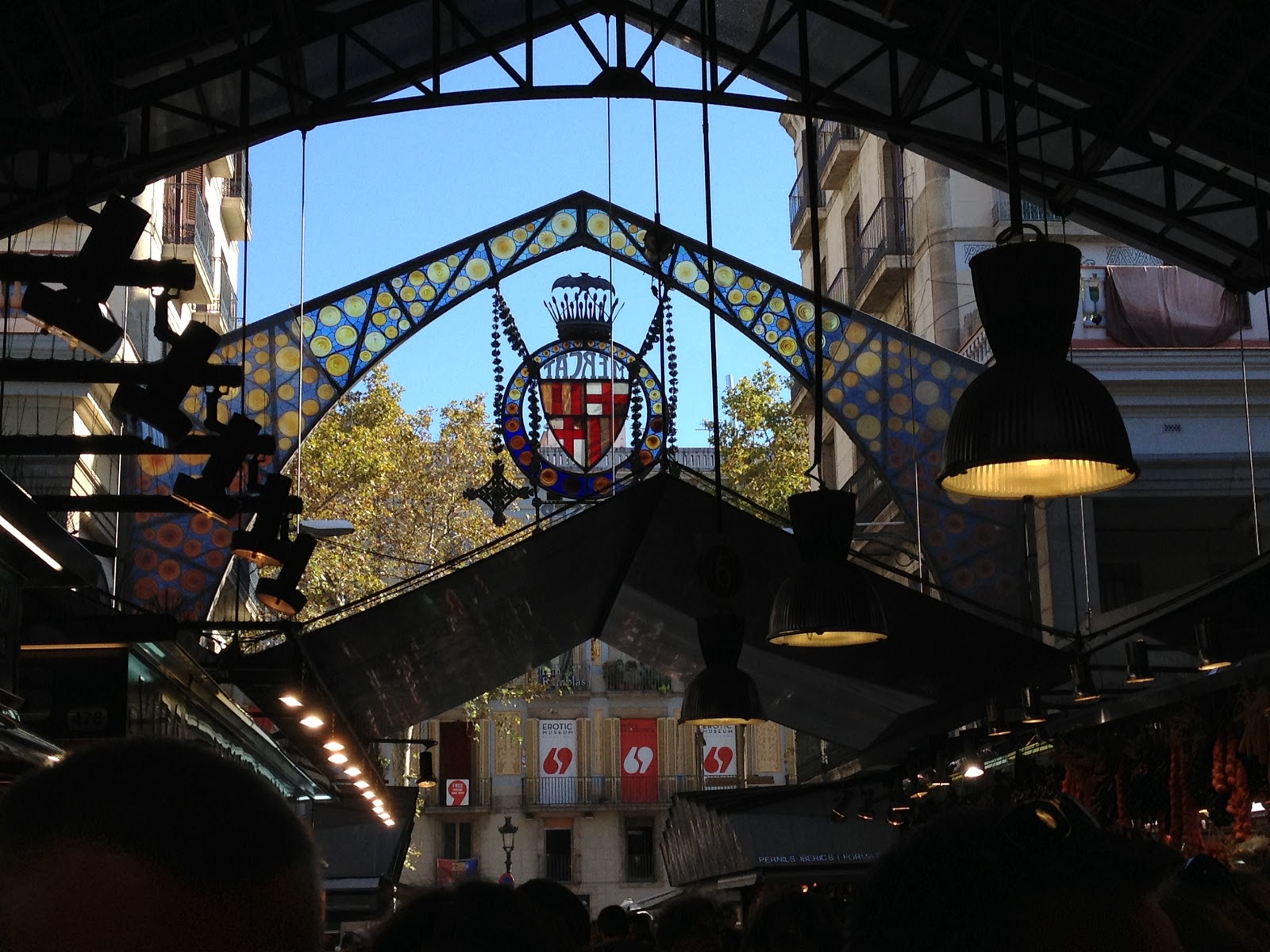
For our groceries, we have shopped mostly at the queen of Barcelona markets, La Bouqeria. There are nearer places to go, but the Boqueria teems, hums and buzzes with excitement. It has a dizzying array of fish mongers, butchers, bakers, cheese makers, produce and fruit people, spice vendors and snail experts and dining stalls operated by top restaurateurs for breakfast and lunch. It opens early at 6:30 a.m. Sundays it is closed. If you ask a vendor why, they look at you as if you are crazy. “It is the Lord’s day!” Funny, because, though it is a catholic country, as a whole the population is not rabidly religious. Five or so years ago same-sex marriage was made legal here and polls recorded 60+% approval. Which is all to say, the market is closed on Sunday.
In 2007, we had the great privilege and pleasure of eating at El Bulli, the shining star of Spanish restaurants where Mr. Ferran Adria began what here is called “la revolucion”. Having experienced the pinnacle of avant garde food artistry we have opted this trip to eat traditionally which means the Pimientos de Padrón (small green mostly not hot peppers), pa amb tomaquet (toast rubbed with tomato and drizzled with oil and salt), jamón de bellota (cured ham from small black acorn-fed pigs), escalivada (melange of red pepper, eggplant and onion fire roasted till they melt), esquiexada (salad of onion, tomato and fresh cod). We are eating foods that are more dependent on the excellence of the ingredients than they are on cooking skills. Speaking of simple. We went to a small old sandwich shop, Viena. Their ham sandwich found itself in The N.Y. Times. Mark Bittman declared it “the best sandwich in the world!” Flauta de Pernil is the sandwich. Take a petite baguette. Slice it lengthwise. Rub the interior with tomato. Take little-black-piggy-acorn-fed ham and tuck it into the bread. Voila! That is the greatest sandwich in the world. Before you take issue with the pronouncement, visit the Viena Café in Barcelona. Then take your disagreement, IF you disagree, to Mr. Bittman.
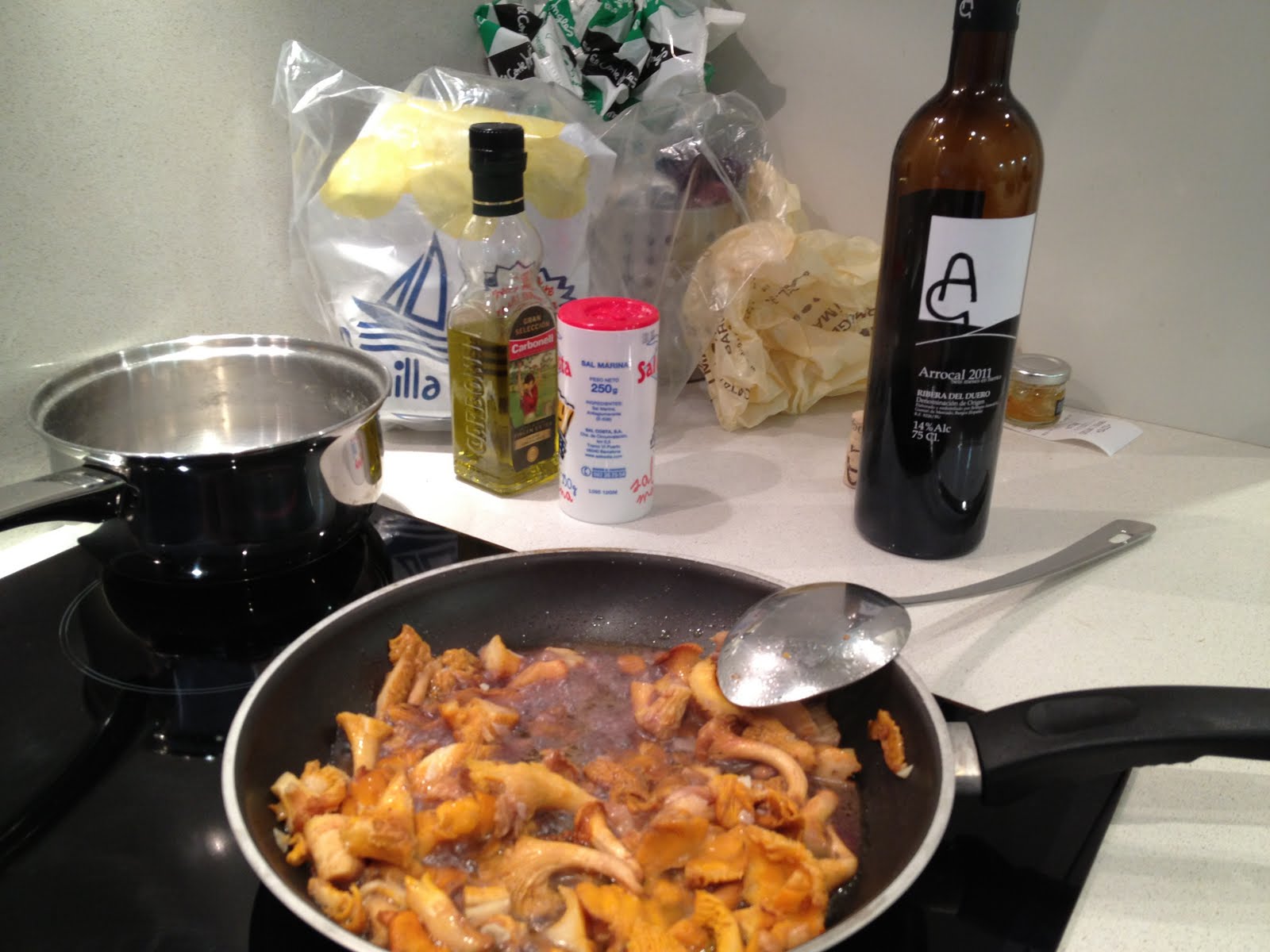
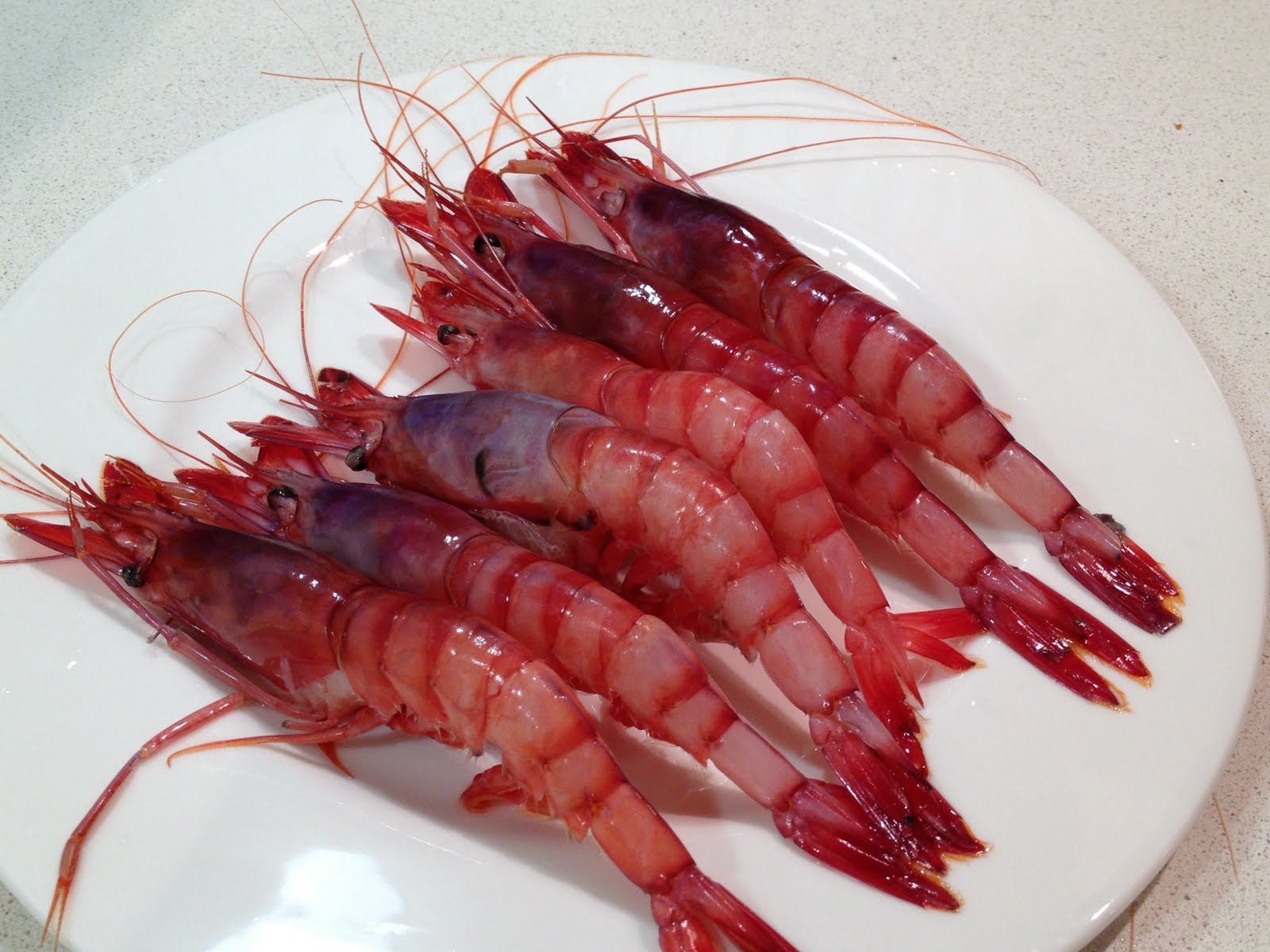
We have eaten at home several times. I think Wes was a Catalan chef in a previous life. He takes to their ingredients like a duck to water. Leave him in the kitchen with something as simple as a tomato, a red pepper, garlic, salt, ham, chorizo and olive oil and ten minutes later oh lá lá what a smell, what seductive flavors. Delicious is the only word. The ingredients individually are a joy. On their own they are so tasty. The spanish red bell peppers, longer and squarer than ours are sweeter with a rich flavor when cooked. The brilliant rosy red shrimp just caught in Mallorca are too beautiful to eat. But we did!
PABLO PICASSO
23 Sept 2012There is a Picasso museum in Paris. But the one in Barcelona is probably more interesting as it is filled with his own personal collection of his hoarded childhood work much of it done before he was twenty years old. He was not native to Barcelona. His family moved there when he was a little boy, but already at ten years old, fifteen years old, he was working out the concepts, themes and shapes that would evolve into his yet to be painted masterpieces.
The museum came into existence when his childhood friend, Jaume Sabartés, used his own collection of Picassos to open the “Sabartés Collection” in Barcelona’s Palau Aguilar on 9 March 1963. Then in 1970, inspired by his friend’s generous gesture, Picasso donated to the museum close to one thousand works of his that had been housed in his family’s Barcelona apartment. To that gift, the city of Barcelona added another medieval palace, the Palau Castellet, to double the exhibition space. And that gift inspired Picasso’s widow to donate 41 more works. The museum is a labor of love, generosity and friendship.
You will not see the iconic Picasso canvases there. (For those go to Philadelphia to see the Barnes Collection.) Instead you will witness his evolution from small child to young man via drawings and paintings. And, of course, it helps if you like Picasso in the first place. And I do.
CAFE DE LES SET PORTES
Tuesday, 25 Sept 2012 and Sunday, 30 Sept 2012Sam and Kathy Adams, about a dozen years ago, introduced us to a restaurant. Every time we visit Barcelona we eat there. It is that good. It is that interesting. And it is called, Café de les Set Portes. That is Catalan for Cafe of the Seven Doors. In 1957, Sam traveled to Europe for the first time. Rumor has it, he ran from the ship directly to the restaurant for his first meal in Europe. When Sam first set foot in the place it was already 121 years old. It has been in business since 1836. For a while it did not have a name, but because it has seven doors that face the street, people recommended it to their friends as “the place with seven doors”. Paella is their specialty. We have eaten a lot of it there. As have Garcia Lorca and Maria Callas and Gabriel Garcia Marquez and Pablo Picasso and Woody Allen and Salvador Dali and on and on. They have kept records of who has dined at which table. At our table last night, Che Guevara, once sat and ate his paella like a good revolutionary.
This week we ate at Set Portes two times. Last Tuesday, Raul and Kathleen, arrived from Maryland. Before they departed on their Mediterranean jazz cruise we whisked them away for an orgy of Paella Parellada and “braço de gitano” (arm of the gypsy) and “puding”. The Paella Parellada was put on the menu by it’s namesake, Paco Parellada, when he took over the place in 1942. Eighty years for a dish to be on a menu is a long time. I suppose one could call it a classic. The dining room, too, is classic with a comfortable old world patina, more 19th-Century than 21st-Century. The waiters wear classic long white aprons. There is wood paneling and there are large mirrors and a floor of black and white tiles and paintings and of course lots of windows and those seven doors. And there are rooms farther away from the front door with autographs around the walls of many of the luminaries from the art world who have eaten there. And a plaque commemorating the November in 1935 when Garcia Lorca, a year before his death, first read in that room his poem, A Poet in New York. The restaurant has survived a lot of history, particularly the Spanish Civil War of Generalissimo Franco. It’s tumult and tragedy. Currently, Catalunya is quite united in their local pride. The international news is full of stories about the hardships of Spain. Catalunya, Barcelona particularly, is a major component of the Spanish economy and they feel what they get back from central government in Madrid is not commensurate with what they contribute to the nation. This week the president of Catalunya made a bold move. He called for a referendum. A November election on the issue of Catalunya independence. Is it meant to declare they will leave Spain and become an independent nation? I am not sure. But politics here are very dynamic. Where was I? Dinner? Set Portes? Yes. So the restaurant is historic and eating there is in a sense participating in that history.
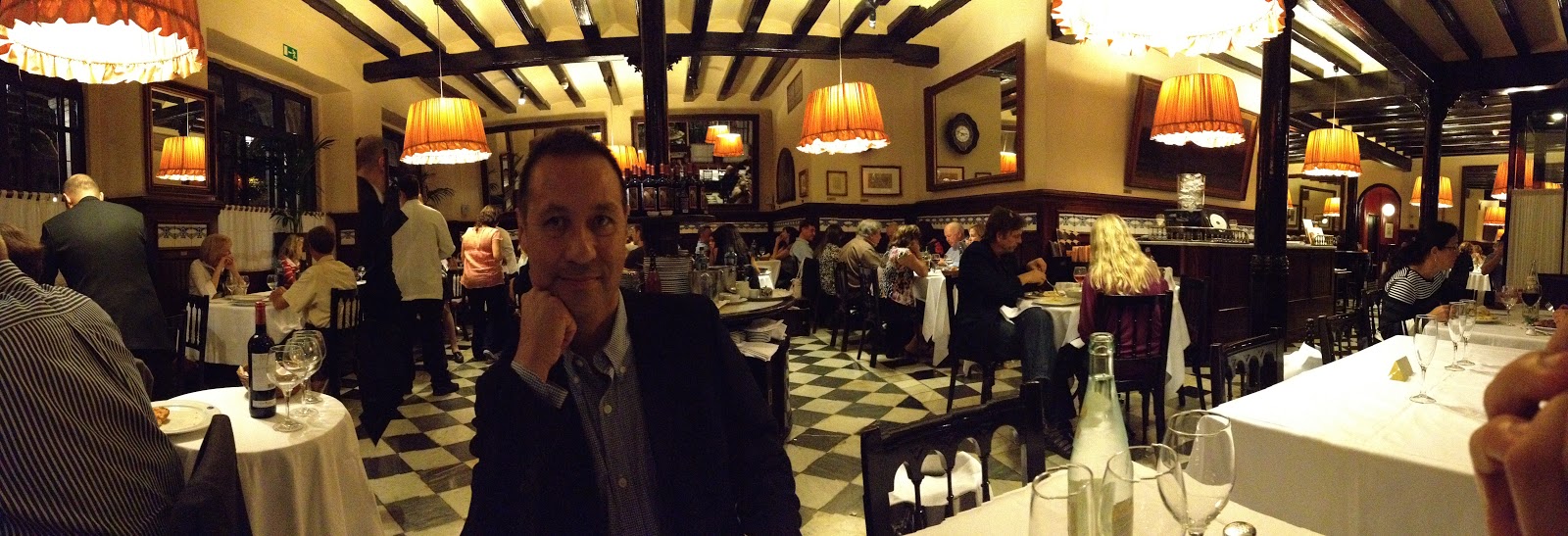
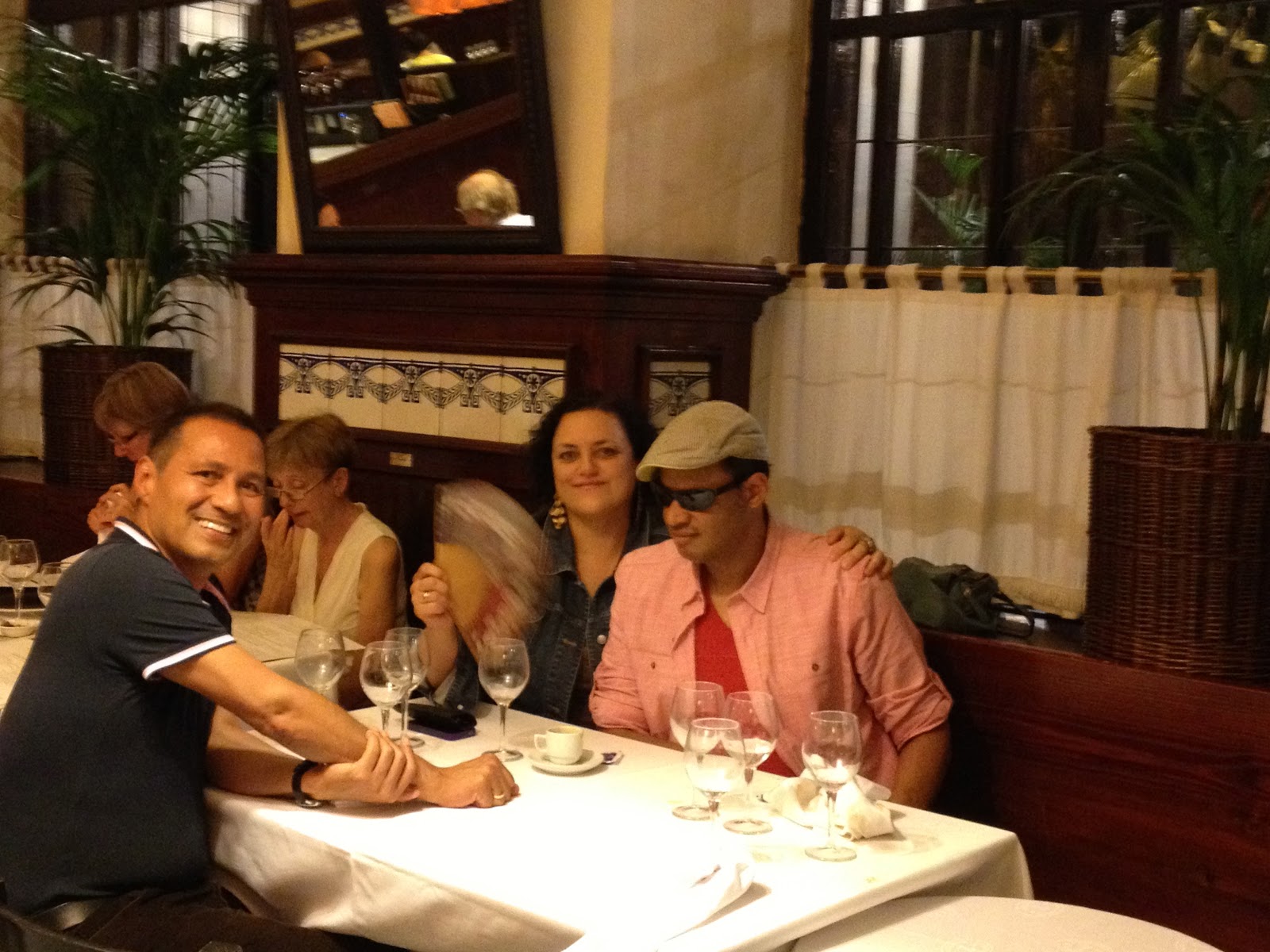
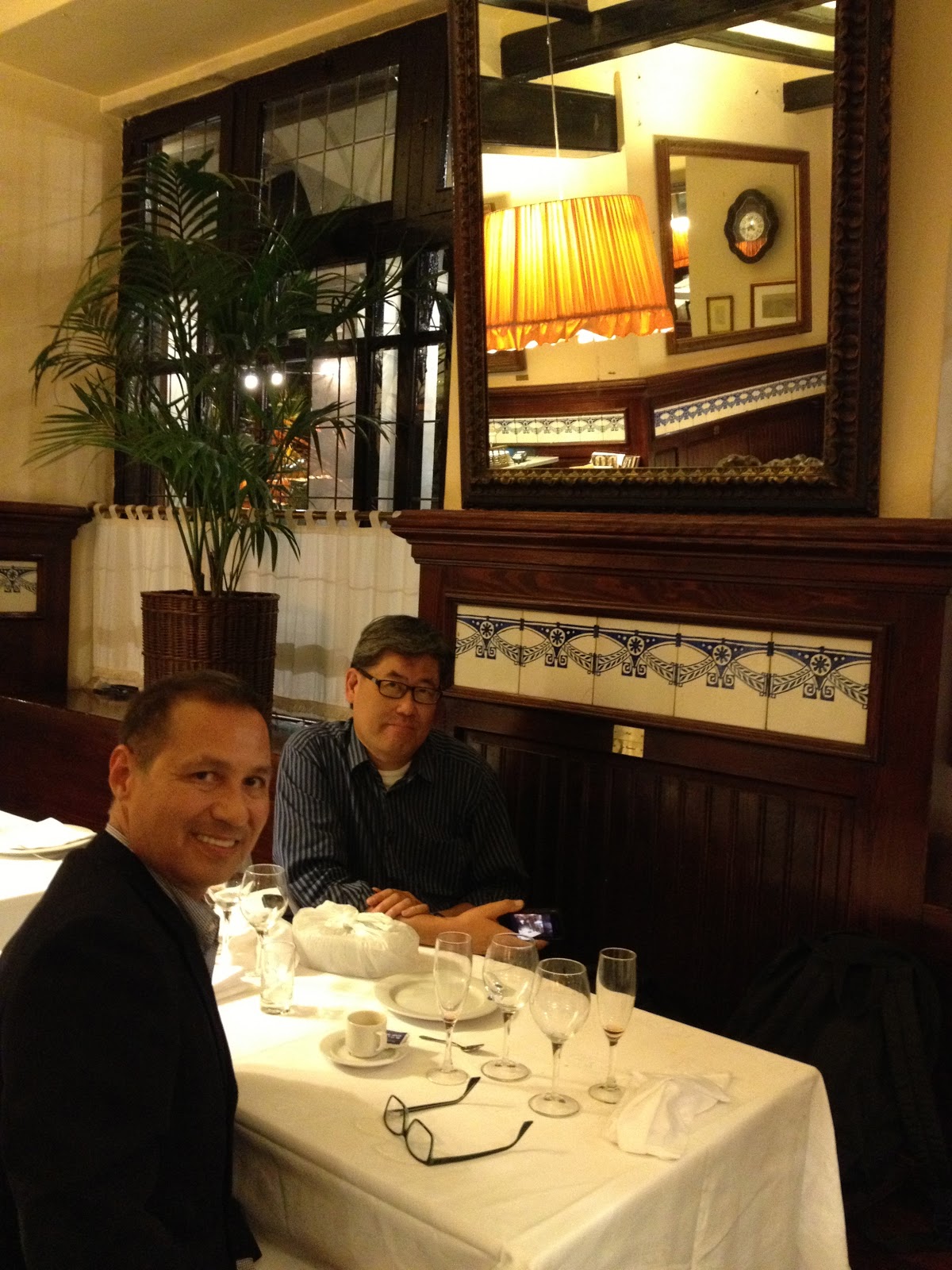
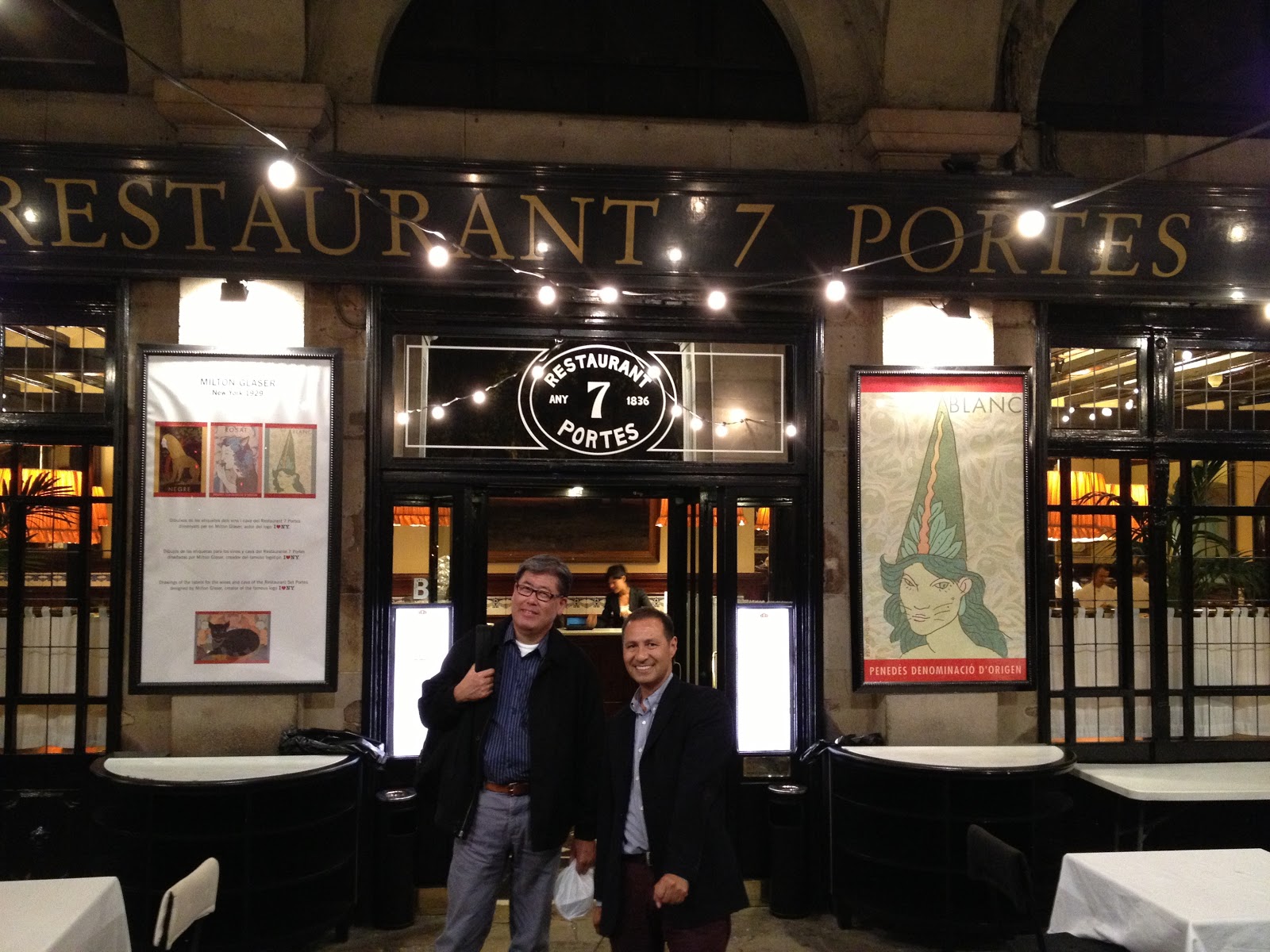
Later in the week, Roland arrived from Los Angeles and we went there with him, too. And we were full again. And we lingered long drinking rosé cava and eating black rice and sausage and bacalao and then dessert. Again I ordered the “puding”. Sounds like pudding, but more like flan. Take a loaf pan. Put sugar in it’s bottom. Add madeleines. Pour in egg custard and bake till firm. Turn out and slice. The result is like firm flan with caramelized sugar. In this instance they dotted the plate with large rosettes of unsweetened heavy whipped heavy cream. Of course, you need digestive assistance after that. So we had Etxeko’s Patxarana. A digestivo made from sloe-fruit, herbs and anisette. I felt very good after that. Could it have been the 30% alcohol content? Hmm.
Marlow and Wes
1 October 2012
Adios BarcelonaSent via BlackBerry from T-Mobile
Dali-esqe?
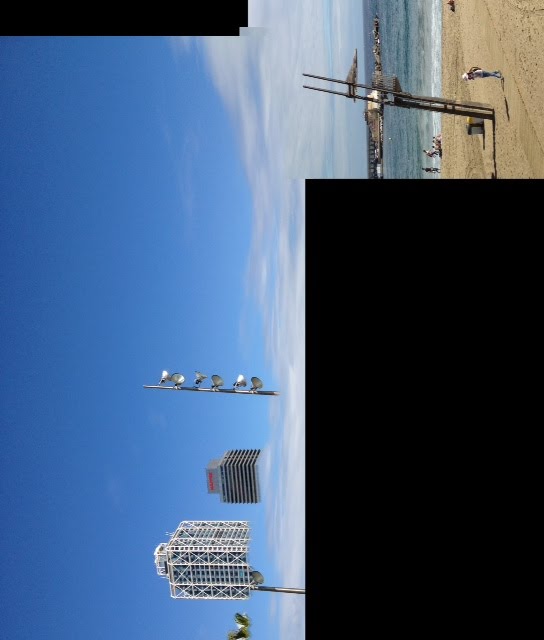
First attempt at new “panorama” feature. I think I have a lot to learn.
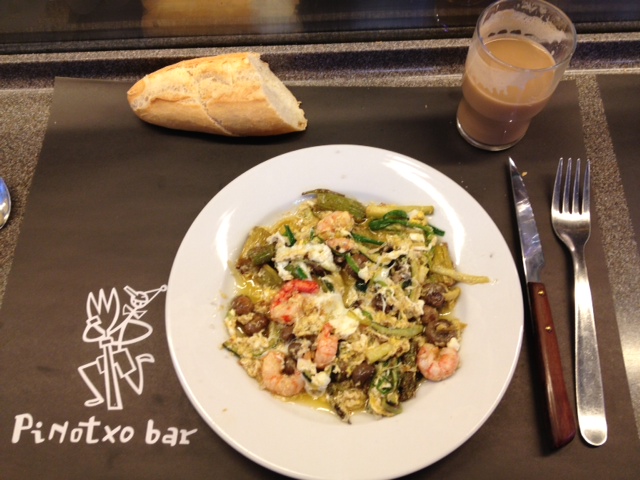
Breakfast at Pinotxo
29 Sept 2012, Barcelona, Vienna Phil
Our two weeks in Barcelona have flown by.
And I have some catching up to do in my reporting.
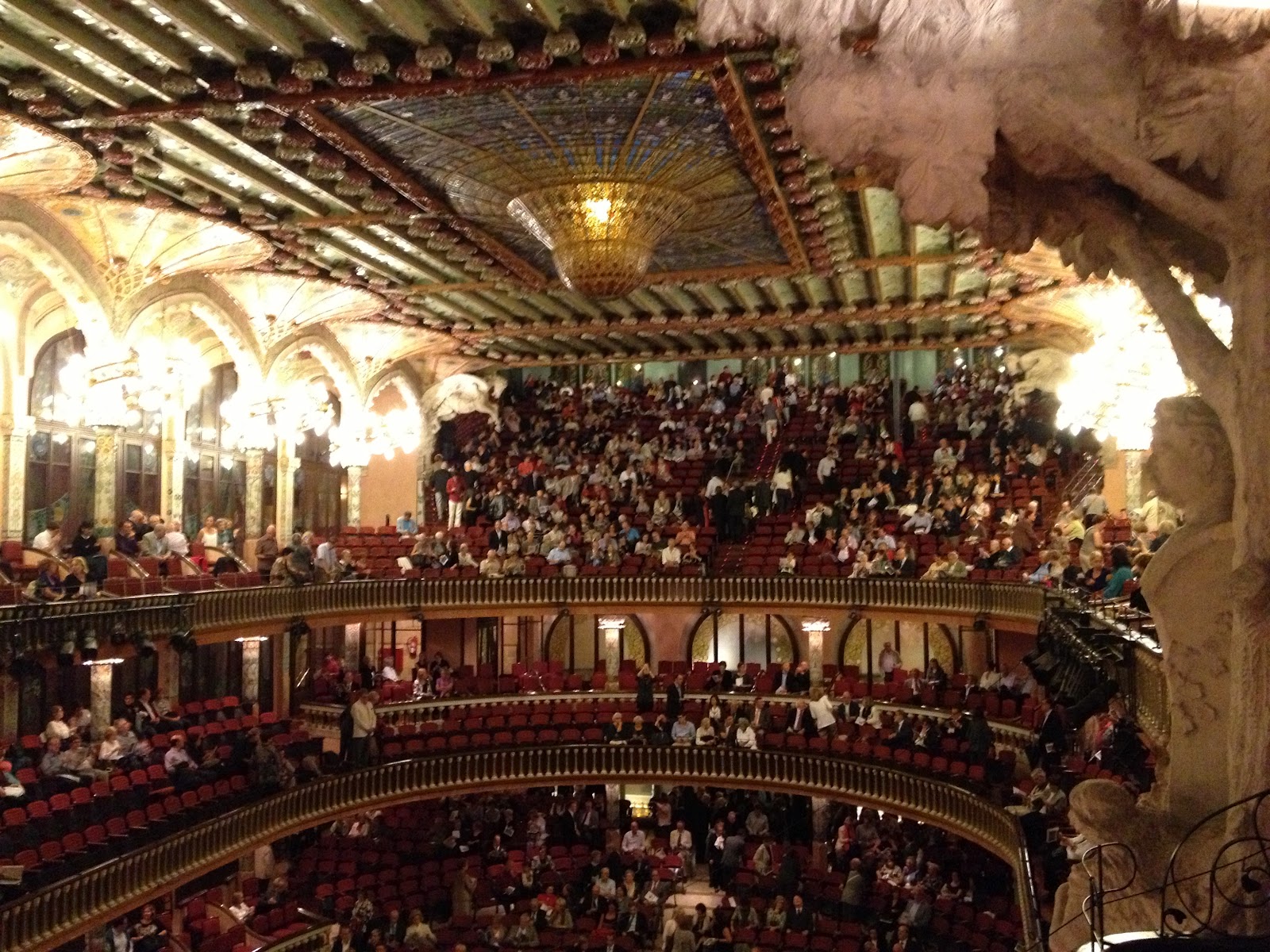
Friday night, Wesley took us to see and to hear the Vienna Philharmonic. The venue was the Palau de la Música Catalana. It is a gorgeous theatre. Jaw-droppingly so. And it is difficult to overstate the joy that washes over you when you approach and enter this theater.
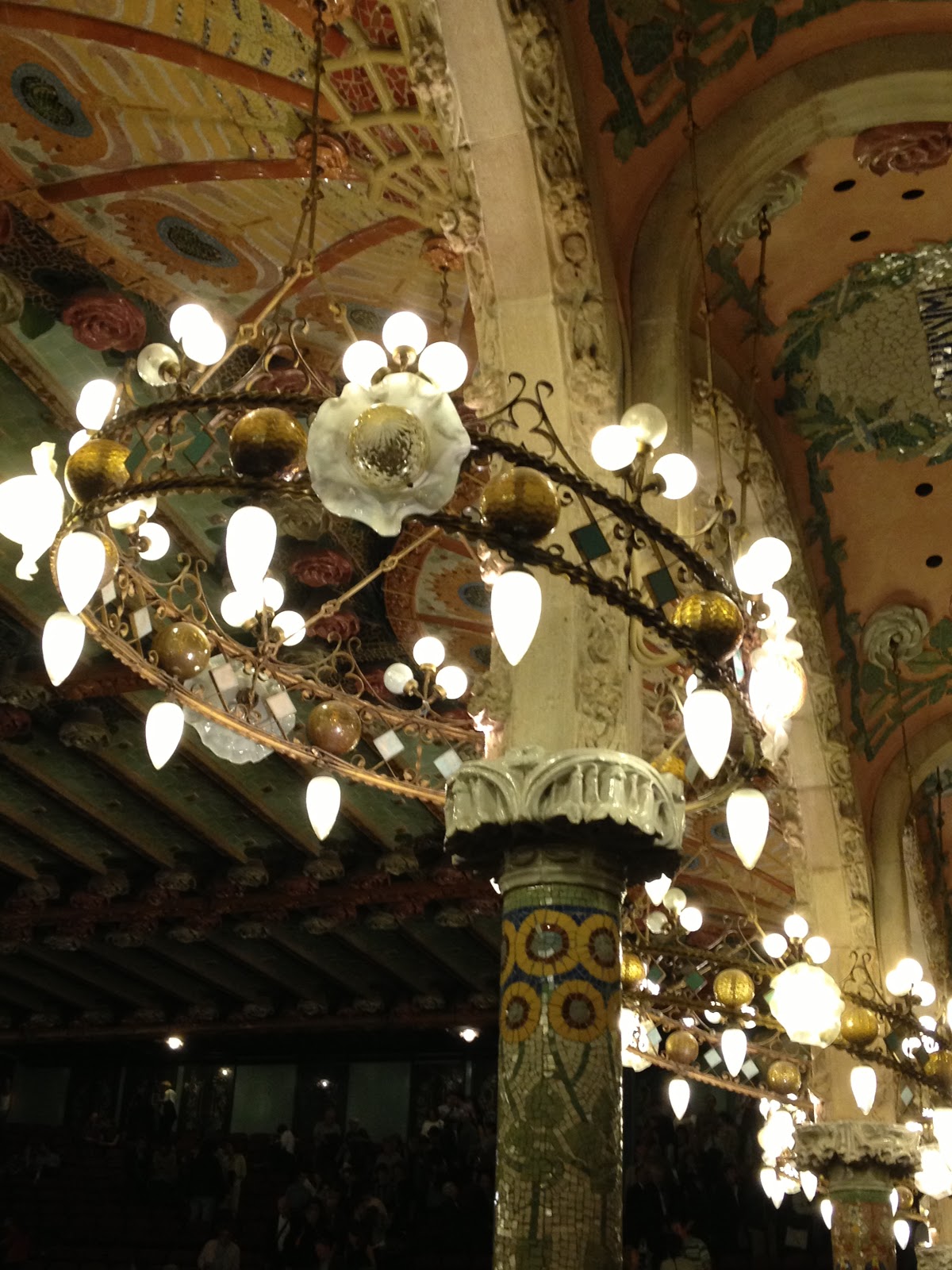
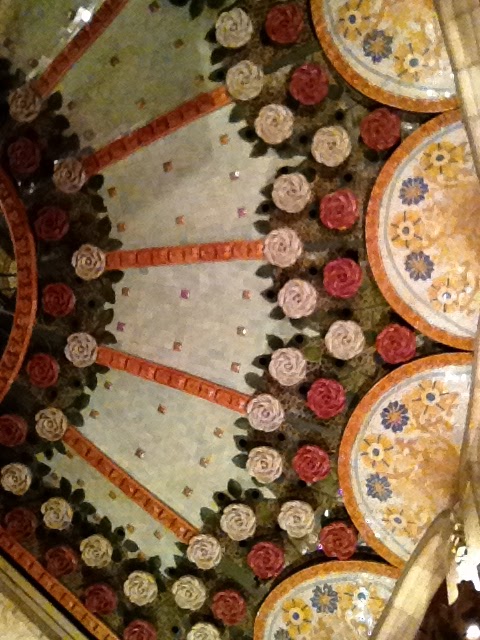
Palau de Musica anticipating the Vienna Philharmonic We are all familiar with old European theaters. They are formal. Velvet curtained. Gold leafed. With Royal boxes. This theater is not like that, at all. It is like no theater anywhere else on the planet. It is “irrational exuberance” in the form of architecture. Inside and out it is a fantasy of ceramic and wood and glass and stone, materials manipulated into shapes and forms that seduce the eye. Flowers and horses and murals and mosaic depictions of the muses whose upper torsos burst out of the wall as stone statues with instruments in their hands.
Lighting detail
Ceiling detail Who would build such a theater? And why so over the top expressive?
The Orfeó Català built it for themselves. A place to perform Catalan music, specifically, Catalan choral music. Orfeó Català was a choral society. Still in existence, they formed in 1891 as part of the Renaixença, the Catalan Renaissance which celebrated the end of a two-hundred year decline of Catalan culture caused by Phillip V when he outlawed all Catalan expression in 1714. In a burst of Catalan pride, the Orfeó Català decided to erect a shrine to their national music. They raised money and asked architect, Lluis Domènech i Montaner to build a concert hall.
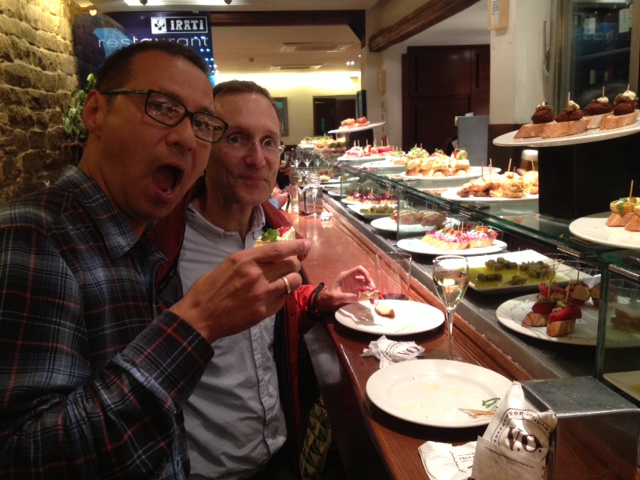
Tapas before the concert Barcelona in that decade was teeming talent. Antoni Gaudí was sculpting his wavy stone master-piece buildings. Picasso had his first solo show in the city. Joan Miró entered the Fine Arts Academy. And Pablo Casals was an international cello celebrity and a Catalan booster par excellence. The Palau architect selected from the pool of gifted local artisans. Master makers of ceramic tiles and art glass. And stone carvers, expert in the undulating style of stone masonry popular in 1900’s Barcelona. The end result is more than a pleasure to sit in. I know it is a lot of superlatives, but come see the Palau and you will understand.
Back to our concert experience. When listening to an orchestra, it is a particular thrill to feel as if you are in the center of it so that when they play full force you feel the force of the vibrations shake your skeleton. Our seats had that feel. We were in the three slender, high, curved rows that are on either side of the organ and are about a dozen feet above the orchestra.
The first half of the program was the second symphony of Johannes Brahms, 1833 to 1897. It was written for the Vienna Philharmonic. They premiered it in 1877. One could say the music of Brahms is in their blood, in their DNA. There were elderly gentlemen in the string section and it is not a stretch to imagine that their grandfathers played in the orchestra during Brahms’s lifetime. And maybe even on the same instruments. The Vienna Philharmonic owns all of the string instruments used in it’s performances. That is how it retains it’s string sound which is say is magnificent. So the first half of the concert was lovely. Did it knock our socks off? No. But let’s wait to hear the second half.
Moments later……After intermission they played the fourth symphony by Brahms and it was as if during intermission they practiced or they drank triple expressos. They evolved into super-orchestra. On the edges of their seats they passionately poured their hearts out. Like a school of fish. They turned on a dime. Played like a single organism improvising the symphony for us on the spot. I do not credit the conductor. They played as if eyes closed they knew exactly how to get to their destination. It all sounded inevitable. Like that is the way that symphony has to sound. And maybe they are right. It seemed so to us. We were more than satisfied. Sitting almost snuggled side by side in our tightly placed seats we were in sonic heaven. All was right with the world. Especially so in the second movement where the strings played pizzicato so gently it would soothe a baby in a cradle and the winds played in a delicate whisper of sound that caressed our ears and literally made us feel good all over.
Barcelonetta Beach, Sept 30, 2102 Wes made a great choice. It was a special night out for us.
Life is good. Very good.
Marlow and Wes
29 September 2012
Barcelona
Palau de la Musica Catalana
Vienna Philharmonic
30 September 2012, Saturday, Barceloneta
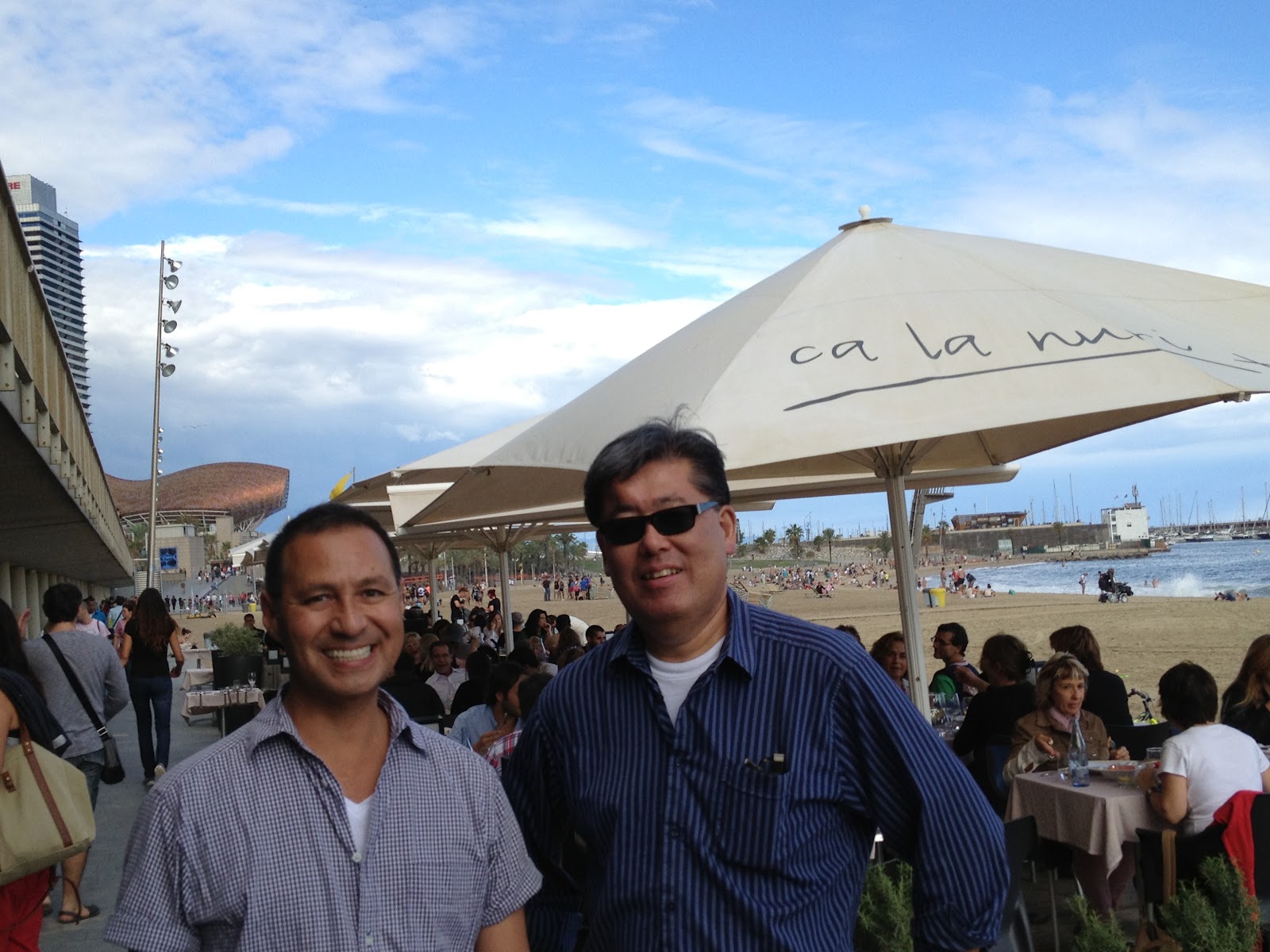
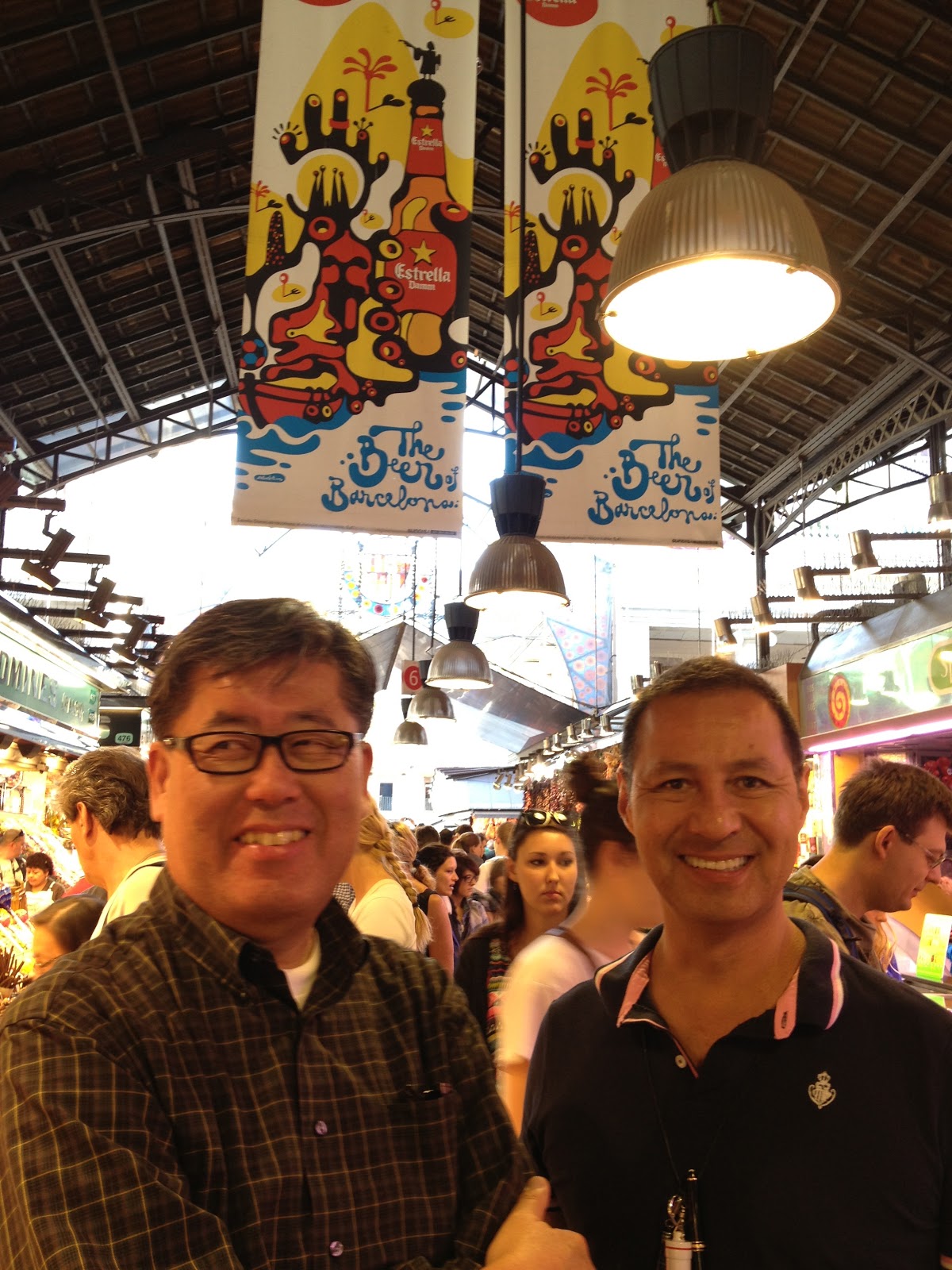
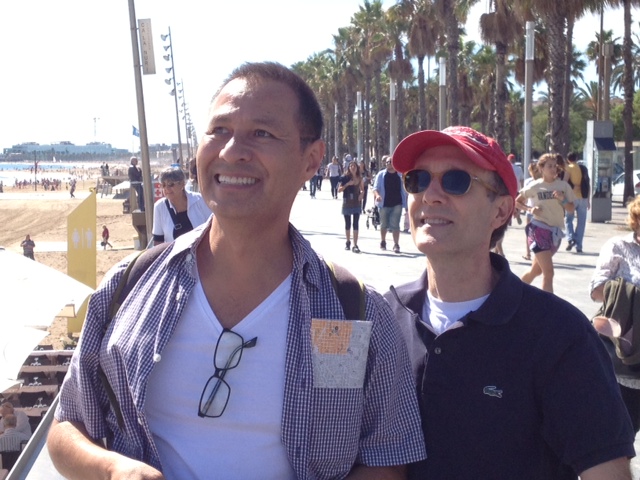
We are sitting on the sand at a table under an umbrella 70 feet from the blue water of the Mediterranean Sea at Barceloneta Beach. Roland is with us. He arrived last night from Los Angeles.
Since we are at the sea we chose to eat seafood. The tastiest mussels. Plump. Orange. Glistening with fresh sea water in the shells. Sardines. Catch of the day. Lightly grilled with coarse salt. Sweet and fleshy. The ever present Pimientos de Padron, sauteed and salted. Leeks. Slow braised till tender enough to cut with a fork. On a bed of Jamon Iberico and sprinkled with fresh roasted hazelnuts.
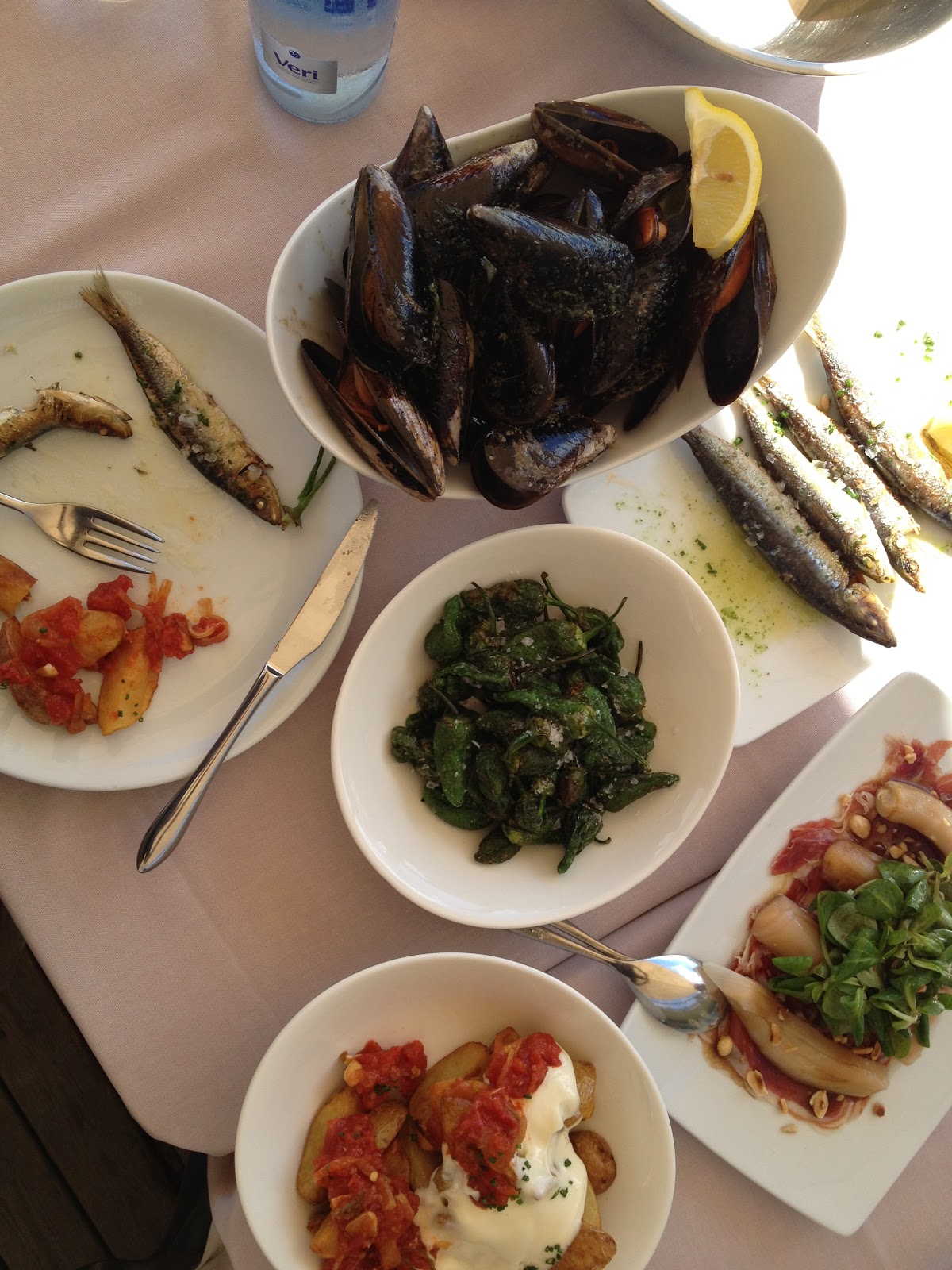
We washed it down with Cava, Catalunya’s version of Champagne. A blend of three Spanish grapes: 1)Xarel-lo, for flavor and strength; 2)Macabeo, adds acidity and freshness; and 3)Parellada, adds aroma and creamy softness. More than you need to know about Cava, but here’s more. Until 1986 when Spain entered the European Union, cava in Catalunya was called Xampàn. The French made them change it. Cava refers to the caves the wine is stored in. And 95% of Spains Cava comes from Catalunya. (Pardon my long-windedness).
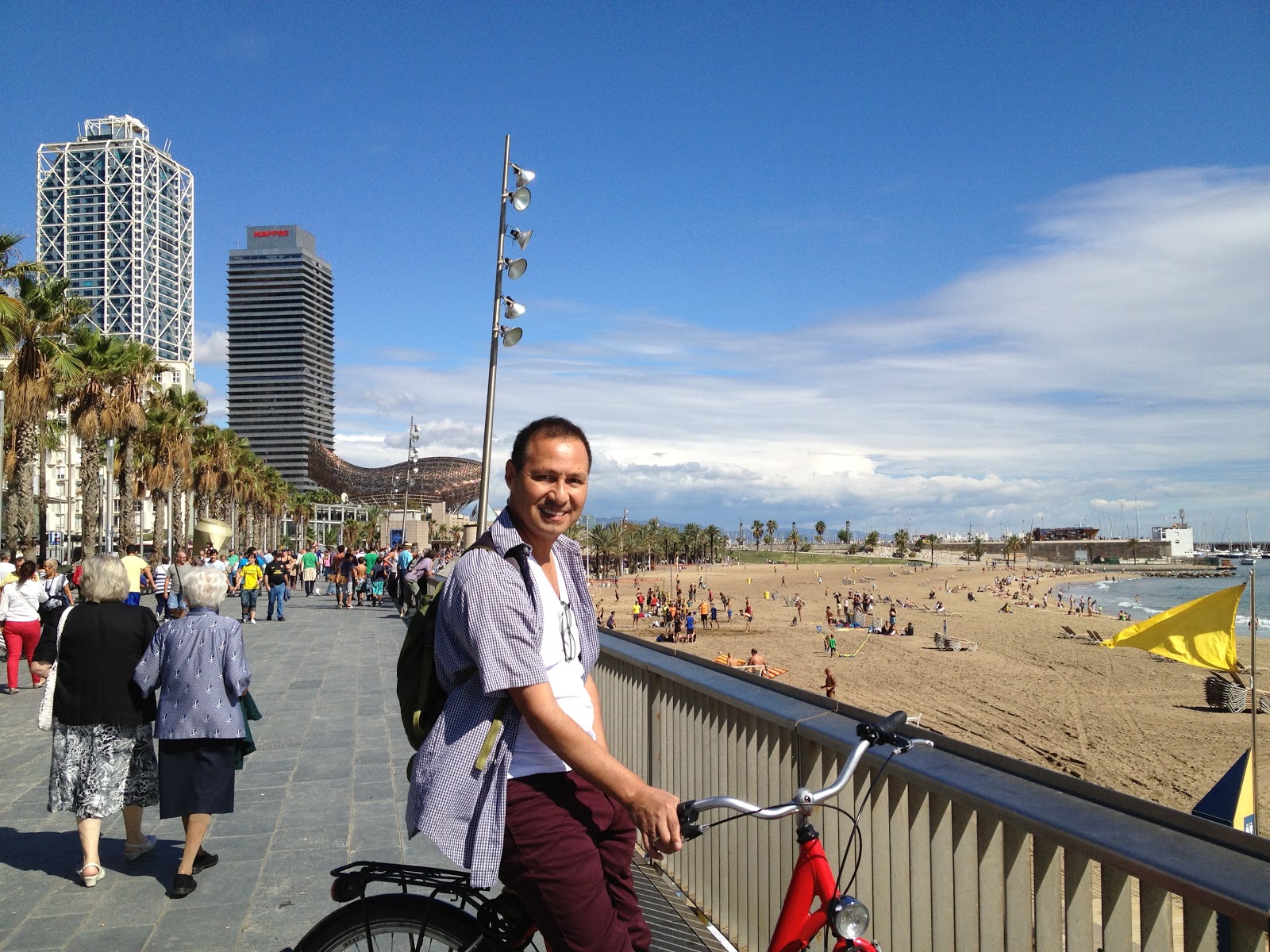
We pedaled here. It is a perfect day for cycling. After two days of rain the sky is intensely blue. The light is clear and sparkling. The temperature, about 70-something. The waves splashing so close by are tempting. But last week we spent two days on the beach. On the sand. In chaises. Dipping in the water for refreshment.
Our restaurant today is “Ca la Nuri”. In Catalan: House of Nuri. It is a few feet away from the large copper sculpture by Frank Gehry that people call “the fish”. But really to me, up close, looks like a conquistador’s helmet. At this moment my table mates have abandoned me for the bicycles.
Signing off from Barceloneta. Marlow. 3:00 p.m. 30 September 2012. Saturday.
24 Sept 2012 M&W in Barcelona, Part 2
It is Monday, September 24, 2012 and we have completed our first week of residence in Barcelona. We are settled in. We do our laundry. We take the buses. We shop for groceries–vegetables, meats, cheeses, vinos, artisanal gelato, organic expresso, eggs from “liberated” chickens (i.e. free range.) And for the past four days we have been surrounded by the intense revelry of the locals during the city wide Mercé Festival.During the past 2000 years Barcelona has had two patron saints. For the first 1700 years it was Eulàlia. Then Mercé came along and took the job from Eulàlia. It is said that the raindrops that fall on the Mercé Festival are the tears of Santa Eulàlia still sad at having been replaced.
The Mercé Festival was a religious festival. Nowadays, it is non-religious and more or less a gift from the city to the people. For four days, from 10 a.m. until past midnight, in the Ciutadella Park, in the public plazas, at Gaudi’s Sagrada Familia Cathedral, on the major thorough-fares there are hundreds of events. Concerts of folk music, rap, salsa, rock and roll. Light shows. Moving pictures projected on the facade of Gaudi’s Sagrada Familia Cathedral. Contests to see who can make the tallest human tower. They call them castells. The tallest are ten tiers with four people on each tier. The castell is complete when the small–lightweight–young child climbs atop everyone and raises his or her arm. The crowd goes wild and the humans slide down the tier level by level. There is a parade of larger then life fire breathing dragons that menace the crowd–safely, of course. And another parade of giant people which are statues twelveifeet tall. People climb into them and walk waving the arms and moving the heads. There are tap dancers moving to Glenn Miller played by a large live symphonic wind band. And kooky mini-theaters built inside mobile trailers. They seat about a dozen people and put on puppet shows and artsy films. There is the ground-level movie screen with a camera in the center which captures the passers-by on the screen then somehow moves their heads onto different bodies. Fireworks, of course, there are tremendous fireworks displays and for the price of your empty glass all the champagne you can drink. You just return over and over to the champagne tent for refills. Actually, it is not champagne, it is cava, sparkling spanish wine made in Catalonia. All of that and more was swirling about us for four days. It was surreal. At times, it was sensory overload, but it was a great display of the locals coming out en masse to “forget your troubles, come on get happy” all paid for by the city.
Concurrent with that, I, as usual, have been soaking up the local history, the most recent 800 years which is the age of our particular neighborhood which is called, El Born. Born is from the verb, bornar: “to celebrate tournaments, which included jousts, popular feasts, processions, and other public events”. It is said that Don Quixote jousted here. The star character of the Cervantes novel got into lots of trouble on the streets where we live. He may have been a work of fiction, but Cervantes describes well the ambiance of the neighborhood in 1500.
Wes stayed in this apartment two years ago. He loved the neighborhood so much that he is back and this time I am with him. The Born ambiance is a bit like The Village in Manhattan. It is compact. There are a lot of casual coffee houses and eateries. And overall there is a creative aspect in the air. Our 19th-Century building has an elegant facade. Rows and rows of tall stone arches running for blocks. It is visually attractive.
Our particular apartment, from where I am writing, is on the third of five floors. I am looking through nine-foot tall glass doors, through the elegant wrought iron railing on the terrace and through autumnal chestnut trees onto the Ciutadella Park and to the blue sky beyond. The iPod is playing spanish piano music. The pianist is Barcelona’s native born treasure, Alicia de Larrocha. She may have been only five-feet tall, but she played like a goddess.
Now for some description of the El Born neighborhood. I may ramble. I may digress. There may be sidebars. I am known for: why use one word when you can use ten. So settle in. Grab a pillow. Fall asleep if you like. My feelings won’t be hurt. Instead, I will be pleased to provide you with a good nap. Okay, let’ go…….
El Born is anchored by four major elements. They are situated in one trajectory that is maybe 1 mile and a half. The four elements are the Ciutadella (Citadel) Park. The Born Market. The Passeig del Born. And the Santa Maria del Mar Church.
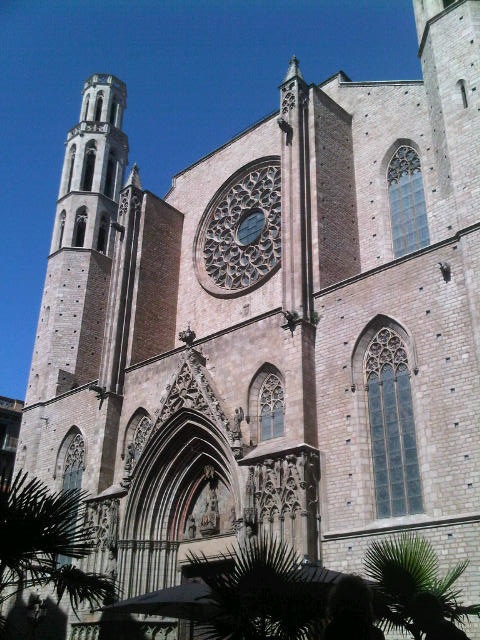
The oldest of the four is the Santa Maria del Mar Church. It was built by Alfons the Good, King of Aragon to celebrate the conquest of Sardinia. It’s first stone was laid on March 25, 1329 and it’s last stone on November 3, 1383. The site had been a place of reverence since the year 100 when, on it, a Roman Necropolis was built to house the bones of Santa Eulàlia, the patron saint of Barcelona. (Remember her?) The Santa Maria del Mar church is a wonderful gothic structure. Inside, it is tall and has long lines, spacious and airy. Up until 1930 it had fascinating art and furnishings. But the during the Spanish Civil War, Generalissimo Franco sent people in to burn what had survived for 600 years.
The church has been the focal point of the neighborhood now for 630 years. Back in the old days this was the neighborhood of artisans and craftspeople. People who built things. We visited the church yesterday to note a few things. There are two plaques near the entrance. They were carved and installed when the church opened to say so and so built this for such and such a reason. Interestingly, one plaque is in Castilian (Spanish) and the other, in Catalan. The city was bilingual. The other thing we looked for was something on the front door. When something expensive is built, the biggest contributors are acknowledged, but if your contribution is not money, but let’s say labor, let’s say, stone masonry, the way they were acknowledged for their volunteered labor was to cast small brass plaques in the shape of a mason with a stone on his back. There are two such plaques installed on the upper part of the grand front doors to the church. It is very sweet to see 630 years later.Let us move onto the second element of the neighborhood. Many of the streets are not wide enough for a car to pass, but the pedestrian street that emanates from the church widens considerably and is called Passeig del Born. Passeig is Catalan for “avenue” and Born, remember, is from the verb, bornar: to celebrate tournaments, jousts, etc. Specifically, this little quarter-mile stretch of widened street was where the jousts were held. Horses. Armor. Guys with long pointy tipped polls trying to poke their opponents. Makes me want to read about it in Don Quixote!
So this street, Passeig del Born, which begins at the church, ends at a structure called, the Born Market, the third element in the neighborhood.
The Born Market was built in 1878 and offered fruits and vegetables to the neighborhood until it closed in 1977. It may have been in a state of major disrepair, but the building had great bones. It was worth saving. Here are some words from a website about the structure: “A building of extraordinary lightness and transparency due to the slender metal columns and the light that filters through the slatted shutters around the side…the roof is laid with red and green tiles in a mosaic pattern…a cupola and crow’s nest crowns the pinnacle….it’s spacious interior has earned it the name of Cathedral of Iron and Glass.” The city government decided to save the building, to repurpose it into a library. So in 2002 they began they restoration. During the excavation they found something remarkable.
Let’s turn back the hands of time to the year 1700. Carlos II, the King of Aragon and ruler of Barcelona died. He died without an heir. Their was an opportunity for someone to become king. The royal families in France and Austria had many willing, chomping at the bit, candidates. The French King Louis XIV sent his grandson, Phillip of Anjou. The Austrian Hapsburg Emperor, Leopold I, sent his son, Archduke Charles. There was trouble–known as The War of Succession. For a dozen years the two skirmished. A political wrestling match with guns and blood and vendettas. Eventually, Austrian Archduke Charles quit to take a job as Holy Roman Emperor. On September 11, 1714, Phillip became King Felipe V of Aragon , ruler of Barcelona, and had a lot of scores to settle with the local population who had not sided with him which was most of the El Born neighborhood. From 1717 to 1719 he set about razing the El Born neighborhood. By razing I mean bulldozing, flattening, leveling, destroying. It was typical at that time that if you won a battle you destroyed your opponents castle or in this instance all of their homes. And not just their homes. King Felipe V banned the Catalan language, dissolved the local government, closed the university and executed his opponents.
So, back to the Born Market. In 2002, during excavations, they discovered directly beneath the market, the ruins of fifty structures and the paved roads that ran between them. The structures were medieval homes, stores and artisan workshops. And there were household items and artisan tools. A wealth of evidence of life before 1717. The building will begin it’s new life as a center for Catalan culture. You will be able to descend a stairwell into the old city ruins. This will all come to pass on September 11, 2014, the 300th anniversary of Felipe V coming to power. This market is adjacent to our apartment.

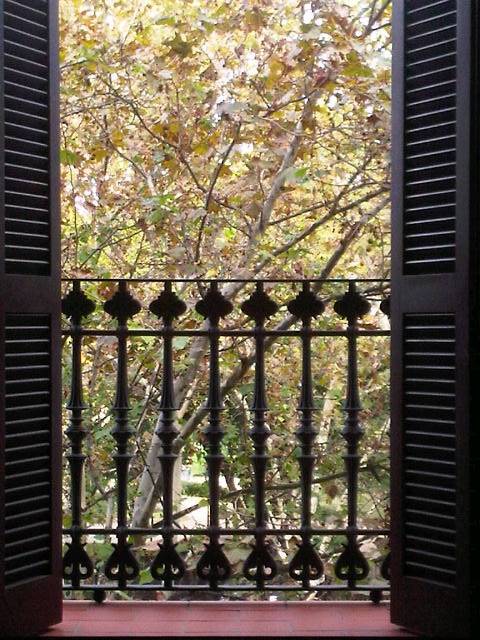
And now for the fourth element of the neighborhood, the Ciutadella Park. Ciutadella means Citadel as in military fortress. Felipe V built a monumental fortress from which to rule over what he called the savage population of Barcelona. The fortress no longer exists. In it’s place is a large public park. The park where much of the Mercé Festival occurred. It is an are beloved by the locals. And it is all built above the ruins of their ancestors homes. And that is what our lovely apartment balcony looks upon.
Marlow and Wes
24 September 2012
Barcelona
Sent via BlackBerry from T-Mobile

 Wes & Marlow Travel Blog