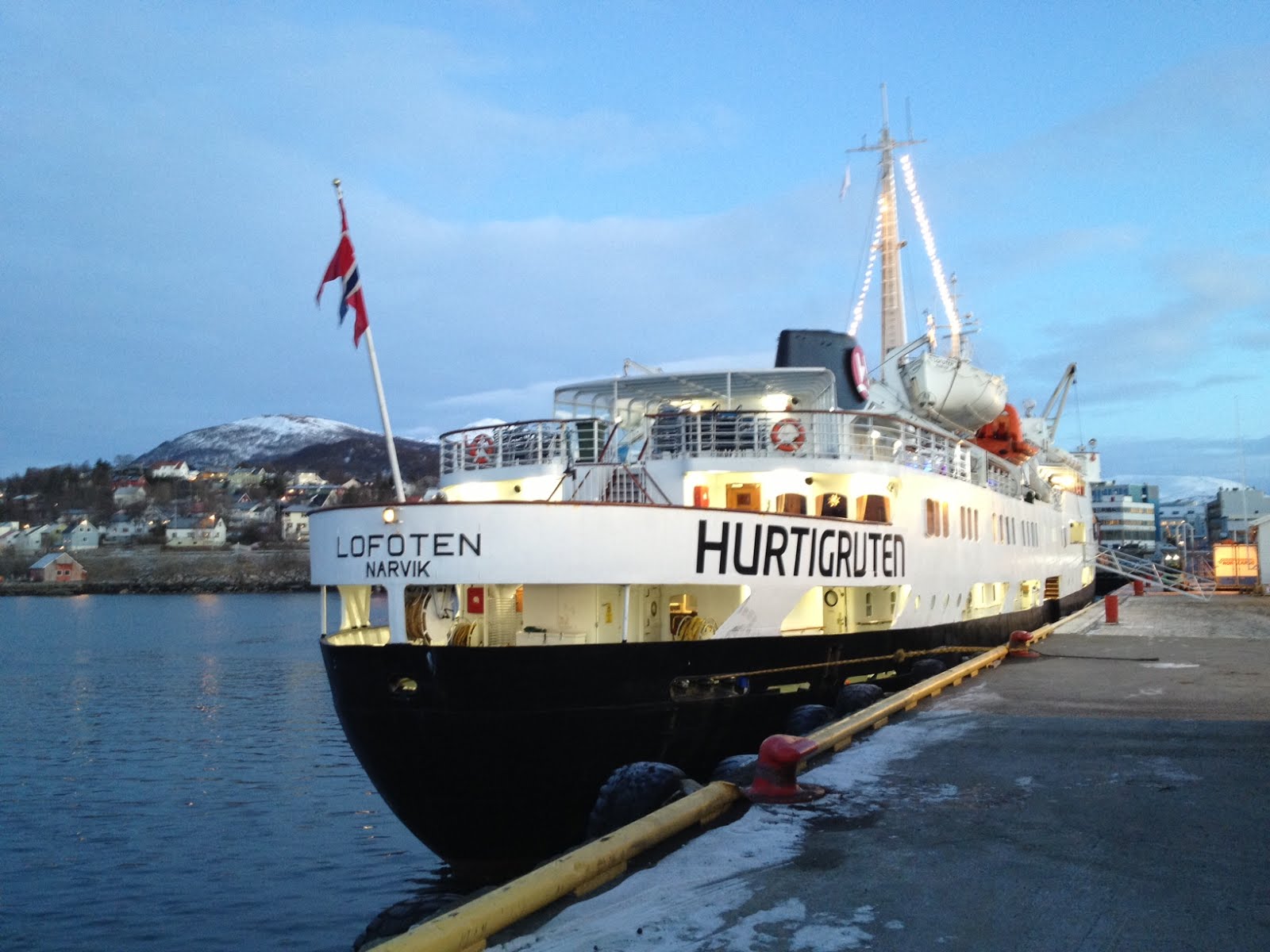
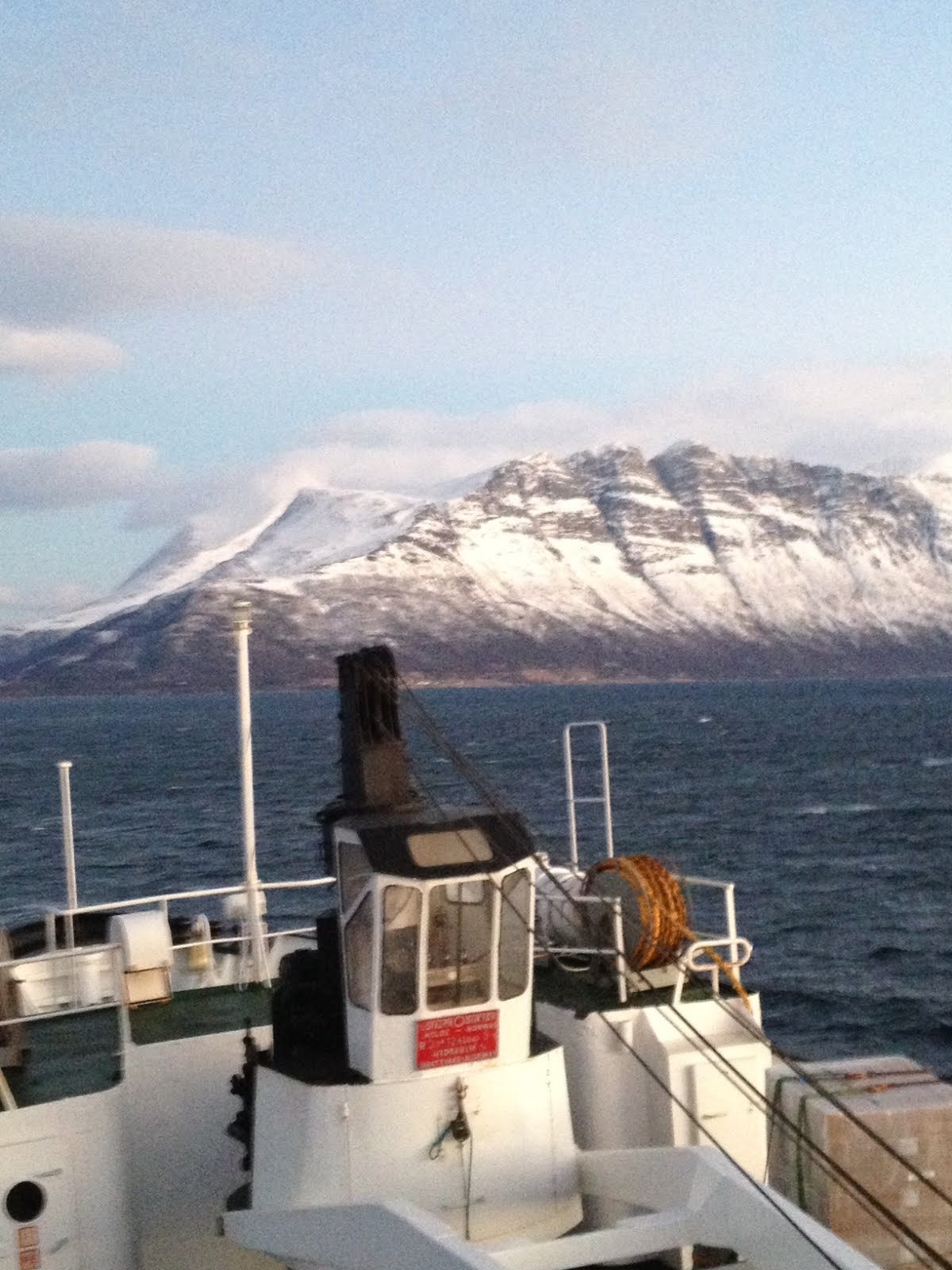
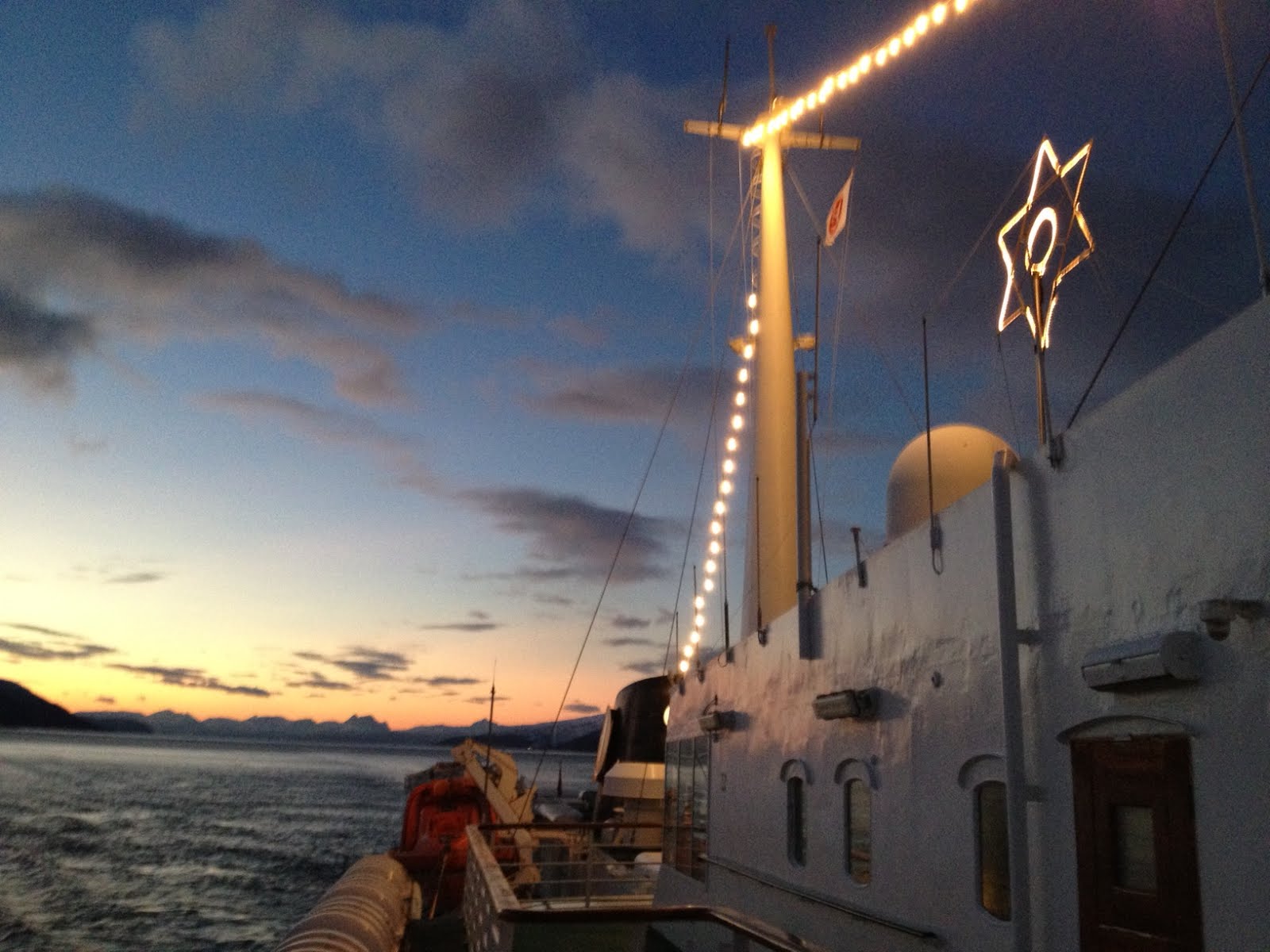
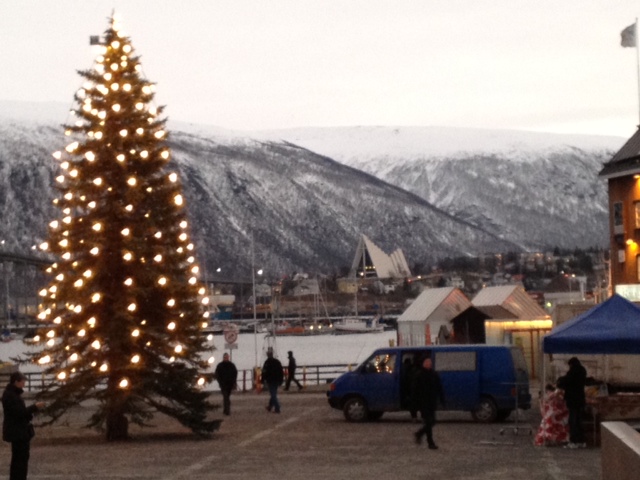
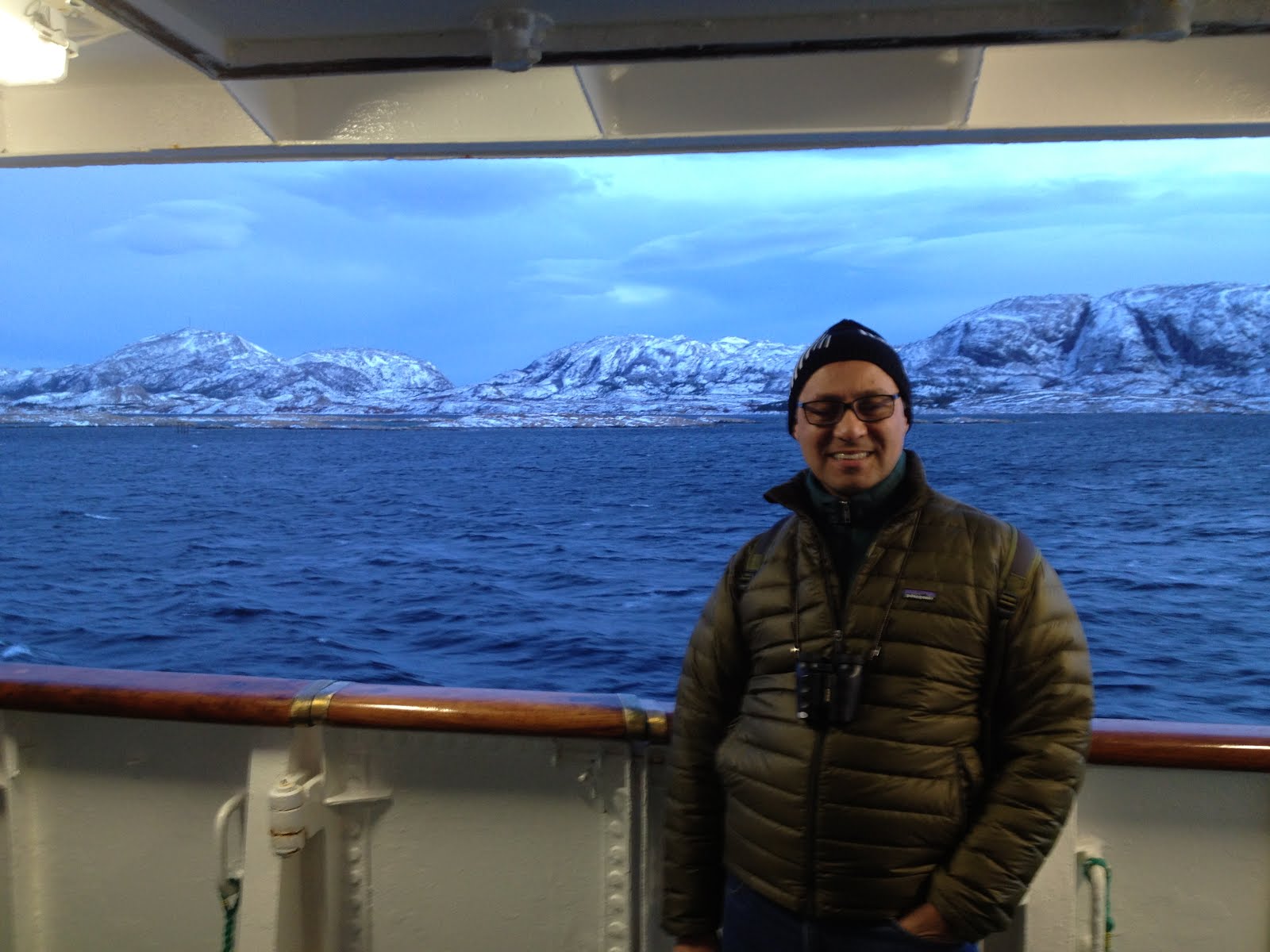
We’re now in Tromso, capital of the Arctic. It is daylight starting at 10 and setting at 2. These are photos from our trip today.
We’re now in Tromso, capital of the Arctic. It is daylight starting at 10 and setting at 2. These are photos from our trip today.
14 December 2012
Bergen, Norway
It is December and we are in Bergen, Norway.
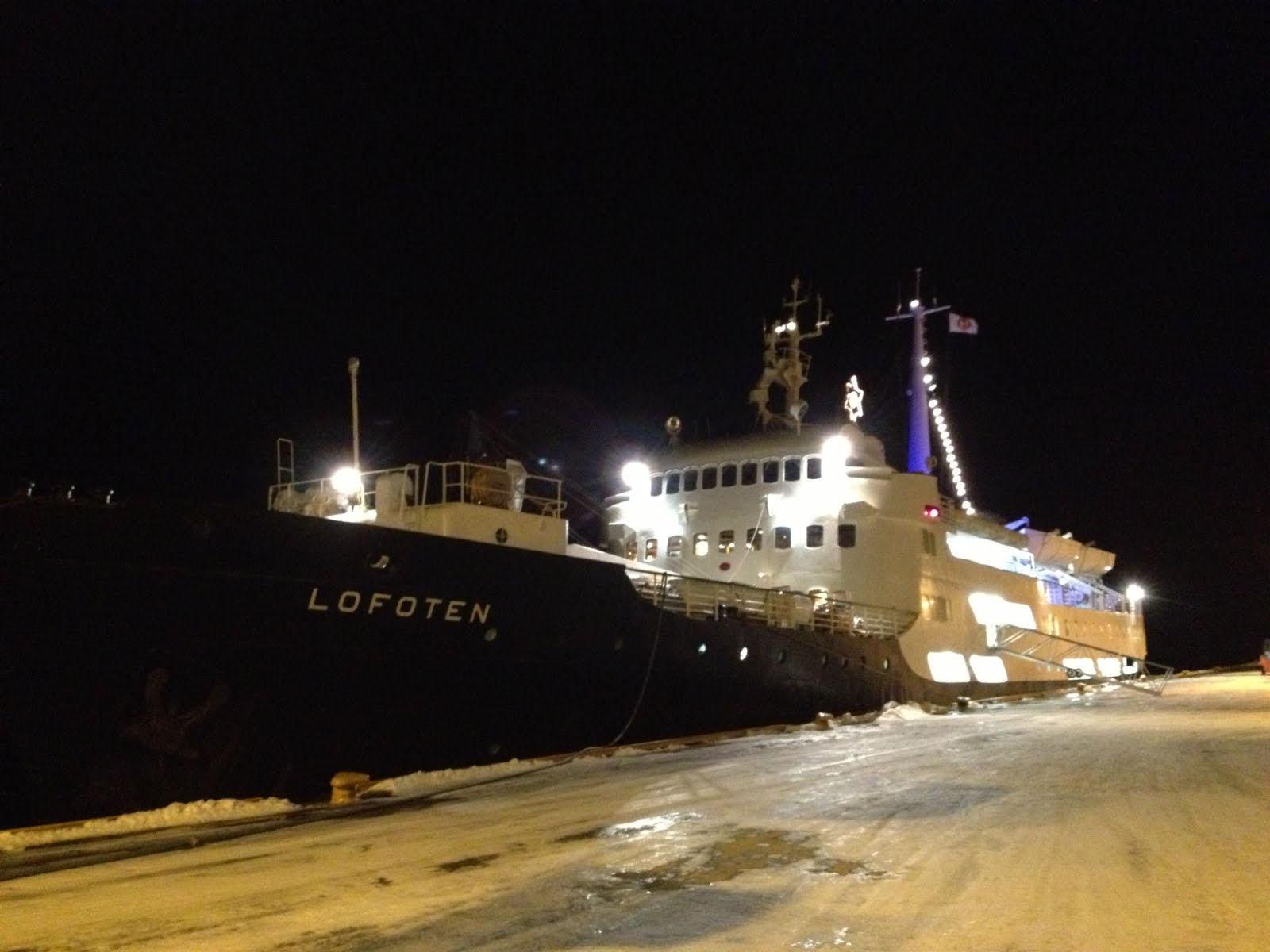
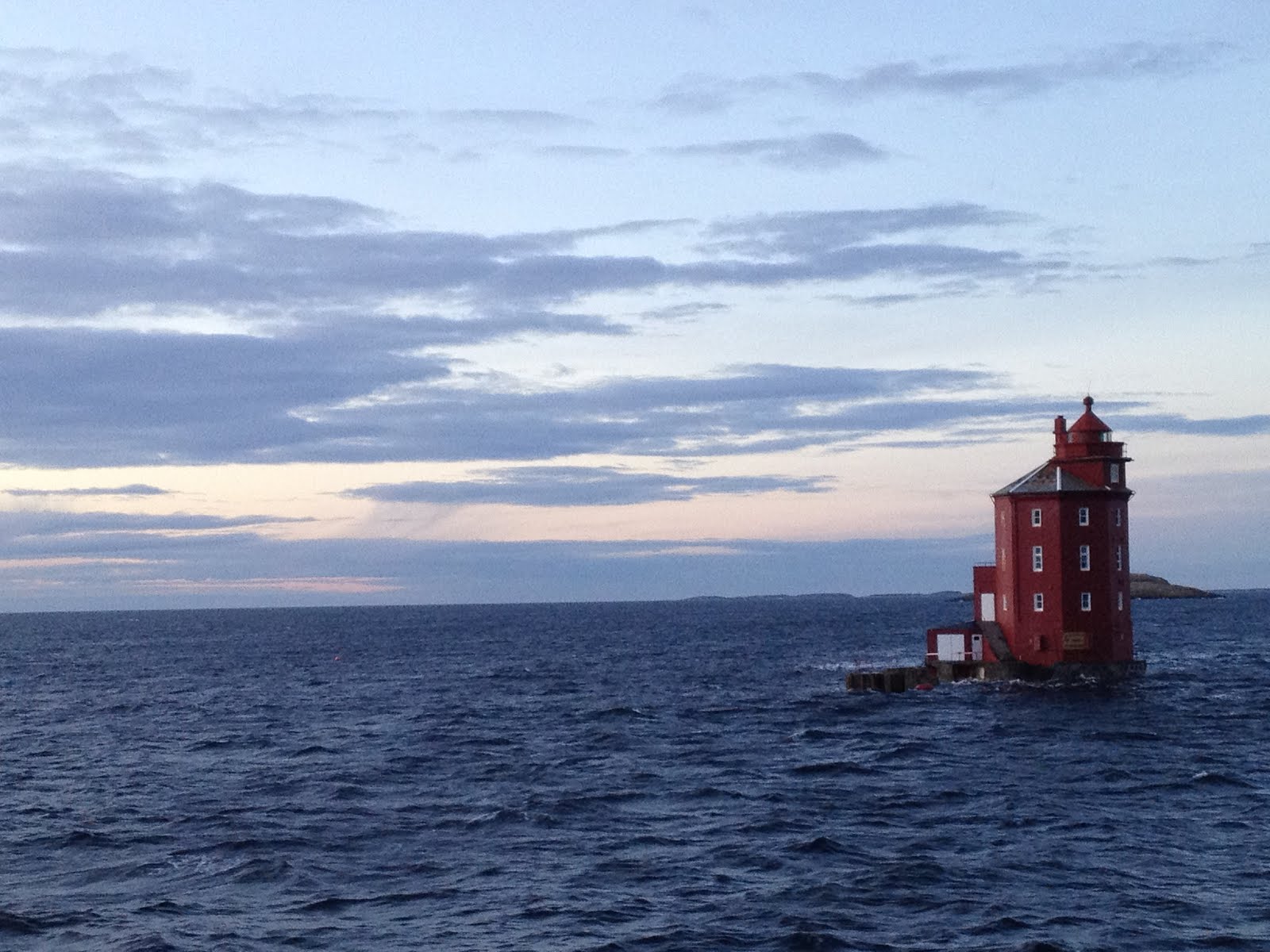
Norway has a long coastline. It is irregular and broken into hundreds, maybe thousands of islands and fjords. In two days we will travel by ship, the Lofoten, up the coast, but first we will spend a few days in Bergen in the southwest of Norway.
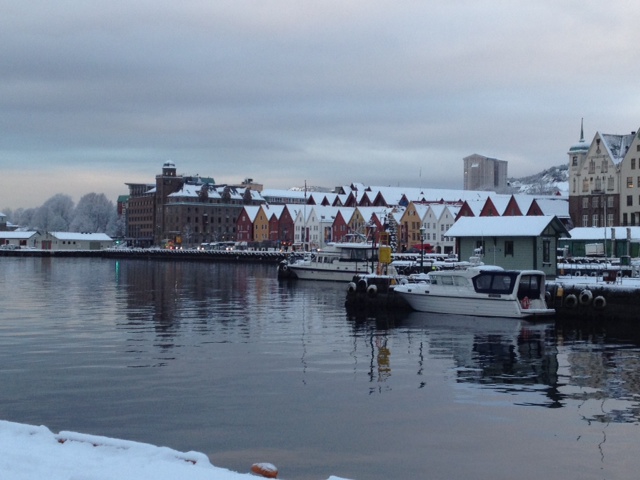
Bergen is about one-thousand years old. What remains from it’s earliest days is a row of Thirteenth-Century buildings on the harbor’s edge. The row consists of a dozen-plus wooden structures. Each one is three stories tall with a pointy roof. Some, in their old age, lean against each other otherwise they are stand about a bed-width away from each other. They are painted each a different shade of butter, terracotta, moss or rust. Together, they make a quaint, folksy postcard image which is used as the symbol of Bergen.
They were built for use as headquarters for German sea-faring merchants, known as the Hanseatics. The buildings were multi-purpose. Their lower floor’s long and large rooms were used for cod. The fish was piled high. Their livers were pressed for oil and the fish themselves, salted, hung to dry and eventually shipped throughout Europe. The smaller rooms housed the inventory and payroll offices. And along the walls were rectangular cabinets–six-feet long, three-feet tall and three-feet deep–each with a little door to open and climb in for a sleep.
UNESCO has designated this cluster of buildings a World Heritage Site. And the first building in the row is our small hotel which shares the building with the Hanseatic Museum where you can see a three-story portion of the building as it used to be. All old dark worn wood planks. Hardly a right-angle anywhere, the walls lean like a house of cards. There is original wall paper–faded and barely intact–and hand blown glass windows. The walls without paper are painted with various designs to bring cheer to the dark interiors.
The Museum occupies the front of our hotel with our hotel in the rear. Our hotel shares some of the old features, but has been upgraded with carpets and wall papers and upholstery that are warm and attractive to the eye. The bathroom floors are heated. The free-standing bathtub is perfect for our cold snowy nights. Breakfast is excellent buffet with all pickled herrings I love. Overall it was a great choice.
Two foods in Norway are unusual: reindeer and whale. When in Bergen one ought to try them. Afterall, where else can you try them? For me, once is enough. I had them when we were here three years ago. I had them again this time. They are more interesting than they are delicious and I can move on to herring which I love.
We went to hear the Bergen Philharmonic Orchestra. Afterward, we hung out with orchestra members. Above their stage, the players operate their own canteen. They have a little bar. They take turns staffing it and sell stuff at cost. Everyone we met was welcoming and interesting.
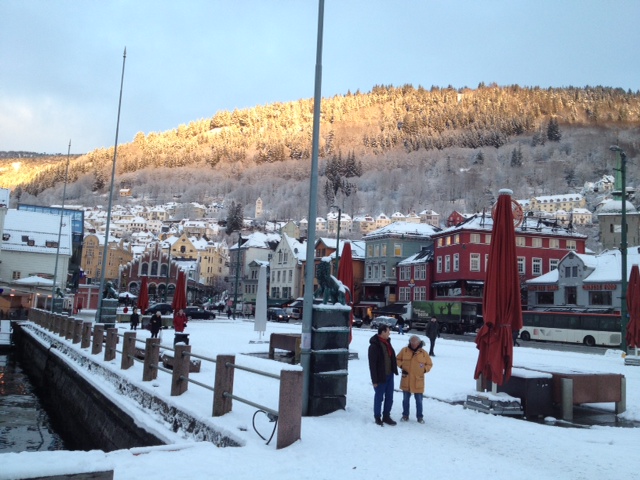
The climate here is cold. Everything is snowy. The narrow lanes we walk are cushioned with snow in a good way. The city sidewalks are slick with ice in a perilous way. It is chilly, chilly, chilly. And I love it. It suits me. If I am feeling lazy and sedentary, I can go outside and the inertia disappears instantly. I become vividly alert and happy.
On Friday we will board the ship, the Lofoten. It will be my first time overnight at sea. I admit I have butterflies. I do not know how I will respond, but I can’t wait to find out!
Marlow and Wes
Bergen, Norway
Thursday, 14 December 2012
Sent via BlackBerry from T-Mobile

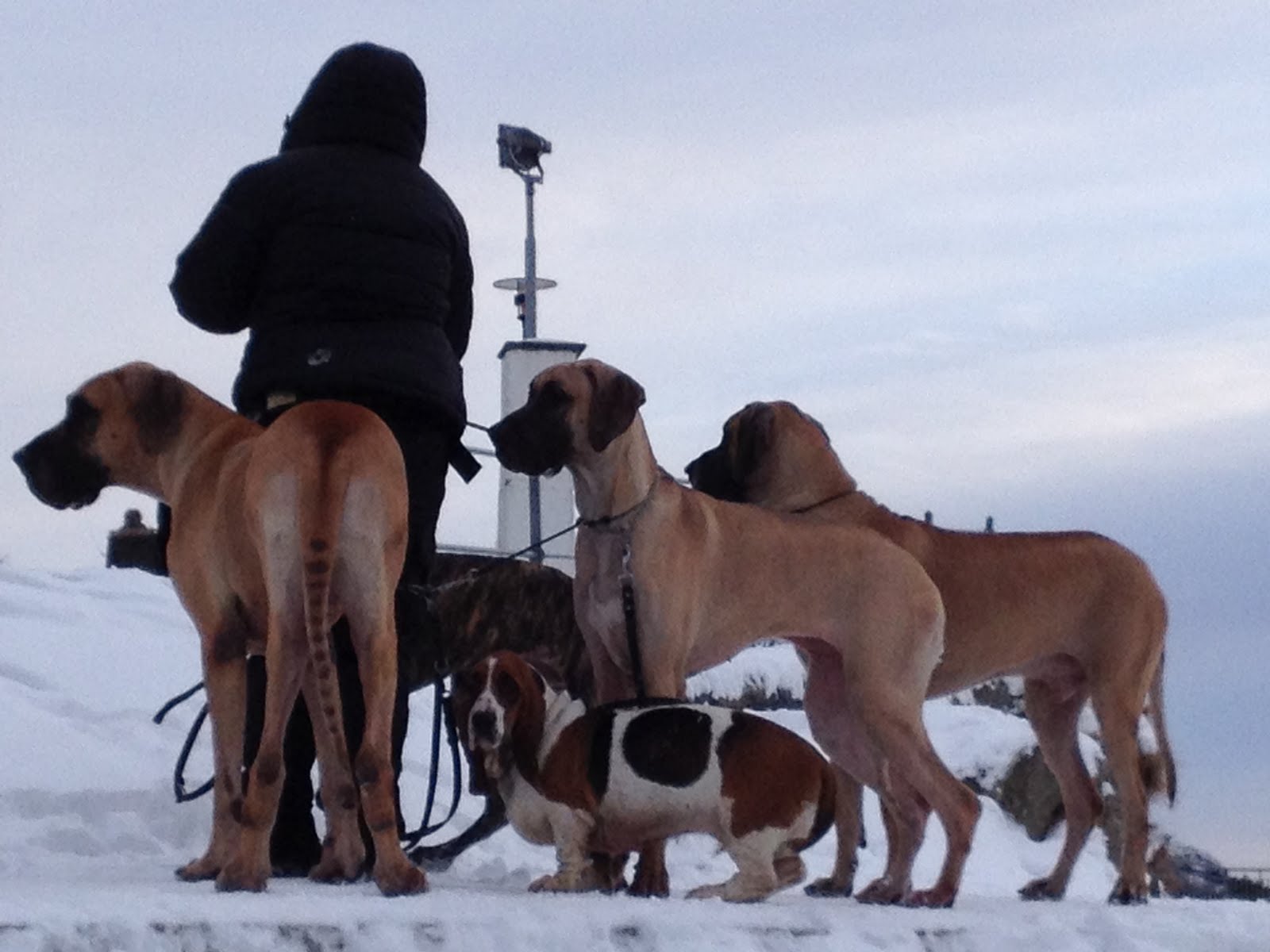
We met a group of hikers on our walk today …
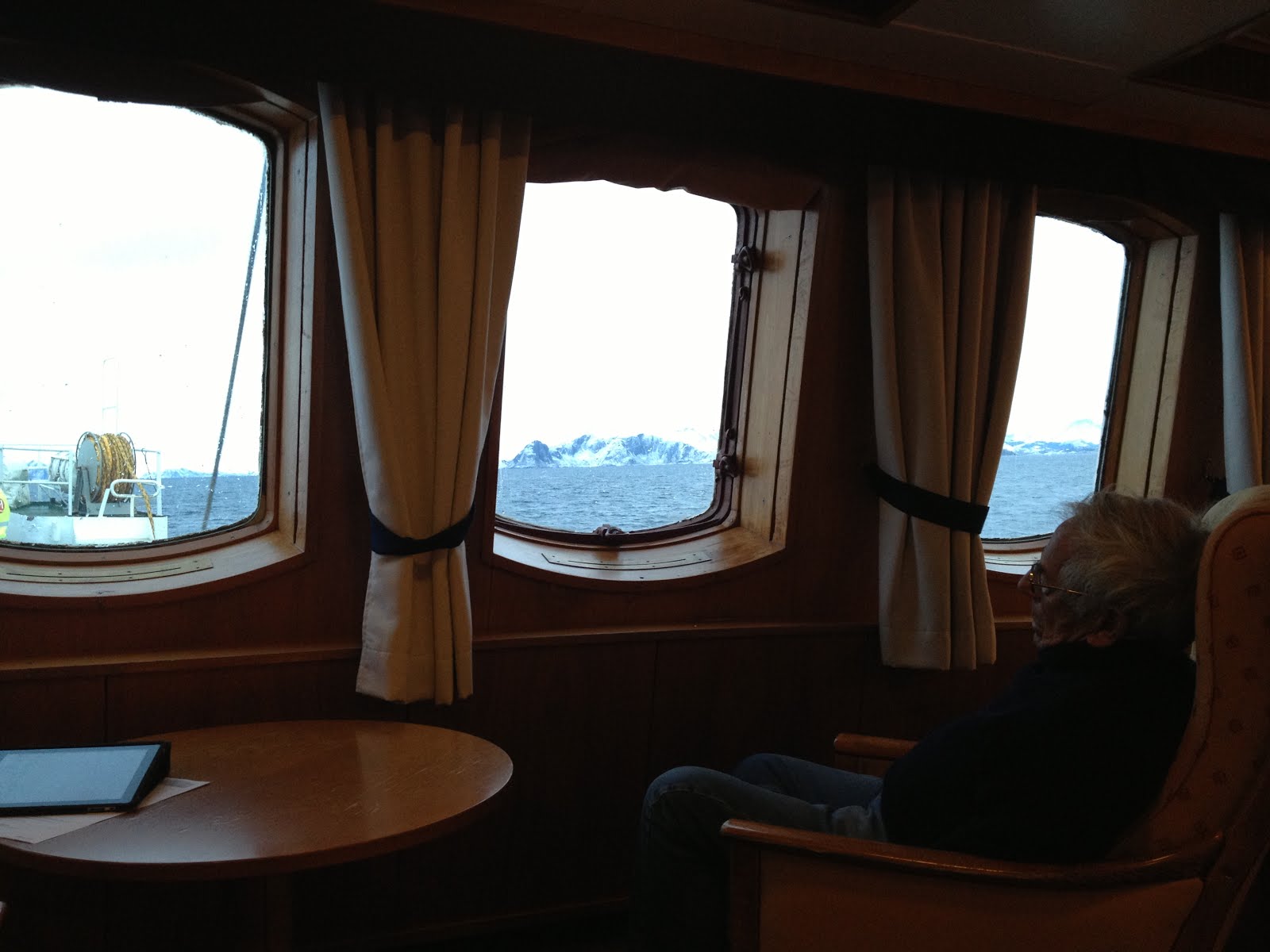
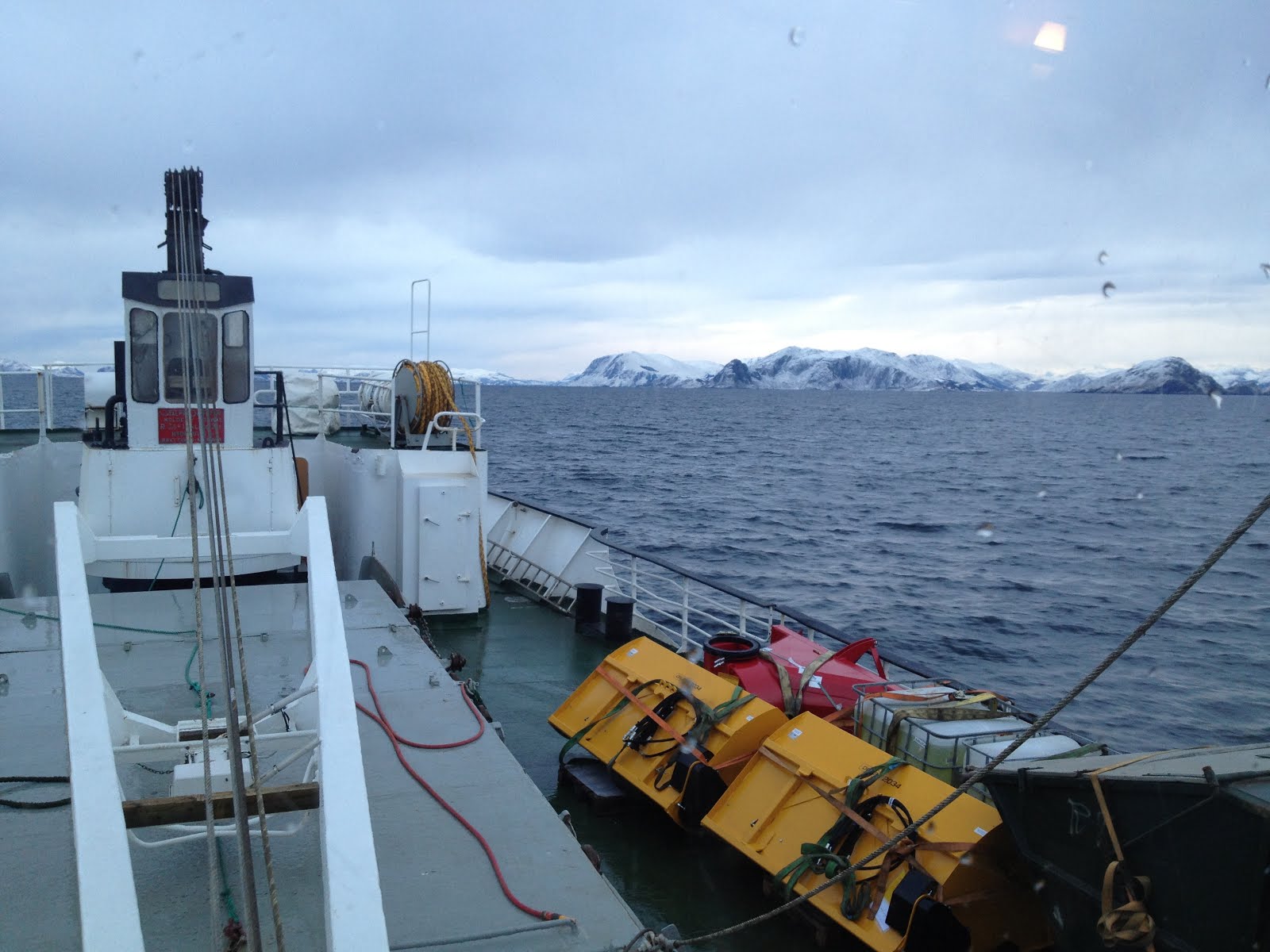
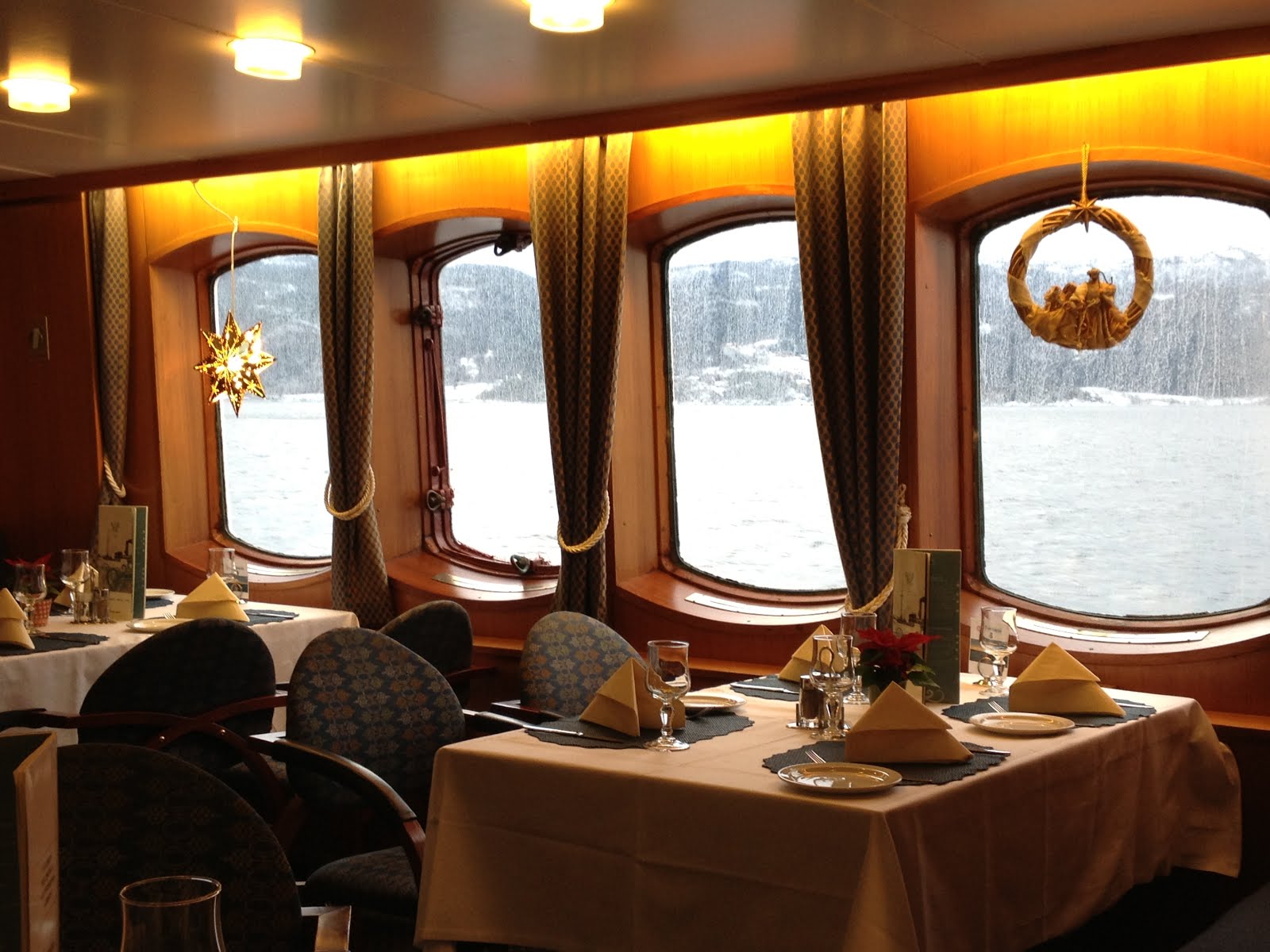
We are spending four days aboard this working ship as it heads north on the Norwegian Sea towards tromso.
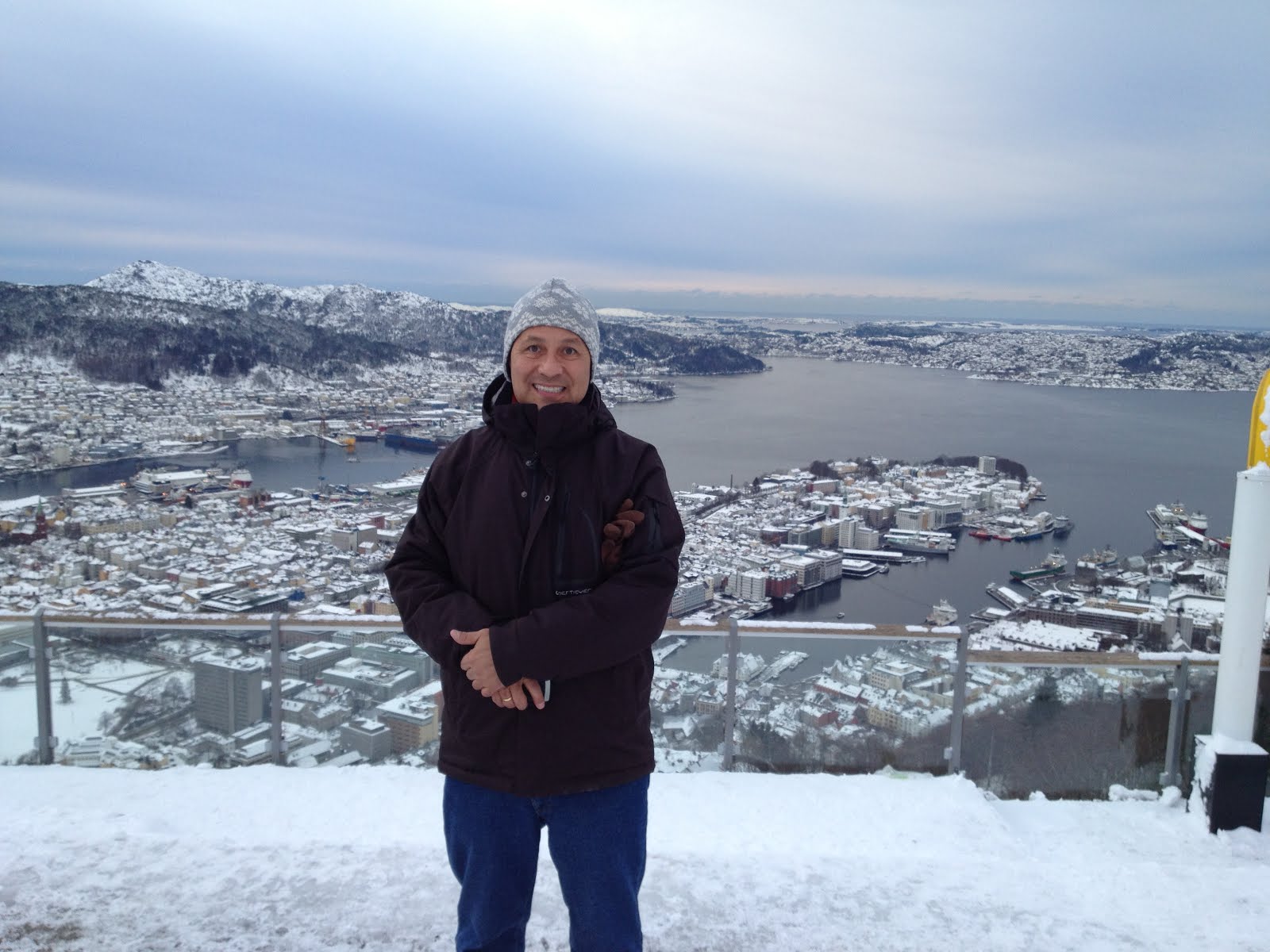
A funicular took us to the top of a hill overlooking Bergen.
Marlow and I arrived in Bergen on Wednesday, Dec. 12 around one in the afternoon. And to our surprise (and great delight) there was not only daylight but blue sky above us! For some reason we were not expecting to have much daylight during this two week visit to the Norwegian coast. The sun set about 4PM so it is not a long period of daylight, but as you can see, we are in for a treat! We hear that as we approach the Arctic Circle the daylight period will shorten. And we will be in Tromso for the shortest day of the year! But I think we will have daylight sufficient to take photos as we head north. We were also greeted in Bergen by Kathy and Sam Adams. They are experienced Arctic travellers so we are fortunate to be traveling with them on this trip!
27-28 October 2012LeipzigThe “Motete” at Thomas Kirche was not a concert. It was eighty per cent music, but it was a Lutheran service. And the Thomas Kirche choir was outstanding as one would expect of a group that just turned seven-hundred years old. Their pitch was exact. Their articulation of all those German consonants was clear as a bell. And their sound, in that famous church of Bach’s, made me think of a pipe organ, a human pipe organ with lungs instead of bellows. We loved it. Our fellow congregants must have liked it, too. But they are Lutherans and applause was strictly forbidden–it explicitly said so in the program. They did not smile and they did not make eye contact. In my view, what Martin Luther advocated is austere and unexpressive unless you are expressing disapproval. His ideas were illegal in Leipzig up until the year fifteen-thirty. After that he became powerful and his practices spread like wild fire.
We arrived into Leipzig’s huge train station–twenty-six platforms. It may be huge, but it is very well laid out and easy to maneuver. From there we walked four blocks to our hotel. The climate was freezing, literally. But walking was still very nice. Leipzig was once a small walled city, like Lucca in Italy, and Dubrovnik in Croatia. In our modern jet-set era it has a fin-de-siecle, an old world charm which is rare and a pleasure to stroll through even when you are pulling roll-aboards from the train station.
And what a reward was in store for us when we reached the hotel. The Steigenberger Grand Hotel is a state-of-the-art luxury inn. One year old. A baby. Hardly been slept in. It looks and feels like “the” place to be and in Leipzig, it is. We especially loved the spa. We dragged our world-weary, achy, travel-abused limbs down there and–after sauna and steam and foot soaks and warm-scented tropical showers and bathrobes and chaises and softly wafting spa music–floated out hours later relaxed and renewed.
In addition to the Thomas Kirche we dwelt a bit in the world of the Nicolai Kirche. It, too, is Lutheran. It, too, featured Bach and his new cantatas every other week. But since nineteen-eighty-nine it has a distinct honor related to the fall of the communist government in East Germany.
The church began a weekly, what they called, “prayer for peace” during which they prayed for fairness, democracy and peace. Their communist government tried to stop them by force and violence then by infiltration. Once the police were in the church and heard the “prayers” they softened and it changed the relationship between the oppressors and the oppressed. It is considered that the movement to bring down the Berlin Wall and communist rule and to re-unite East and West Germany got it’s start with the Nicolai Kirche’s “prayer for peace.”
Leipzig in the Snow Today is a special day. It is snowing. Scarves, gloves, hats. People carrying pine boughs. Is it Christmas behavior? Or is it seasonal behavior? Weather gets cold, let’s get pine boughs, drink mulled wine, eat more stew. I love it. We walked in the light snow to visit the residence of the composer, Felix Mendelssohn who lived in Leipzig for the second half of his life. He died fairly young at thirty-nine years old. Just outside the old city, a block past the old moat, we arrived at an old wooden door. Turned the knob, entered and ascended an old, decorated, dark wooden stairway that looked unchanged from when Mendelssohn last walked it.
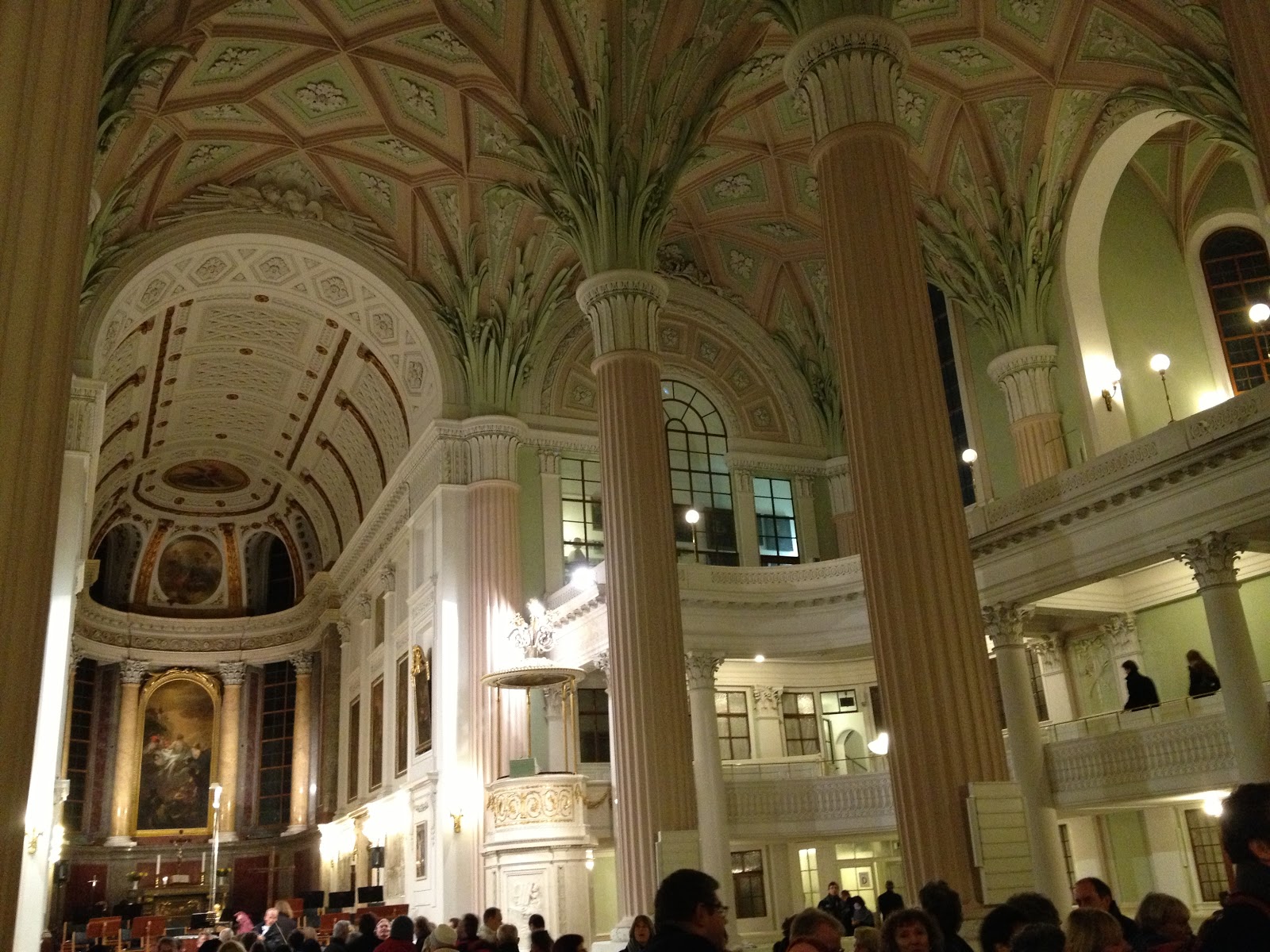
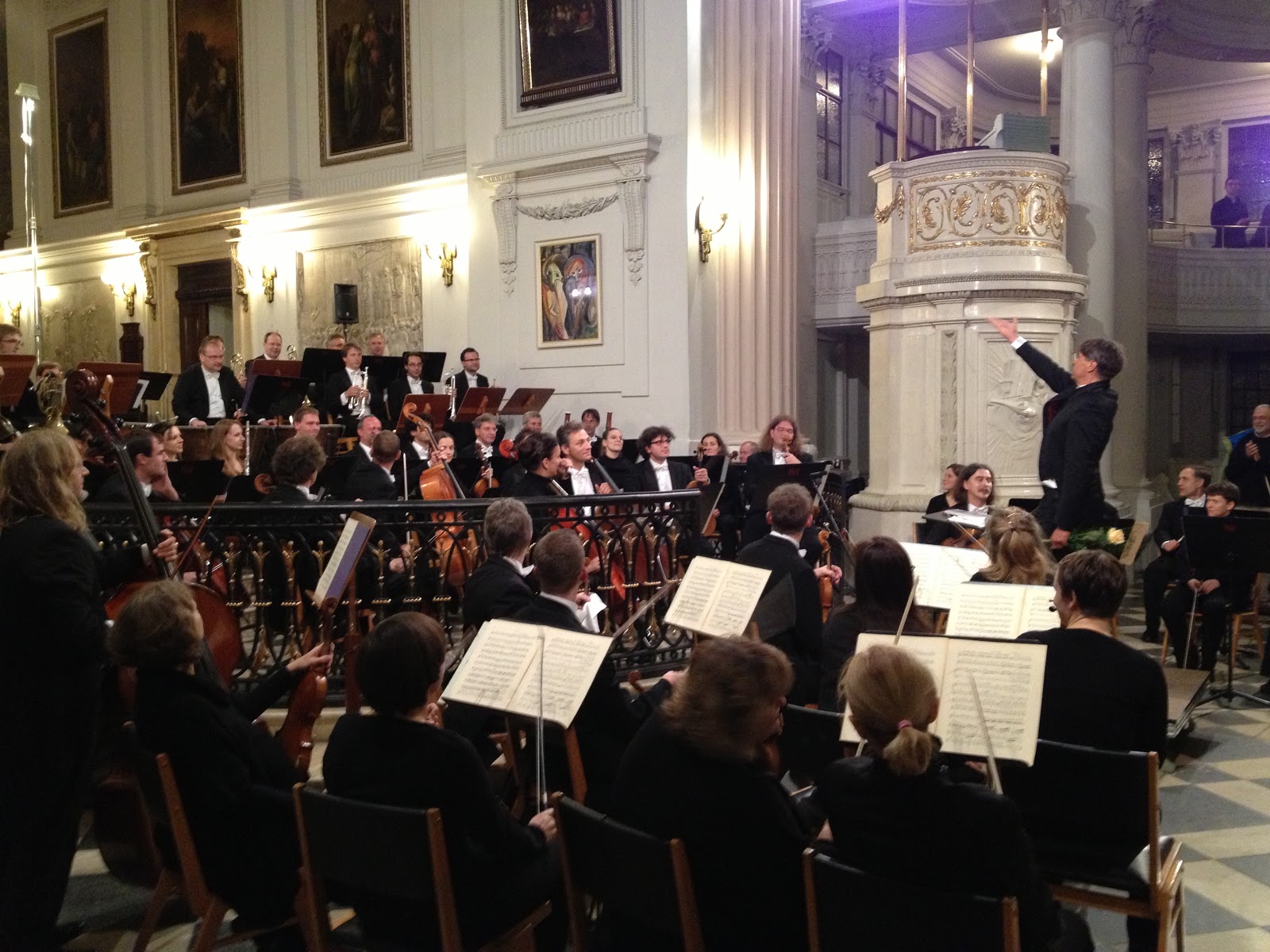
Worn, uneven and creaky, we walked the stairs up to the second floor and into his apartment. There were about ten rooms open for us to see. The largest was a salon with a piano for performances. Otherwise, the rooms were small with room for a bed and a desk and not much else. We saw his watercolors paintings. And his composing desk. And we stood in his bedroom where he died. Mendelssohn was a prodigy and, like Mozart, as a child and a young man he was reading latin and greek, composing, conducting, dazzling audiences with his piano virtuosity and traveling and painting with watercolors images of his favorite places. During his final dozen years he started a music conservatory (it still exists) and became conductor of the Gewandhaus Orchestra. There he promoted works by his composer colleagues and honored dead unplayed composers like Bach and Schubert. He revived their unperformed works. The evidence indicates he was a good man, a kind man who sought to always be helpful. Those thoughts were fresh in our minds when we went to hear his symphony in a concert that evening at the Nicolai Kirche.The Nicolai Kirche is about nine-hundred years old. Add to that it’s “prayer for peace” history, it’s Bach connection, it’s Martin Luther history. And factor in it’s flattering acoustic, it’s pastel green and pink interior, it’s tall fluted columns that burst into palm fronds when they reach the ceiling. Then there is the magnificent, powerful, pew-rattling organ from the year eighteen-fifty. It is a special place. We sat in the front row of the first pew, practically in the violin section. And it was a good concert.
The orchestra was, as usual in Germany, very good. They began with Mendelssohn’s Symphony Number Five. It is known as, The Reformation Symphony. Mendelssohn’s family was jewish, but they knew how to be Lutheran-friendly in order to avoid discrimination. To honor the three-hundredth anniversary of Martin Luther’s “Augsburg Confession” Mendelssohn (twenty years old) wrote a symphony using Martin Luther’s hymn, “Ein feste Burg ist unser Gott”, (A Mighty Fortress is Our God.) The next piece, an organ solo by Max Reger also used the hymn. The concert finale was the Symphony Number Three by Camille Saint-Saens. Wes and I were both hearing the Saint-Saens for the first time. We loved it. Our heads were full of history. Our ears saturated with music. For a perfect ending we went in search of pastry.
We had very good food in Leipzig. It was different than Berlin and Dresden. There were more stews and wild game. And things that tasted like home-cooking. At our first dinner we ate herb-crusted wild boar on a bed of wild mushrooms. And a goulash with roasted parsnips. We drank beer. The prominent one here is Ur-Krostitzer, in business since fifteen-thirty-four.
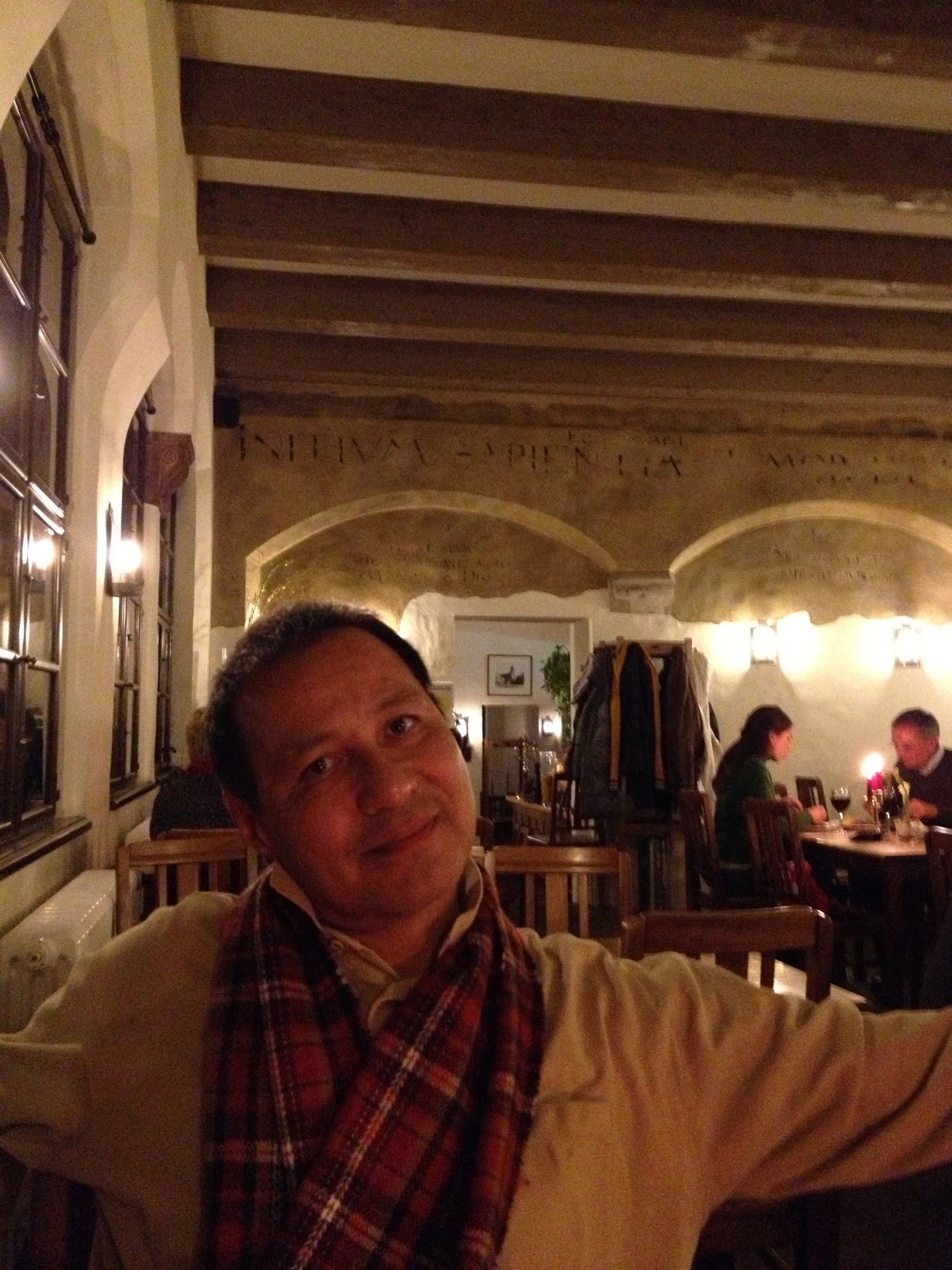
For our final Leipzig dinner we ate in the “Alte Nicolaischule” Restaurant. The building began life as the Nicolai Kirche boys school in the year fifteen-eleven. (Their most renowned student, opera composer, Richard Wagner, was asked to leave after two years. Instead of doing his school work he would while away the hours writing plays in five-acts in the style of Shakespeare. A very creative slacker.) Today, the building is no longer a school. The ground floor is a restaurant and to open the front door and walk in is to turn back the hands of time and enter “ye olde tavern.” Austere stone floors and walls. Plain wooden chairs and tables dim lit with candles. Like a roadside inn for horse-drawn carriages. Like walking into a centuries-old painting of a tavern. The menu was fresh game. As if the chef went, today, on a hunt and what he caught is what we will eat. Catch of the day. We had pheasant and venison. Both were outstanding. Served with sides of brussel sprouts, diced bacon, spiced red cabbage and mashed potatoes. Tall, too tall, steins of beer. An outstanding meal. The waiter came over. He said something in German. We shook our heads and made uncomprehending eyes. He steeled himself for English and said, with slow precision, “The. Meal. Vas. Appropriate?”. Yes, we said, very appropriate, thank you, very delicious, too delicious, wonderful, danke.
Goodbye Leipzig. You have been wonderful.
27-28 October 2012
Leipzig
A Closing Statement:
It has been an exceptional experience. Wesley the travel planner has done an indescribably outstanding job. Many times, I have felt, “I cannot believe I have the tremendous good fortune to be in these places having these experiences”. We traveled to four countries. They all felt comfortable even where language was a barrier. As you can tell by my wordiness, I have been an insufferable history geek, but I cannot be accused of not squeezing every ounce of culture out of each place we have been. If I have written too much, if I have oversaturated the readers, I apologize. These entries began as a way of sending updates quicker than postcards. Now, they seem like something that can be read years from now to get a sense of how the world was when we were there. And if I am too wordy, blame it on James Michener. Good bye, till the next trip.
Marlow
29 October 2012
Frankfurt, Germany
Sent via BlackBerry from T-Mobile

 Wes & Marlow Travel Blog