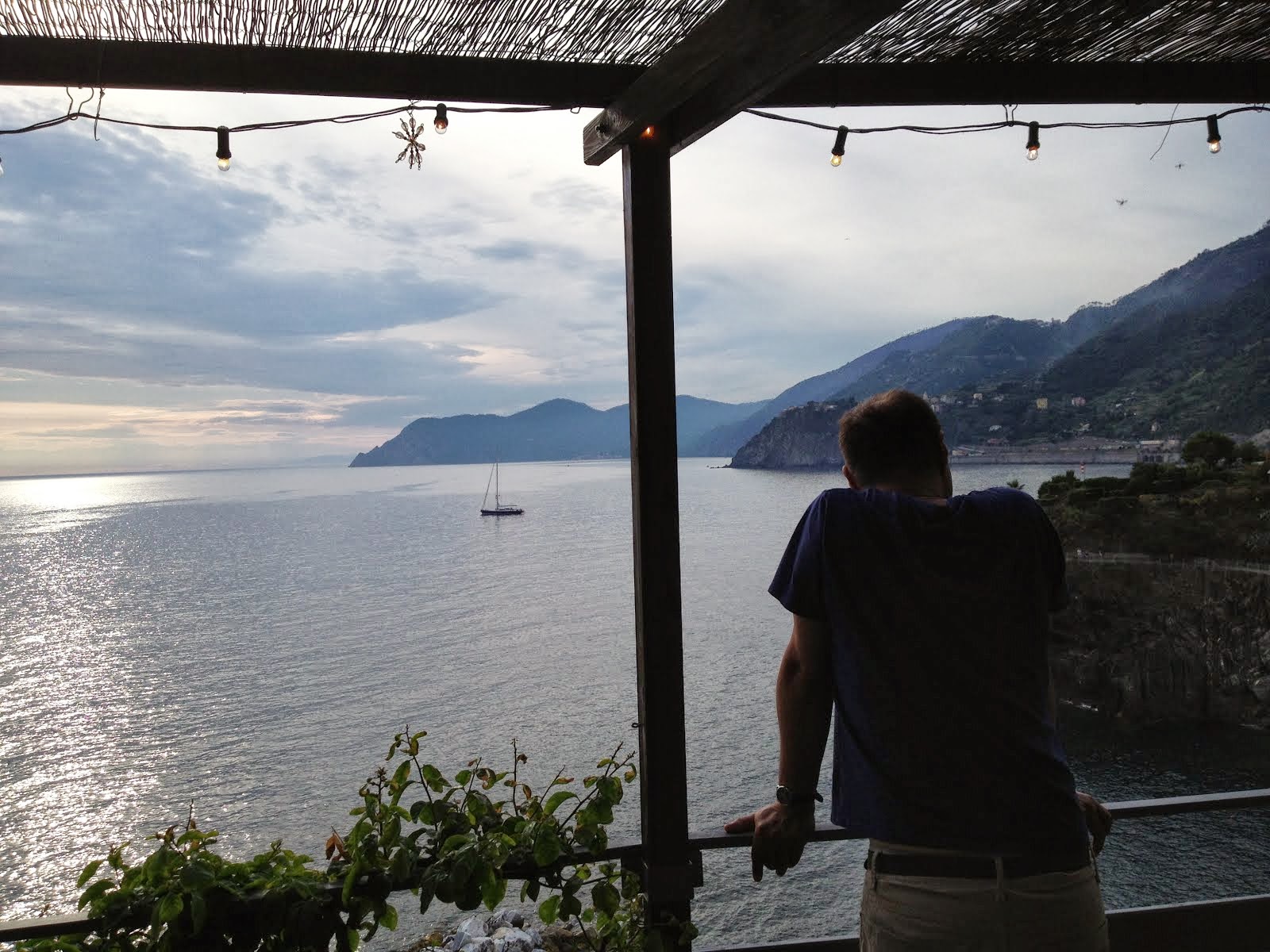
At home in the Cinque Terre
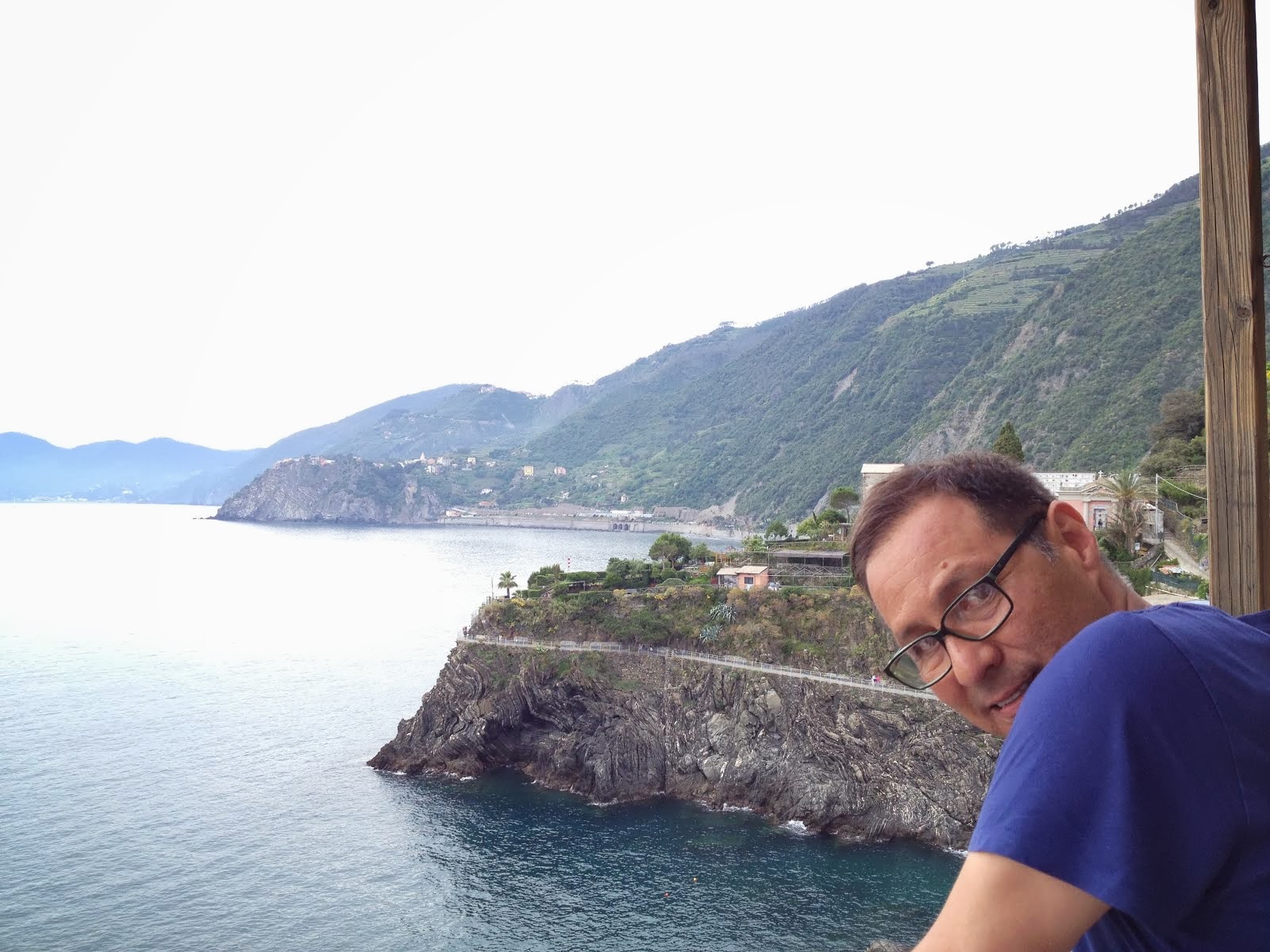
We’ve arrived in Manarola.
Castiglione delle Stiviere and Villa Sostaga
Castiglione delle Stiviere lunch and Villa Sostaga
6 June 2013
Villa Sostaga at Lago di Garda in Gragnano, Italy
From Mantua we took a train to Verona. In Verona we picked up a rental car. In the rental car we drove west and north to Lake Garda.
En route we stopped in the hill town of Castiglione delle Stiviere. From a distance it looked promising. There was a large church atop the hilly town. And we heard cuckoos in the trees. But on arrival the town seemed deserted. Most everything was closed. We persisted. We walked several blocks searching for signs of life. Finally, Wes saw a small open door in a tall stone wall. Through the arched doorway was a sunny garden. A green lawn. A few tables under sun-drenched umbrellas. Serendipity found a table with two seats awaiting our arrival. Claudio Truzzi, the owner and chef of Hosteria del Teatro, made recommendations, took our order, prepared our meal, poured our wine. He was our private chef shared with two other tables.We had smoked caviar from local fish atop a smear of salted butter churned from the milk of the cow of Claudio’s nonna. We had warm shrimps dipped in Claudio’s saffron mayonnaise. We had Persica (perch) from Lake Garda and Ombrina from the sea. We had miniature panna cottas, delicate light as air amaretto cookies and candied pomelo peel. It was a perfectly beautiful day. The sky was blue. The climate mild and warm. We were without obligations. Without places to be. Or things to do. Just us, the food from the land and the sea, the balmy breeze, the antique terra cotta skyline, the quiet village, and the tiny salamanders basking in the grass.
Eventually we drove to the village of Gargnolo on the western shore of Lago di Garda. From Gargnolo we began the seven kilometer ascent on the narrow two lane road constantly on the edge of cliff. At times the road seemed only one and a half lanes wide. Motorcycles sped around blind curves. Locals accelerated impatient and close on our heels. The bicyclists were impressive. They pedaled with great ease up the steep incline. And as we got higher the view of the lake got grander. The driver was tempted to look away from the road. All in, it was a thirty minute drive of constant hairpin turns. Not really perilous, but driving it for the first time it seemed so.
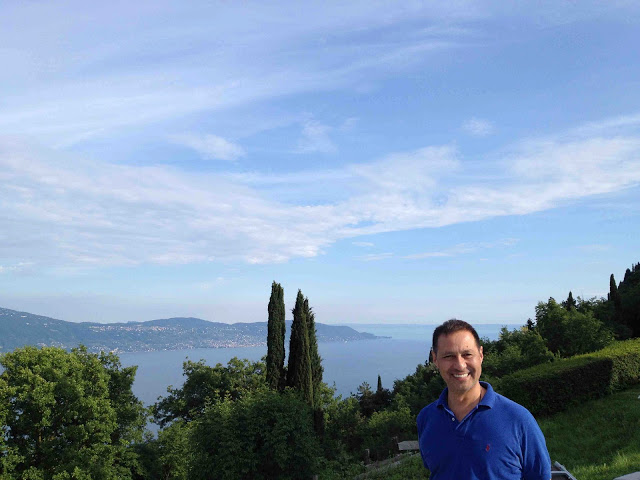
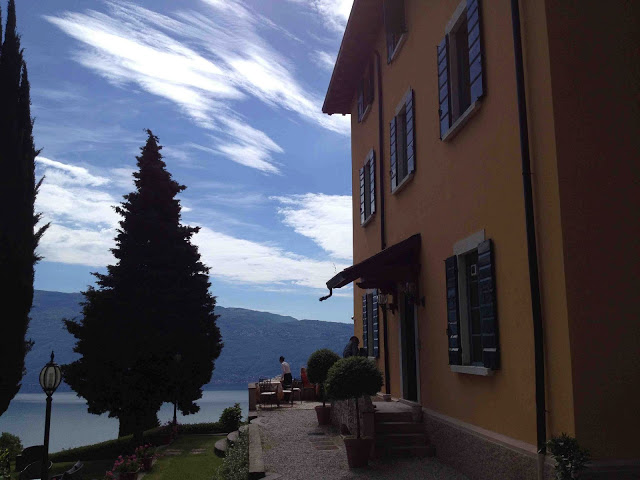
At last we arrived to the Villa Sostaga. Eighty perfectly situated acres on a high promontory. The focal point, an elegant three-story mansion amidst tall cypresses.
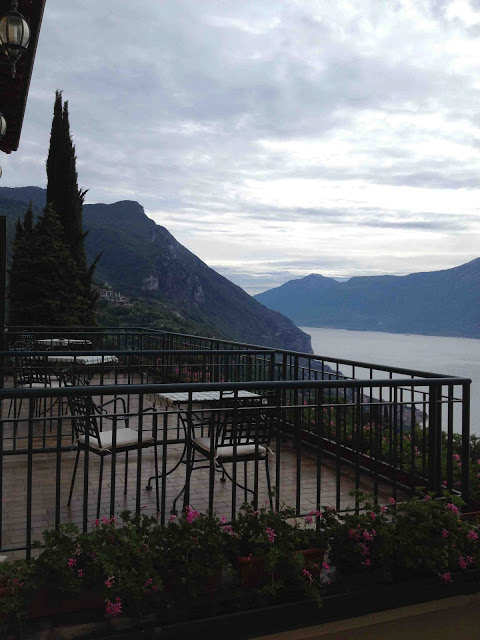
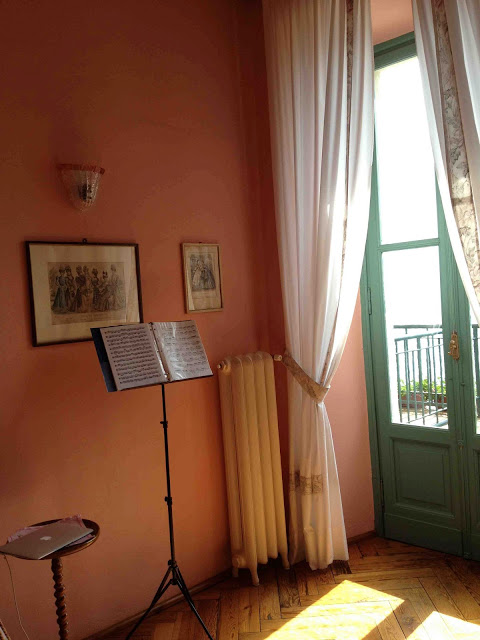
In the mansion, on the second floor, with a terrace, and facing the lake was our room. We have twelve foot ceilings and salmon walls. A sitting room and a bedroom. Elegant furniture. Hand blown glass light fixtures.
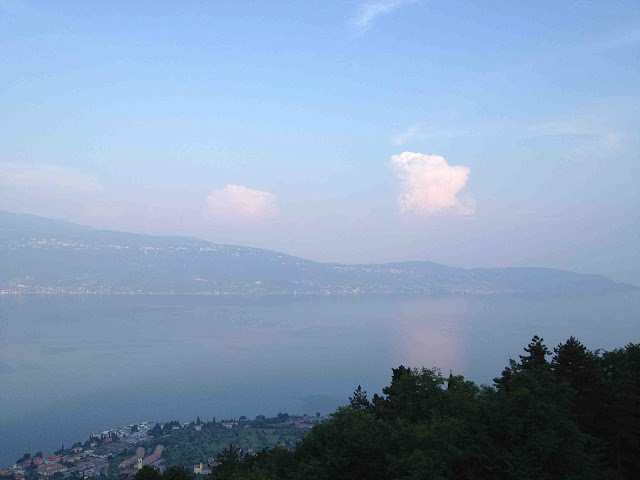
The sky is ever evolving. A painters challenge. One moment everything is enveloped in a blue haze. Then golden light arrives and glitter on the water. At times the lake, mountain and sky meld into a two-dimension impressionist canvas, with shapes and contours and colors suggested but not explicit.
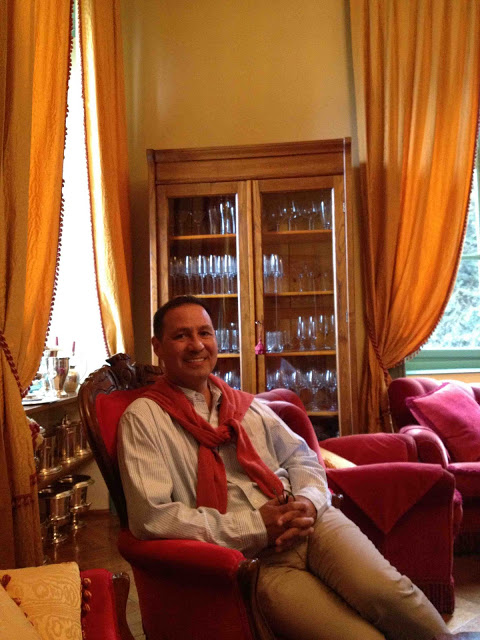
Directly beneath our room is the glass enclosed dining room. A solarium of sorts. However cool the temperature is on the outside the sun warms the inside to a perfect climate. Our table is at the window facing the lake. We take our breakfasts and dinners there. At times it is a bit unreal. A bit Downton Abbey-ish having servants and formality and constant luxury. The owner, proprietor is a good manager and it is a well oiled operation. And mutually beneficial. He is pleased to have our business. And we are pleased he makes available his paradise.
We are here with friends from New York City. They have been here several times and encouraged us to come enjoy it with them. They, the New Yorkers, have a generous friend who has sent for their enjoyment a case of fine wine to the Villa Sostaga. Twelve excellent bottles of German, Austrian, French and Italian wines. We are lucky to share in their good fortune. The wines have been an outstanding addition to our dinners.
Our stay at the Villa Sostaga is five nights. It is a place to rest and be peaceful. The main activities are walking through mountain lanes, sitting at the pool and quiet conversation which are not events to write home about. So I will not go on about the birds or the land.
Tonight, the five of us will go down the hill and away from the lake for dinner with a couple from Bologna, two violinists.
Marlow and Wes
6 June 2013
Villa Sostaga in Gargnano on Lago di Garda
Sent via BlackBerry from T-Mobile
Tiratappi Baldessare Castiglione and Due Cavalli
Tiratappi, Baldessare Castiglione, and Due Cavalli
2 June 2013
Mantova, Italia
Last night we ate dinner at the end of our street, at Tiratappi.
The ambiance was comfortable: soft lighting and American music softly wafting: jazz, Sinatra, and several jazz versions of Over The Rainbow.
The Tiratappi chef, is from Sicily and cooks Mantuan dishes with Sicilian ingredients.
We had goose carpaccio dusted with brilliant green Sicilian chopped pistacchios on a bed of sliced Sicilian blood oranges drizzled with fine olive oil.
We had four thick pork loin medallions in a small pool of melted bitter sweet chocolate, probably blended with a touch of olive oil It was an interesting and successful combination.
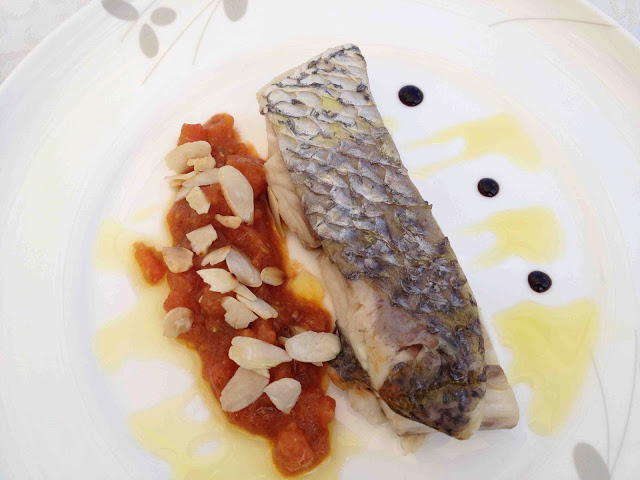
We had grilled Branzino. It was exceptionally tasty. Maybe the Sicilian waters where the Branzino was born is extra rich. Or maybe the Branzino’s diet there is particularly good. Something had to account for it’s great flavor. It was more than just the excellent cooking.
We had caponata, (Italian ratatouille): eggplant, zucchini, red pepper, onion and olive cooked with a pinch of sugar and a splash of vinegar.
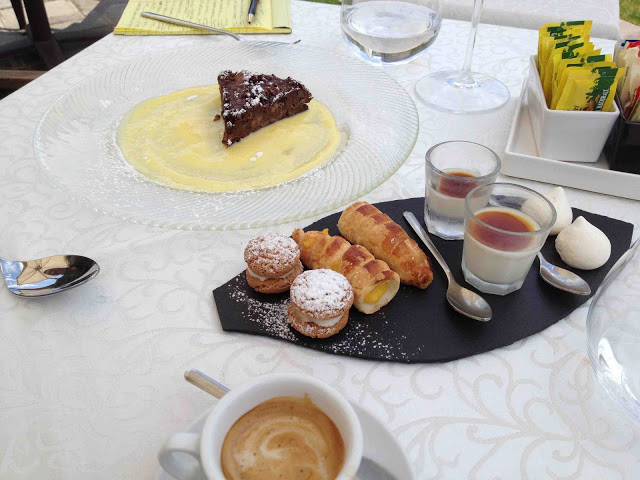
For dessert, we had Cannoli Sicilana: three thin round cookie cylinders filled with orange infused pastry cream, on each end was placed a candied orange peel, all dusted with powdered sugar and chopped pistachios.
Finally, we had sips of Limoncello to aid our digestion and make us pleasantly woozy for the half-block walk home.
During the meal we used the iPhone to translate compliments for the Tiratappi staff. They were very happy with us and we with them. As we departed we learned that Tiratappi is run by a husband and wife, their son and his girlfriend. The husband/chef is from Sicily and the two women are from Croatia. We told them of our outstanding visit to Croatia. We had a great time reminiscing with them.
********************
While here, I have been reading The Courtier, by Baldessare Castiglione. Tom and Bronwen gave the book to me a while back because it has sweet opinions on where, when and who should play the viola.
Baldessare Castiglione worked in the service of the Duke of Mantova in the Gonzaga court. His book is an instruction manual in how to properly serve a Duke or a Prince. An etiquette book of courtly manners. How to fit in with the court crowd.
By coincidence, I am finding the book a useful guide for my work place. When I go to work, I do so with one-hundred people all hoping to become the favorite of the powerful few. No situation is new, is it?
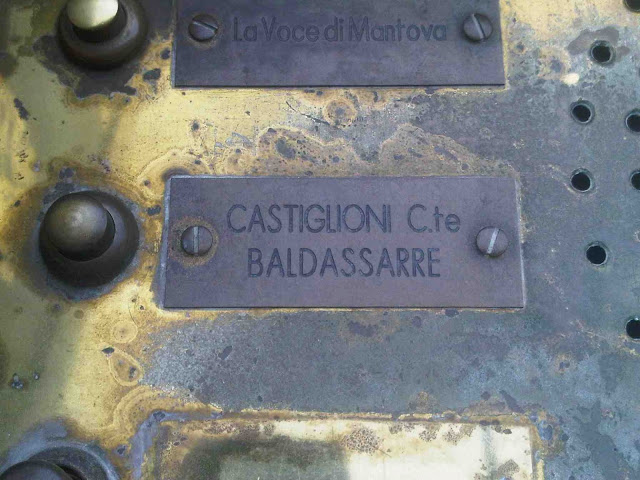
Around the corner from us is a palazzo of the same vintage, but smaller than the Palazzo Ducale. Beside the door is a door bell and a brass plate. Engraved in the brass plate is “Count Baldessare Castiglione”, the same name as the book author from five hundred years ago. He would be pleased to know his descendants have endured, maintained the title of Count, and probably have done so by following the advice in his book.
*********************
Lunch today was taken at Due Cavalli. We sat on a terrace whose entire trellis was covered with a very mature wisteria vine just beginning to bloom. A very beautiful setting.We had Maccheroni with Stracotto. It was a short ridged tube-shaped past about one-third inch long cooked a perfect “al dente”. It was in a large bowl tossed with a long-cooked (six hours) red wine sauce of stewed donkey. It was delicious. And just about every table (which were mostly locals,) was having it. It was very good.
We also had a mixed plate of cooked meats which were veal steak, roast tongue and guinea hen. Also very tasty.
For desert we shared broken bits of Sbrisolano which is a quite tasty thing, but will sound odd. Imagine a streusel topped almond cake that instead of rising, fell to a half-inch thickness and turned hard. That is Sbrisolano. One breaks it into bits and nibbles it between sips of coffee.
********************
So ends our Mantua stay. It is an excellent place to get some rest. There are not a lot of museums or compelling attractions to pull you this way and that. There are no luxury hotels or Starbucks on every corner. It is an old fashioned kind of town where walking in the afternoon is a great entertainment. I like that. It feels like time has stood still here in a good way.
2 June 2013
Marlow and Wes
Mantova, Italia
Sent via BlackBerry from T-Mobile
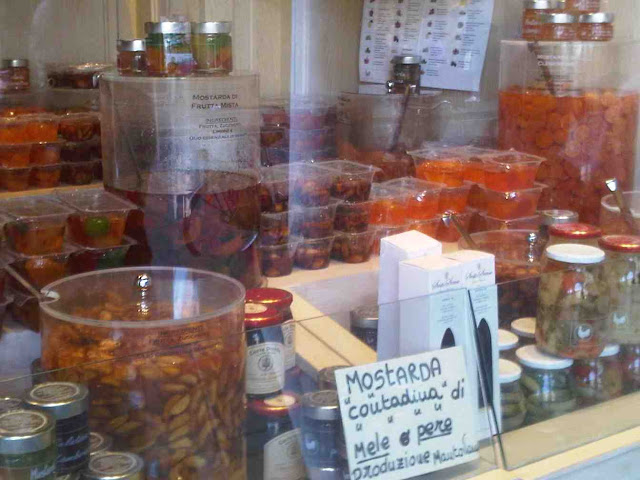
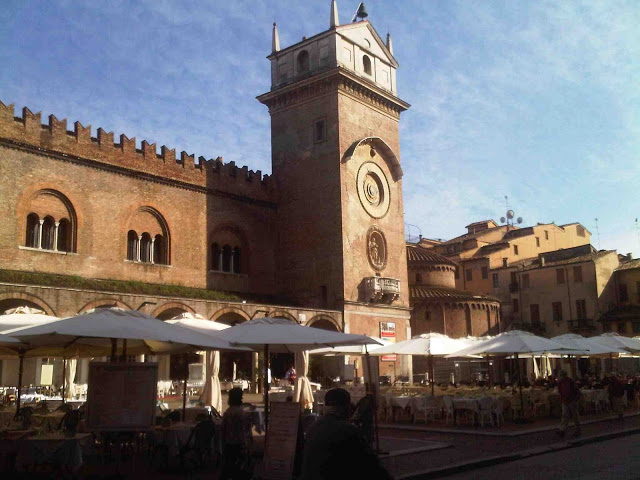
Palazzo Ducale and Claudio Monteverdi
Palazzo Ducale and Claudio Monteverdi
31 May 2013
Mantova, Italia
Mantova, Italia
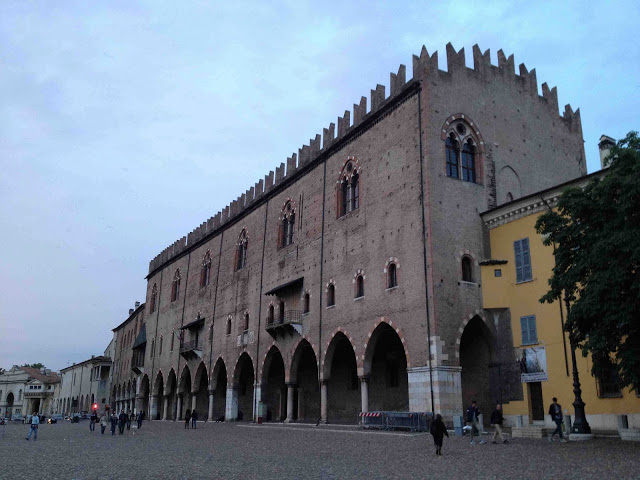
During our guided tour of the Palazzo Ducale I learned that I was not correct about the number of rooms it contains. It has five hundred rooms. It is a city unto itself. Imagine the management of such a place. Heating and lighting and bathing and cooking and dusting and furnishing and staffing and financing. We hear all the time about oligarchs and billionaires, but I doubt any of them have a residence with five hundred rooms.
In it’s day, the Palazzo Ducale housed eight hundred people. It’s day was approximately from the year thirteen hundred to the year seventeen hundred and seven.
The Gonzaga’s were farmers of no significance until they came to power in a coup d’etat in 1300. They slaughtered the city leaders (the Bonacolsi family) and took over their houses and palazzos, and exiled the leaders of the losers to a tower where they were abandoned for a two hundred year stay; shackled in irons, in a room, alone, with the doors and windows sealed over.
After their brutal beginning, the Gonzagas became patrons of the arts and made Mantua into a renaissance mecca. The Gonzagas patronized Leonardo da Vinci, Michaelangelo, Raphael, Titian, and Claudio Monteverdi.
Today, their palazzo has few traces of their existence. In the year seventeen hundred and seven–after a lack of male heirs and several missteps–the Gonzagas fell from permanently from power. And Mantua passed through French, Austrian and Napoleonic hands. By the year eighteen-hundred everything of value was gone except the building.
*******************
Exactly one year ago Mantua was shaken by an earthquake and the most important room of the Palazzo Ducale has since then been closed. The room is called the Camera degli Sposi (chamber of the newlyweds) and contains frescoes, five centuries old, by Andrea Mantegna that depict important events in the life of the Gonzagas.
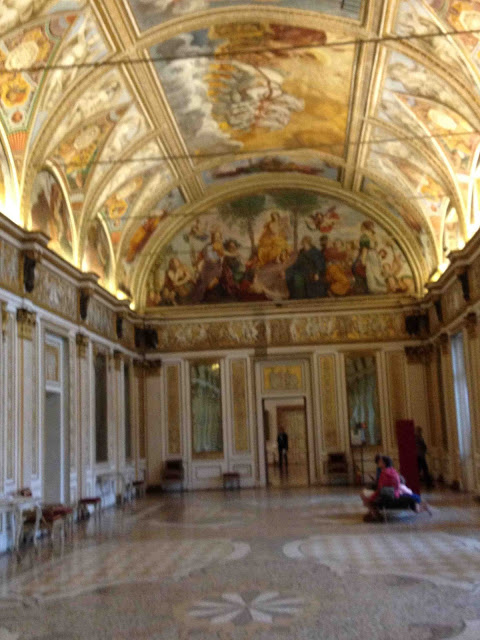
We were not able to see that room. Instead we were snuck into a recently discovered room. A room that centuries ago was walled over. It was known that something was behind the wall, but it was not opened up until the year nineteen-hundred and ninety-eight. The room was where every Friday night for ten years–four hundred years ago–Claudio Monteverdi entertained the Gonzagas with his new compositions.
At one time vocal music was basically poetry set to music. Simple music with one vocal line and one slender accompaniment. Monteverdi imagined a larger form where the text could tell about people: what they experience, what makes them good or bad, how it feels to be in love, what effect does power have on them. Simply put, Monteverdi invented opera. And he did it in Mantua on the Gonzagas nickel.
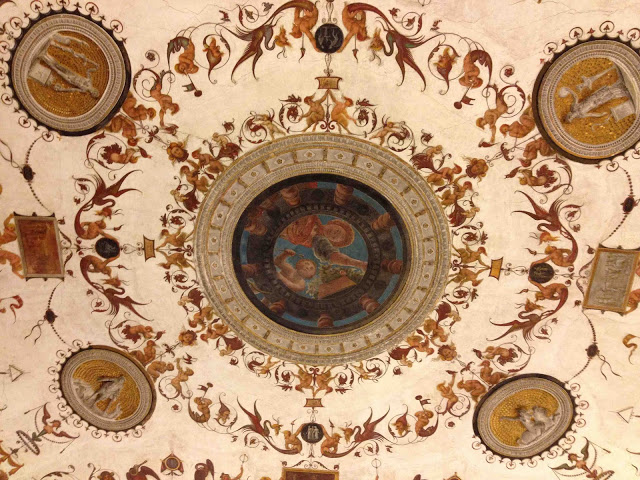
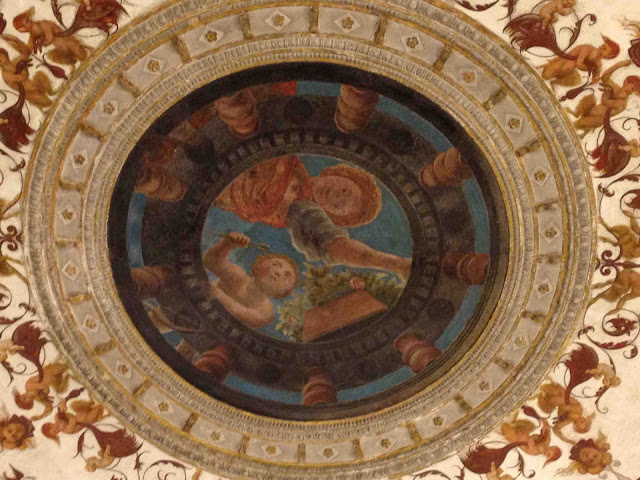
Lorenzo Bonoldi, our outstanding guide, arranged for us to visit the otherwise unavailable music room where Monteverdi played. The room is just raw space, unrestored, somewhat crude, a little dusty. It’s a mid-size room. Somewhat rectangular but with a triangle of walls projecting into the center. It used to have an unusual ceiling like an umbrella and in the arcs where the umbrella meets the wall there were a semi-circle frescoes which are still visible. If those walls could talk.
Marlow and Wes
31 May 2013
Mantova, Italia
Sent via BlackBerry from T-Mobile
Teatro Bibiena and the Aperitivo
Teatro Bibiena and the Aperitivo
30 May 2013
Mantova, Italy
Mantua does not have a symphony or an opera company or a grand concert hall. But it does have a lovely and intimate theater, the Teatro Bibiena where we heard a concert of baroque music.
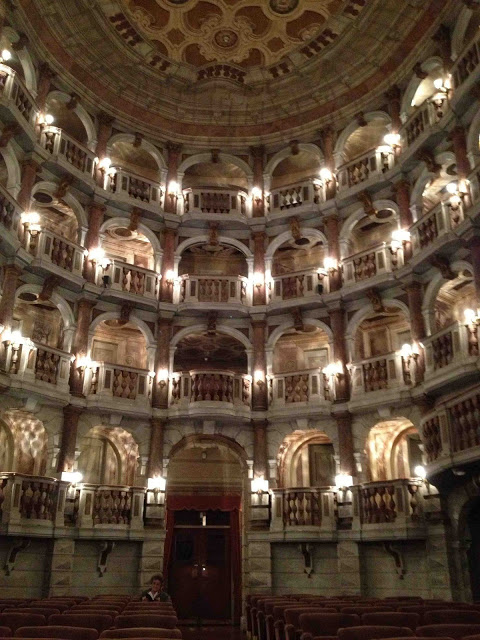
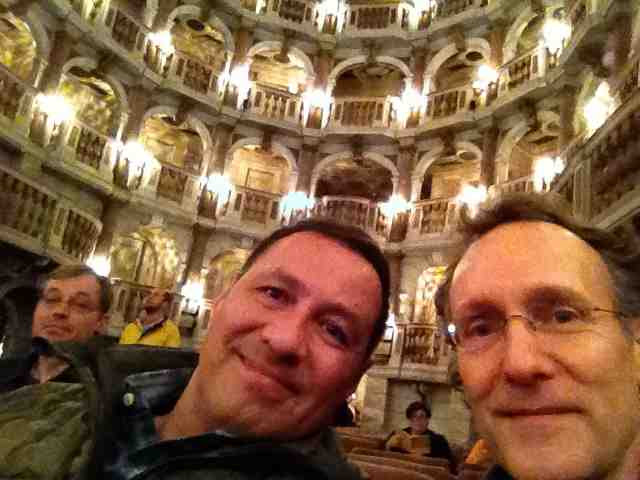
The footprint of the theater is small and it is bell shaped. In the small part of the bell, on the main floor, there are velvet arm chairs and in the large part of the bell is a small platform for the performers. There are seats in boxes on three balconies that encircle the room all the way around, three hundred and sixty degrees. And though the interior of the theater is wood and plaster it is painted to look like marble and stone.
Mantova, Italy
Mantua does not have a symphony or an opera company or a grand concert hall. But it does have a lovely and intimate theater, the Teatro Bibiena where we heard a concert of baroque music.
The footprint of the theater is small and it is bell shaped. In the small part of the bell, on the main floor, there are velvet arm chairs and in the large part of the bell is a small platform for the performers. There are seats in boxes on three balconies that encircle the room all the way around, three hundred and sixty degrees. And though the interior of the theater is wood and plaster it is painted to look like marble and stone.
The original theater was built near the year sixteen-hundred and was intended for scientific lectures. That theater burned and during the seventeen seventies the Teatro Bibiena replaced it. One of the first concerts featured a thirteen year old sensation. He played his own compositions. His name was Wolfgang Amadeus Mozart.
********************
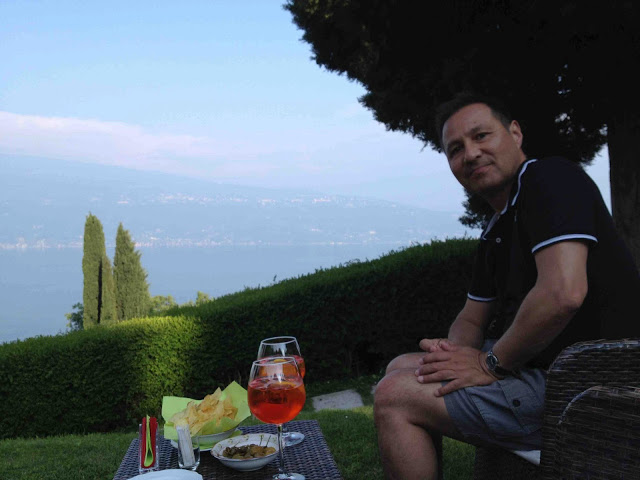
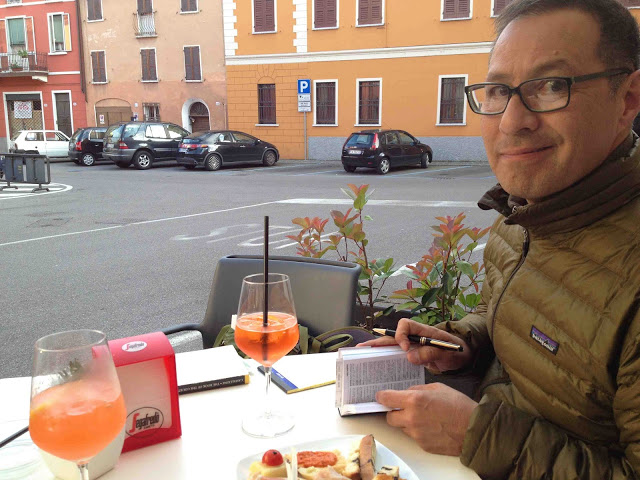
Everyday at every hour it seems to be the cocktail hour. Just like the passeggiata, the aperitivo is a daily ritual. Which is not to say everyone is boozy and drunk. The aperitifs are low in alcohol and always served with snacks. A glass of prosecco. A Campari and soda. An Aperol Spritz. A dish of potato chips. A plate of tiny sandwiches.
A bowl of nuts. The aperitivo and the passeggiata lead me to imagine that it is the pleasures of life here that are primary and the duty of work is secondary. It probably is not the case, but on the surface to me it seems so.
Marlow and Wes
30 May 2013
Mantova, Italia
Sent via BlackBerry from T-Mobile
Bicycles and Passeggiata
30 May 2013
Mantova, Italia
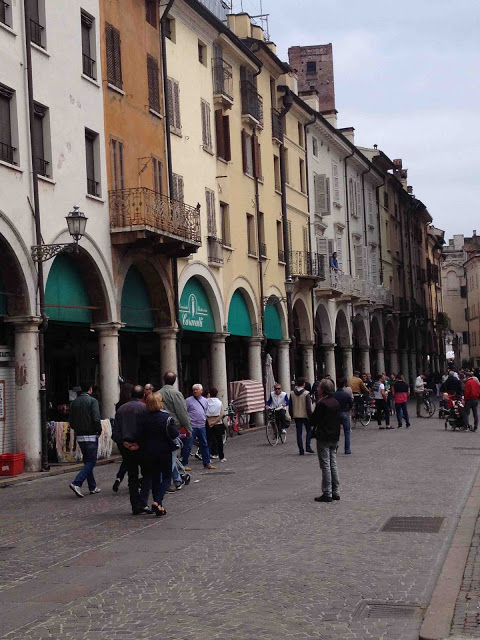
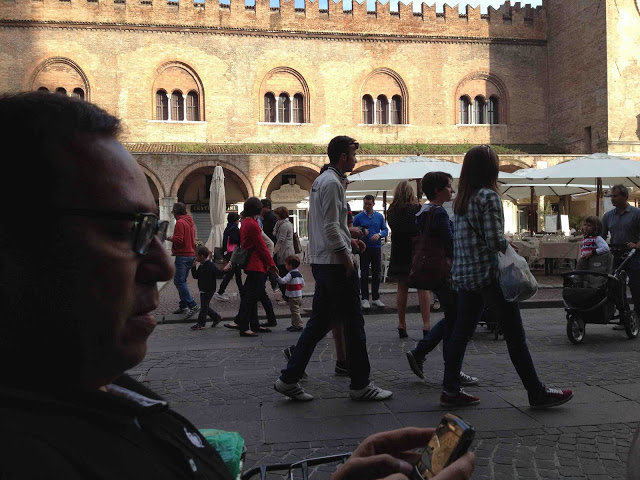
Yesterday, we pedaled all over Mantua: the lumpy, bumpy cobble stoned streets, the narrow alleys, the piazzas and the waterfront path. As major cities go, it really is tiny.
The waterfront area–where there are parks and bicycle lanes–is on the Mincio River. Many centuries ago when the castle and the palazzos were young, the river was dammed to create a lake to surround and protect Mantua from invaders.
Yesterday, we pedaled all over Mantua: the lumpy, bumpy cobble stoned streets, the narrow alleys, the piazzas and the waterfront path. As major cities go, it really is tiny.
The waterfront area–where there are parks and bicycle lanes–is on the Mincio River. Many centuries ago when the castle and the palazzos were young, the river was dammed to create a lake to surround and protect Mantua from invaders.
Touring Mantua on bicycles is a perfect thing to do. It is also the main transportation in town. Everyone seems to have a bicycle. They have baskets on the front and saddle bags on the sides and a tiny child seat with a tiny seat belt. There are women, eighty years old in skirts on bicycles. And chic young women, too. Teenagers fly by like greased lightening. The bicycles are like their cars. Some are upscale, shiny, smartly outfitted. Some are just utilitarian. Sometimes, when parked, the bikes are locked, but mostly they are not.
In the afternoon, though, the townspeople walk. They call it the passeggiata. I have heard about it. I knew about the concept. We have been in a lot of Italy’s villages and cities and I have never really felt it. Here it is impossible to miss. And difficult to not get swept up in. It is the thing to do.
The streets are full of people in pairs and people alone. Older couples with canes holding hands. Pairs of women, arm in arm. Young lovers pressed close together. Groups of boisterous teens bouncing along. They are not at the movies. Not watching television. Not texting. Just walking in the fresh air with each other. Old fashioned.
30 May 2013
Marlow and Wes
Mantova, Italia
Sent via BlackBerry from T-Mobile
Aperitif hour in Mantova
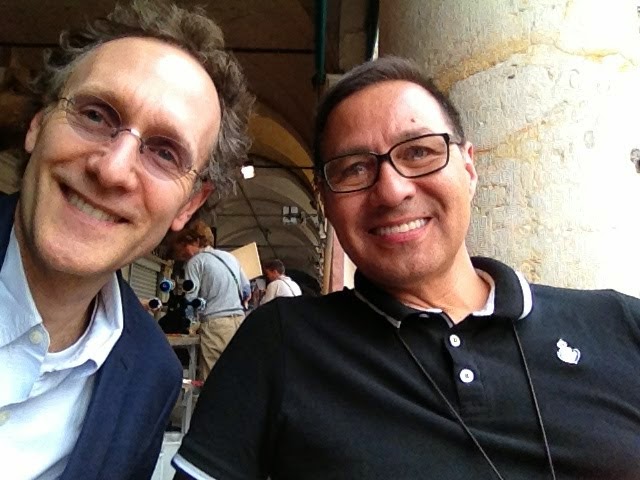
Sunday evening in Mantova.
29 May 2013, Mantova, Italia
29 May 2013Mantova, ItaliaOur trip is now in, somewhat, full swing.
We flew from Los Angeles to Zurich, non-stop, in business class. It was cushy and comfy. We were pampered. Life was good.
From Zurich we flew to Milan’s Malpensa Airport and spent the night in the Sheraton Hotel which is on-site and has a view of the tall and snow covered Swiss Alps. It rained over night and we awoke to even snowier Alps.
From Malpensa Airport we boarded a train to Milan. Upon arrival and during our ninety minute lay-over we stepped outside for lunch at a sidewalk cafe in the sunshine under the tall plane trees which were in full bloom with new born spring leaves, baby-soft and brilliant green.
We boarded another train to Mantova (Mantua) and two hours later we arrived to our station and walked a dozen short streets to our inn.
Where we are staying is not a hotel. It is a converted set of apartments down a narrow crooked street. Our unit is on the second floor. It has a bedroom, a sitting room, a small kitchen set-up, and is extremely quiet and extremely comfortable with modern decor and ancient wood beams all painted white. The host, Cristina, is a warm and welcoming presence. Just the thing one wants after a two day journey.
Mantova is almost a small island. It projects into a small lake and is surrounded by water on three sides. The fourth side, the one sort of connected to the mainland, has a river slicing across and under it.
The small, historic and ancient city center–our part–is a cluster of buildings dating from the twelfth to the seventeenth-Century. It is so darn Renaissance, as if it were an effective urban planning project in a sixteenth-Century style.
Today was a market day. Not much food. Lots of clothing and household stuff. Not much of interest to locals. Yet it was taken as an opportunity for the locals to dress up, stroll and visit. There is a traditional look here. The locals dress in the manner of my old Italian music teachers. Men, portly, in sports coat, tie and vest. Women in below-the-knee wool skirts and nice tops and sweaters buttoned to the neck. The women walked slowly, arm in arm. Grandchildren were doted on. Sweet gossip was exchanged. The pace is slow–andante– and the people, the old and the young, are expressive and passionate.
We sat in a sidewalk cafe having breakfast and witnessed the goings on.
Breakfast is small. It is not a meal of significance. An expresso. A thumb-sized sandwich. A pinkie-sized sweet. That is all.
Style-wise, architecturally, the town is all of a piece. Nothing modern. At least, nothing that seems of the twentieth-Century, though the plumbing and electrical amenities are quite up-to-date.
All of the streets–narrow and crooked–are cobble stone. Not the neat and tidy flat pavers. The cobble stones are stones. Fist-sized, round and uneven. A challenge for cars, bicycles and for recently broken feet.
The center piece–the highlight–of Mantova is the Palazzo Ducale. We will visit it tomorrow.
Mantova was ruled for four-hundred years by one family: the Gonzagas. Imagine that. The U.S.A. has existed for two-hundred and twenty-five-ish years. We have had forty-some presidents. Mantova had only Gonzagas and the power passed from father to son for four-hundred years.
If one is powerful, I suppose, one needs a large house. The Gonzagas had a palace. It had, about, one hundred and forty rooms, still does. Of interest to me are two musical issues. The first one involves Claudio Monteverdi who worked here for the Gonzagas in 1600. Monteverdi is considered to have invented the “opera” here in Mantova.
Before Monteverdi, music was considered perfect and beautifully constructed if it was simple and spare: one voice singing a simple melody with an accompaniment that stayed in the background. But Monteverdi was a modern guy. His sensibility was progressive. In his mind, the style was too simple. Why have just one voice? Why not two? Or more? Not just one line. Make it several. Beef up the accompaniment. Add some drama. Make it compelling. Throw in stories to illustrate and examine the great issues of the day, (which were the same then as they are now: power struggles, fidelity, deceit, consequences, etc). Keep music from being pretty background stuff. Make it relevant and brain-feeding.
Monteverdi worked for the Gonzagas. He wrote Orfeo, the opera, for them. It was performed in the Palazzo. (We saw Orfeo, in a dazzling production in Berlin last October). And he composed and performed music for the Gonzaga court on select Fridays in the Palazzo in it’s Hall of Mirrors which, long unknown, was recently discovered during a renovation when a wall was knocked down and the old room was found.
The other musical issue for me is the production of Verdi’s Rigoletto which was filmed in the Palazzo three years ago.
It was filmed in real time. That is to say, Zubin Mehta conducted the orchestra in the Bibbiana Teatro two blocks from the Palazzo while, the singers (Placido Domingo) sang their roles in costume as if on-stage, but in this instance their stage was the Palazzo. They sang their roles–with the orchestra playing in their discrete ear-pieces–while moving from room to room, through corridors and down the streets of town. All the while the hand-held cameras followed them.
I saw it on television three years ago. It was exciting and I was attracted to the Palazzo and to the town. And I am thrilled to be here.
Rigoletto tells the story of a court jester, a buffoon with a sharp wit sometimes, too sharp. He has offended. He has few allies. He is the butt of jokes. What makes him serious though is his daughter and he is an over protective father. His daughter meanwhile is seduced and has ran away. Rigoletto, hasn’t any sympathizers in the Duke’s court. He is outraged over his daughter’s antics. He seeks revenge. And his revenge does not go well as it is his daughter who ends up slain.
Rigoletto is based on the Gonzaga court. But Verdi’s original idea came from a Victor Hugo story about intrigue in the French royal court. But the Verdi’s publishers thought it was too provocative to make the opera about a recent French ruler so soon after the French Revolution and Napoleon, etc. So Verdi looked for a ruler no longer in power. The Gonzaga’s of Mantova were perfect. They were not royal. They had been out of power for over a century. They were not a hot button issue. Mantova was a tiny place without national ramifications. The Gonzagas were ripe for the picking as they had become extinct as rulers around 1707.
The current town’s people all seem to have a story to share about the Rigoletto television production from three years ago. It was made over several months during a the summer. Mantova was hot. There were mosquitos. The town, apparently below sea-level was sweltering and humid. The singers’s make-up ran.
Tomorrow we will tour the Gonzaga’s Palazzo Ducale’s 140 rooms. Maybe we will sense the presences of Monteverdi and Rigoletto.
Marlow (and Wes)
29 May 2013
Mantova, Italy
Sent via BlackBerry from T-Mobile
Trondheim, Norway: 24 December 2012
24 December 2012
Today was a great day.
After a turbulent, stormy night in the Norwegian Sea we arrived in Trondheim on Christmas Eve. It was a frosty arrival. Icy, windy, sunless. Perfect Christmas climate. I loved it. I walked from ship to hotel while the others took a taxi.Earlier in the week, we learned that Norway closes for business on Christmas day and the days just before and just after. Our hotel, the Britannia, may be the only hotel open for the three days of our stay. But restaurants are all closed. Entirely closed.
This afternoon we went to visited the Nidaros Cathedral for the four o’clock mass. We walked on snowy sidewalks in twilight to the church gates. Between the gates and the sanctuary door is the cemetery. The dates are from many centuries ago. Tall elliptical gravestones. Candlelit. The oldest stones atilt. Tall, leafless trees overhead. Resting in an undulating flat grassy field. Against a twilight sky, hazy blue, illuminated by a half-moon.
We passed through the Romanesque doorway into the church. It is magnificent. A long expansive space with a tall rectangular tower near it’s center. It is enormous. With gothic vaulting that thrills the eyes. It is all so perfect in form and line.
The space was filled. The people looked joyous. Dressed well. Many children. People in traditional dress. A man with black shoes with silver buckles, white cable knit socks up to his knees where a red braided tassel was tied. Black wool breeches from his knees up. A white collarless starched shirt under a colorful knit vest in red, buttoned up to his clavicle. Finally, a wool coat, white, snowy, fine, with two vertical rows of silver buttons and elegant, discrete ornamental stitching.
We took our places. The choir began. Boys and men singing. The organ played. It filled the room with quaking sound. The program followed the format of a traditional mass. Singing. Standing. Sitting. Sermon. Etc. Etc. Until the Hallelujah Chorus. The tremendous bells began to chime, heard throughout the town. The people rose and filed out into the Christmasy ambiance of Norway winter.
We had lowered our expectations for food. Then back at the hotel, the staff surprised us. They showed us to an elegant dining room built in the eighteen-nineties. Chandeliers. White roses. Candles. Red walls. Glossy black tall wooden doors. I felt I had fallen into a Christmas scene in a Bergman film. We were each presented with a plate of various foods. Salmon. Cheese. Potato salad. Cold poached turkey. And a bottle of Spanish wine from Catalunya. Afterwards, there was a triple-tier of cookies. All variations on butter cookies. And delicious coffee. The hotel presented all this to us as a gift. It was all very wonderful. The stuff of sweet dreams. Which I will now lay down to.
Marlow and Wes
The Brittania Hotel
Trondheim, Norway
24 December 2012
Sent via BlackBerry from T-Mobile
 Wes & Marlow Travel Blog