Wes and Marlow
14 November 2015
Ferrara
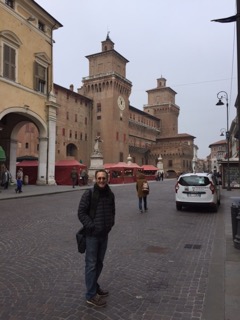
It is, again, a birthday weekend. In fact, today is the day! Wesley’s birthday. He has the desire to visit Ferrara so we packed a small backpack for two and got on a train for the thirty minute ride.
From the Ferrara train stazione we walked fifteen minutes to the historic center where there are impressive castles—with moats and drawbridges—and the cathedral. The cathedral is like those in Parma and Modena in that it was built in the early eleven hundreds. And like them, it is built over the ruins and remains of buildings from several thousand years ago, mostly pagan shrines to Egyptian deities, I think.
Ferrara, on the perimeter, has unremarkable even somewhat ugly concrete buildings. Then suddenly you cross a street and and the scale becomes small, the streets paved with small stones, the doorway arches are pointed and all the front walls of the small buildings are tilted and leaning from centuries of settling into the soft ground beneath their foundations.
We found the way to our hotel. It sits in the historic district opposite one of several super large—five hundred room—castles of the Este family.
The hotel is small and modern. Their clientele is international. There is a guest book in the lobby. It is open to a page from nineteen hundred and ninety eight. Two of the signatures on that long ago page are from long ago friends of mine.
Our room is a block away from the hotel proper in a building from the fifteen century. It is a split level room. The ceilings are particularly high. The windows look into a courtyard garden with large mature trees. Portions of the old stone walls are, here and there, exposed, but overall it is smoothly plastered and mostly modern.
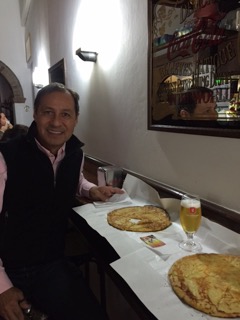
We went next door to a pizzeria for lunch. Immediately inside is a large, brick, domed, pizza oven with two white hot logs blazing inside. We ordered farinata di ceci.
We have not had it before. We did not know what to expect. It is chickpea flour mixed with water and olive oil, poured into a shallow round tray and baked in the pizza oven which is near eight hundred degrees. The farinata di ceci came out of the oven the thickness of two tortillas. It was egg shell crisp on top and bottom. In between it has a texture of firm custard.It is an outstanding thing to eat, especially on a chilly day.
We took a nap, freshened up and went out for round two of the Ferrara birthday experience.
For the birthday cocktail we are in the Enoteca al Brindisi. It has been open since, could it be true, the year fourteen hundred and thirty five. Copernicus drank here. The painter, Titian, drank here. Benvenuto Cellini drank here. Now, Wes and Marlow drink here. A sparkling rosè and a prosecco, both tasty. The effervescence in both are celebratory. A wooden board of sliced meats came, also, to the table. The room looks old, but not five hundred years old. Everywhere, it is knotty pine with honey toned varnish. Picnic style tables and benches, back to back, are also pine.
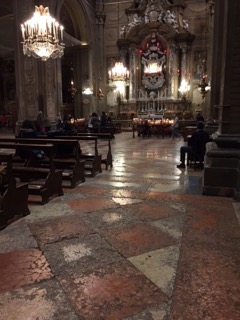
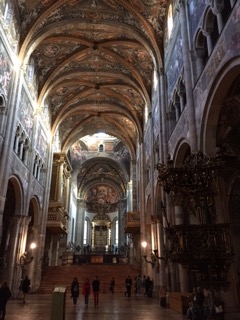
Just before stepping in here, we walked into the cathedral where a service was in progress. The interior is romanesque and gothic. There is a lot of trompe l’oeil painting of renaissance detail. There are crystal chandeliers everywhere. The floors from front to back, as in Parma, are blocks of pink marble.
If the appearance of the church reflects the city, Ferrara is awash in money and good taste. Though the decor is over the top and then some, it works. The elements all contribute to an excellent whole. The place was jammed. The priest’s sermon sounded typical. The cathedral interior reminded me of opera sets by Franco Zeffirelli. Large scale, grand, opulent, gleaming. I could imagine Mister Zeffirelli walking the Ferrara cathedral with a note book jotting ideas for his designs. Meanwhile, back at the enoteca, we paid our bill, with a final sip in honor of the enoteca’s five hundred and eighty fifth year in business.
Outside, it is chilly. As we walk down a narrow street and into the piazza—in front of the cathedral and the castle—we enter a temporary tent. Inside is a wonderful food market, Mercato di Campagna Antica. It’s long tent is parallel with the long cathedral. Inside, are hundreds of cheeses. Parmigianos and pecorinos. And there are truffles, black and white. Beautiful fish. Eels, live, coiled in a barrel, lungs puffing in and out. Fruit and vegetables. The best products on offer anywhere.
Now, out of the cold, we are in the warmth of Ristorantino Quel Fantastico Giovedì, a ristorantino. It is highly recommended by trusted friends and considered very expensive by local standards. We learned today that yesterday the President of Italy had lunch here. We wonder what he ate and where he sat. The two rooms are smallish, about twenty four seats per room. Low ceilings. Old heavy beams painted white as are the walls. The seats are armless, high back and black leather. Table linens are grey and white.
A small appetiser has arrived. It is a small glass holding cream of fennel and basil with almonds toasted and slivered on top. Also, a warm plate holding four breads appears. One bread in particular is a show piece of Ferrara, rolled and sculptural, simple and white.
We are drinking Foss Marai Valdobbiadene Prosecco from the Veneto.
Now, the extraordinary fun begins. Two plates, large and square, have arrived. The silver domes are lifted to reveal Pasatelli con Fonduta di Parmigiano and with white truffle shaved all over. Pasatelli is our new passion. It is all over Bologna. It is a pasta hybrid. It has four ingredients: egg, grano cheese, bread crumbs and nutmeg. Often, it is served in broth. We have had it that way. And we have had it “asciugo”, dry, not in broth, but added to a non-soupy stew. Also Wes has enjoyed making it at home several ways. But tonight, with white truffle, the first ones of the season, it is outstanding.
The President, yesterday, ate in this ristorantino. We asked the owner what he ate. She is accustomed to reknowned customers, but to have the President at her table was a rare thrill for her. She said he ate Cappellacci di Zucca alla Ferrarese con Burro Fuso, Salvia e Mandorle Tostate, (small pasta stuffed with pumpkin in sage butter). And he ate Sformata di Patate e Salamina da Sugo Cotto nel Latte Fresco. For dessert he had sorbetto. She said the dishes are simple local specialities. And he ate them in the small room we are seated in. He ate food, simple and local.
Our main courses have arrived. For the elegant birthday gentleman: Faraona Farcita alla Crema con Funghi Porcini. And for me: Guancia di Vitella Cotta a Bassa Temperatura con Polenta Grigliata.
Translated, it means guinea hen stuffed with porcini mushrooms. And veal cheek slow cooked. Both plates were long white rectangles. Both were arranged the same with braised raddicchio on one end, very thin discs of eggplant lightly grilled. The vegetables were strewn with tiny purple shiso leaves which were a wonderful mystery flavor until we recognized them. Between the vegetables were our main courses. Both when they hit the tongue, delivered enormous pleasure. And both were in a buttery sauce which is not a daily item for us, but as a bit of birthday luxury it was very welcome.
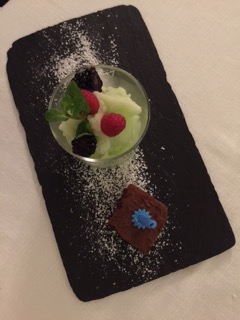
For dessert, we asked for sorbetto, the same flavor the president had yesterday, lemon basilico.
We said to the owner, if it is good for the president it shall be good for us, too.
Another birthday wonderfully celebrated. Thank you Ferrara. Happy Birthday, Wesley!
Wes and Marlow
14 November 2015
Ferrara
Parma: Unexpected pleasure in the Palazzo della Pilotta
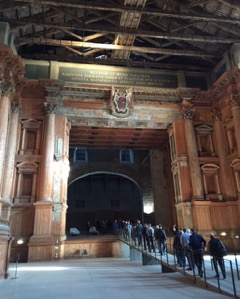
Today we had the most pleasant start to our day on our weekend visit to Parma. We had tickets for an 11AM concert at the Opera and wanted to fit in a visit to the Palazzo della Pilotta (1583), an imposing fortress that houses an art collection (a few Leonardo Da Vinci, Canaletto) but the main draw is the Teatro Farnese – a restored baroque theater originally constructed in 1618 which is contained inside the palazzo. The theater was built inside a large open space in the palace that was probably initially used to hold tournaments, probably with knights riding on horseback and jousting. So we arrived to the palazzo, purchased our entry tickets (with our student discount!) and turned toward the entrance to the theater. UGH. There was a long line of rough-looking mostly male tourists seemingly just off of a bus waiting to enter the theater space ahead of us. I thought they looked russian. We actually considered leaving and returning in a few minutes after the group had left. But decided to enter just behind them anyway. Visitors are allowed to walk onto the stage of this theater. And the group of bus tourists marched right up the ramp to the stage. And after a few short moments we heard the most wonderful sound. I first imagined the museum had turned on a recording. But no, it was coming from the stage, the rough looking crew was actually a mens chorus. They sang this piece (attached) and then left. Please turn the volume up and listen. It is just beautiful singing. And no, they were not russian, they are italians. We have actually come across this in previous visits to churches in europe where visiting groups appear, and sing one or two songs, and then leave. But this morning it was just the most unexpected pleasure! I hope you too enjoy it.
Parma: 8 November 2015
Wes and Marlow
8 November 2015
Parma
About last night, Saturday, in Parma. After dark, we went in search of food. Specifically, “Parma” ham and “Parm”igiano-Reggiano cheese.
The streets of historic Parma are laid out on a grid with corners at right angles. I clarify that because in Bologna the streets radiate outward in about twelve pie slices, pizza slices, toward twelve gates in what used to be the Roman wall. The streets in Parma are narrow. Very few cars are permitted into the historic area. What cars there are are tiny. It is a good pedestrian area.
When we arrived yesterday, at two in the afternoon, the streets were mostly empty. At night they were jammed. Twenty year olds or thereabouts. Hordes of them. There is a current fashion trend among them, particularly the young men. Their hair is shaved very short on the sides and back, on top it bushy and tousled. Also their pants have extremely low crotches like a baby’s droopy drawers. The crotch is inches from their knees. Down below, the legs taper to ultra thin. The bottom hems are turned up and the ankles bare and exposed. Whatever street we walked, wherever we turned, we saw that look. The local shops have very interesting clothes, too. Every third window is a clothing store. And what is displayed is not ordinary. It is creative, wild and eccentric.
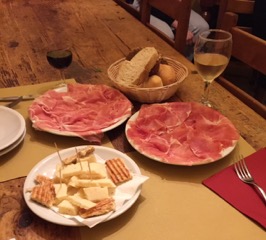
After walking the streets, dodging the locals, we examined eateries, many. We settled on one with outdoor tables. Outside the music was too loud. We went indoors. We came to a bar, jammed. Beyond that was a room looking like the tavern Lilas Pastias, in the opera Carmen. Worn wood floors. Worn long wooden tables. All was bare and worn. It was crowded, but with a few seats left. We took them. The menu was to the point. They had plates of various sliced Parma hams, plates of Parmigiano-Reggiano cheese, bread and wine. We ordered a plates and glasses of those things.
Our wine was red, frizzante Lambrusco and white Soave from Venice. The wine list was entirely local, by the glass and inexpensive. If there was a word of English spoke in the crowd, I did not hear it. We paid. We walked, we squeezed, out through the bar. Sardine can tight. The crowd spilled out to the street, too, more than fifty people outside. All patrons, holding wine glasses, eating panini, smiling, laughing.
I am shy in restaurants in foreign countries. I do not want to go eat like I do at home. I want to learn the ways of the old world where they have eaten certain foods and in certain ways for longer than the United States has been a country. I am wrong, though, in thinking there is a particular traditional set meal where one starts with an antipasto, then has a pasta, and then a meat dish. What I have seen during the past two weeks are Italian people ordering what will please them.
I saw a table order a plate of sautéed vegetables to start, then continued with an order grilled vegetables and ended with one dessert for three of them. I saw another table begin with a cheese plate then order vegetables. And this third instance inspired me: I saw two men start with a plate of prosciutto, Parmiggiana chunks and bread rolls which they assembled into mini sandwiches. Then they had tortellini in brodo (tiny tortellini in golden broth—exquisite comfort food—matzo ball soup refined and elevated to a minimalist masterpiece). Over the tortellini bowl, one man held a large chunk of Parmiggiana cheese in one hand and a cheese grater in the other hand. He grated, excessively, three times, with a pause to rest his wrist in between! Three times he grated until the bowl was fifty percent cheese! He was more restrained with the pepper grinder, but still excessive. I wanted his meal. I would have been too shy, not bold enough to order it. Of course, the language gets in the way here. If I learned the speech to describe what he ordered I could learn it by rote and recite it phonetically. All of this is to say, I am inspired by those eaters. I am like a little Eliza Dolittle, educating myself in the ways of the world.
This morning, Sunday, we woke up in our absolutely satisfying Parma room. The canopy over the bed caused me to imagine I was, during my sleep, enfolded in the protecting embrace of angel wings. I woke up thinking, I have got to get a canopy.
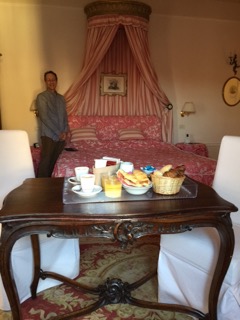
At eight thirty a knock on the door brought the breakfast Wes ordered the night before. The tray was set on a wooden table for two. On it were, in pairs, glasses of fresh squeezed orange juice, flaky fresh large croissants and orange marmelade, caffè lattes, small croissants stuffed with prosciutto, plain yogurt mildly sweetened, and two little, out of place, boxes of Kellogg’s corn flakes.
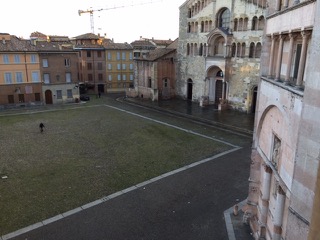
While we ate, the piazza outside our window was still. Occasionally, an elder would pass diagonally through the piazza on a bicycle. The surface of the piazza consists of round fist sized stones pressed into the dirt. It is bumpy and the bicycles clatter as they ride across. In the dirt, between the stones, a hint of grass grows, a skim coat, making a subtle haze of green.
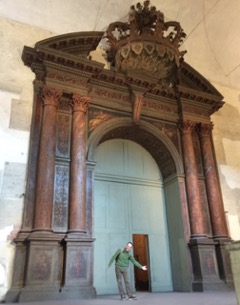
After breakfast we checked out of the Palazzo Dalla Rosa Prati and walked a few blocks to the see the Teatro Farnese. It is accessed by entering a huge building and walking up a massive stone stair way. Approaching the second floor you see the impressive entry facade.
Wes bought our tickets. We walked to the entry and at the same time a large tourist group arrived. We thought we’d have the theater to ourselves. Not to be. The theater has a flat concrete floor. That would work well for one of it’s early uses, four hundred years ago, as an armory for tournaments. Against the walls amphitheater style are wooden bleachers. From the flat concrete floor there is a long ramp for tourists to ascend to the stage. The stage is framed by a large wooden proscenium arch.
It is said, this proscenium arch is one of the first, if not the first. So the large forty person group ascended the ramp. On stage they formed a semi-circle. Then, they began to sing. A men’s choir. The room filled with music. Magic. We became glad they were there.
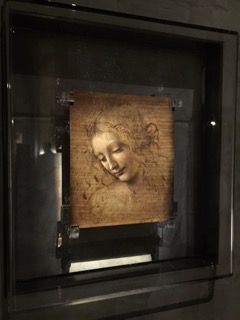
The Farnese Theater exit took us directly into the Pinacoteca, the city’s art gallery. There are many paintings. Big ones. Tiny ones. All old. My favorite, from the forty five minutes we were there, was a tiny self portrait by Annibale Carracci with intense eyes. Another painting stands out for it’s beauty and simplicity. A small drawing. Of a woman’s face. By Leonardo Da Vinci.
From the Pinacoteca we went to the Teatro Regio, the main symphonic and operatic hall. In a ball room upstairs we attended a well attended eleven o’clock chamber music concert. The concert was followed by a light buffet lunch. The line was long. We were at the front. I spoke with the violist from the ensemble. He will come to America next August to drive Route Sixty Six from Chicago to California. His colleagues all remarked how lucky we are to be in Bologna for four weeks. We are.
After the concert, we walked to the train station. En route, we passed by the tiny three story house where Arturo Toscanini was born. The door was open. Toscanini’s children or grand children gave the house to the city of Parma. Now, it is a museum. We began our visit on the top floor. The clerk played a film for us. It was about forty five minutes long. Absolutely fascinating. Toscanini is an icon. The film makes justifiably clear why. It is an emotional story.
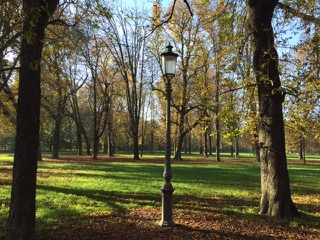
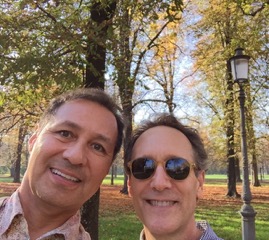
Finally, steps away from the Toscanini house is the Parco Ducale. It is long corridors of trees and green lawns ringed with chestnut trees.
Arrivederci Parma.
Wes and Marlow
8 November 2015
Parma
Modena and Parma: 7 Nov 2015
Wes and Marlow7 November 2015Modena and Parma
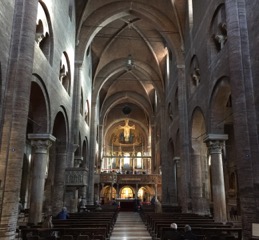
Early this morning, staying in the birthday celebration mood—mine and Wes’s on next Sunday, the fourteenth—Wes had the idea to go on a field trip. We chose Modena and Parma.In Bologna, everyone asked, “why Modena?” They were kind of right.In Modena, we walked ten minutes from the train station to the Duomo. I wanted to see where the great tenor, Luciano Pavarotti’s funeral was held. Where he laid in state for two days visited by 100 thousand mourners. He was a caricature in many ways, but as a tenor he was stellar.
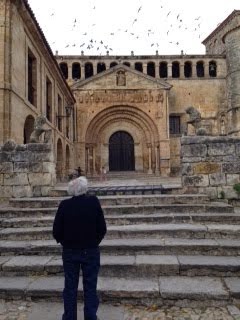
The Duomo is also stellar. It is more than nine hundred years old. Red brick on the inside. White marble on the outside. Historians say it is a magnificent example of the Romanesque style. I cannot judge that. But I can say that it has a simplicity, a restraint that is like a palate cleanser when one tires of tremendously ornamented cathedrals. It has on it’s walls many reliefs of people and events. The carving is bold, to the point and straight forward. The interior has an unusual altar. It splits into upstairs and downstairs altars. It is a pleasure to stand in front of each object and absorb the fine details.(Modena Duomo)
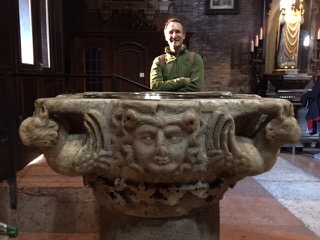
Look who I found at the holy water bowl!(Modena Duomo)
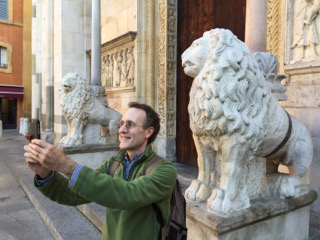
Outside, it’s white marble facade gleams. Clearly, it has been recently cleaned. An interesting feature at one of it’s four entries is a pair of stone lions standing guard. They are two thousand years old, carved in the Roman era. They were found, buried, during the construction of the Duomo.There’s that holy water guy again!
The Duomo is worth a visit, but the rest of central Modena is chaotic. Awful pop music blasts from store fronts. Combined from the various sources they make an aural nuisance. There are street musicians. They are not a pleasure. An electric guitar player, one street from the Duomo, cranked his amp up to wildly loud. Eventually, we found our way to the Palazzo Ducale, a nice area. We found it en route to the train station. We abandoned Modena. We hopped on the train to Parma, thirty minutes away.
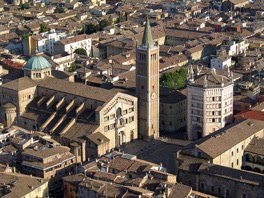
If you google Parma it is easy to find where we are staying. Look for the Duomo (cathedral), then the octagonal pink marble Baptistry next door. Our hotel is exactly the next little building, to the right in the photo, with a red roof, on the piazza.(Parma Piazza)(I did not take this photo. It is from the internet. But I did take the other photos.)
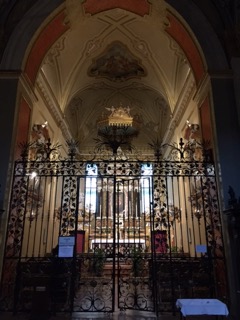
The Parma Duomo is a feast for the eyes. It is entirely with frescoes from floor to ceiling. The floors are large slabs of pink marble from front to back and up and down the stairs. Along both side walls are chapels.Each one has ornamental iron gates and is a full production on it’s own. Wes pointed out, it looks like a theatrical set for Puccini’s opera, Tosca.(Parma Duomo)
From our corner room we look out at the magnificent buildings of the piazza. The room is perfect. Small upholstered sofas, a canopy over the bed, the appointments are elegant, small scale, old world, beautiful. It could not be nicer.We will return to Bologna Sunday night. But Parma, at least in the piazza of our hotel is like a beautiful dream.
Wes and Marlow7 November 2015Modena and Parma
Bologna: 6 Nov 2015
Wes and Marlow
6 November 2015
Bologna
We are at the start of a wonderful meal!
The Drogheria was probably once a pharmacy, hence the name. Now, a ristorante, it sprawls through what were once corridors and pharmacy prep rooms. Mostly tables for two set in former hallways. The wall shelves, formerly for merchandise, now are filled with books within reach of our table. Mostly they are in Italian. Art books: Immagini e Documenti Matera by Matio Cresci. Quattro Passi per Bologna by Giampiero Montanari. In English, an announcement for an upcoming lecture on March 14, 2000 by Harold Bloom on The Importance of Being Misunderstood: an Homage to Oscar Wilde. And Vincenzo Agnoletti’s Manuale del Cuoco e del Pasticciere. Before our food arrives we will be intellectually satisfied.
A small unordered appetizer has come and gone. A small ball of luxurious mozzarella. A dollop of lovely red tomato cream. And a miniature lasagna. Petite and perfect layers.
A small pour of wine appears in our glasses. A welcome aperitivo from the host.
Earlier tonight, we began at Zanarini for what is called, the aperitivo. From about six until eight in the evening, with your cocktail, comes a variety of small appetizers. Because it is my birthday we went to a very, very nice place. Once there, we vowed to go there more often. About our cocktails at Zanarini, the barman is reknowned. He has nightly specials. Also you can give him a few ideas and he will create an original. I said: dark rum. He went at it with serious intent. A little of this. A shake of that. A drop and a drip. In my creation were pineapple, lemon, agave and really I do not know what else, but it was an elegant and finely wrought cocktail. Wes had a Manhattan which also was satisfying. We stood at the bar. Patrons came and went. As did a white golden retriever puppy and a King Charles spaniel. Both sniffed and pranced like the puppies they are. Occasionally they yipped when stepped on by a less than graceful patron. The barman brought eidbles to us. First, a bowl of green olives. Then a plate of puff pastry with toppings. Two tiny bowls of miniature fresh tuna cubes with two tiny forks. A plate of four beautiful creations that were a sprig of this atop a dollop of that on a sliver of a whatever. And there was a glass of crudite with carrot, celery and cucumber. The patrons around us were an assortment of high and low but all within the high class. Some absolutely elegant with poise and charm school carriage. Others a bit overdone. After my cocktail, I continued with a rose spumante. It is a birthday, mine, and effervescence is appropriate.
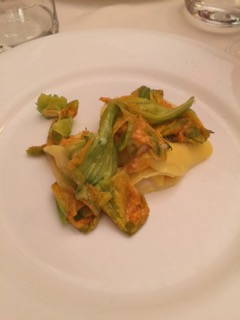
Meanwhile, back at Drogheria, our primi has arrived. It is, let me describe it, more than a ravioli. It is a sack. A pouch. Large enough to fill with two tablespoons of filling. The pasta is house made. That is simply the way it is done here. The filling is squaquerone, a local cheese. It must be fresh. Has to be. It is slightly liquid and mild in flavor. Somewhat like the milky inside of a burrata cheese. Our pouches were filled with it. (Pronounced: squawk-where-oh-nay.) The pouches are topped with steamed zucchini flowers. Very beautiful. The steaming allows the green and orange colors to remain intact and to become more intense. Often the zucchini flower is stuffed or it is fried. Steaming it, to me, in this instance is superior.
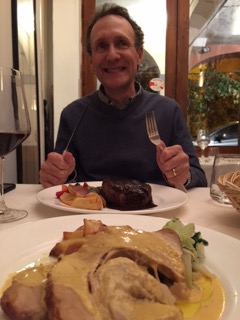
And now for the main attraction. Tranches of milk fed veal (arrosto di vitello) topped with an ultra delicious rose colored sauce consisting of a puree of light color vegetables and probably a large spoon of butter. Beside the meat are gorgeously roasted potatoes and a small heap of green vegetables. I think they are thinly sliced fennel and spinach. Or it is spinach and hard stems with a splash of Pernod.
On the other plate is a slab of beef, one and a half inches thick and extremely rare. Perfect. It is in a pool of sauce made from balsamic vinegar.
Two small frosted glasses of marsala wine have arrived. (I enjoy that they bring unannounced pleasures.)
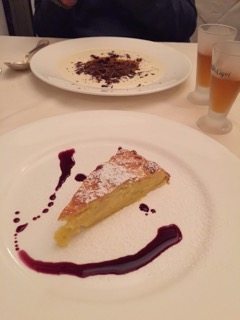
And now, desserts are on the way. Mascarpone with persimmon and shavings of chocolate. Tarta di mela (apple tart).
An amusing aside. A woman just entered the restaurant with a long haired dachshund on a leash. It explains why there are no “doggy bags” here. The dog comes with you. Also there seem to be three dog varieties here: beagles, golden retrievers and dachshunds.
We have now had first bites of dessert. My apple tart is excellent. Wes’s mascarpone with persimmon is beyond description delicious. It is a dinner plate filled with a pool of mascarpone thinned with cream and a tiny bit of sugar. In the center is a small pool of pureed persimmon looking like Monet’s impression of a sunset. Coarse dark chocolate is shaved over the whole thing. It is overwhelmingly good.
An absolutely excellent dinner. An absolutely excellent evening. Happy birthday to me.
Marlow and Wes
6 November 2015
Bologna
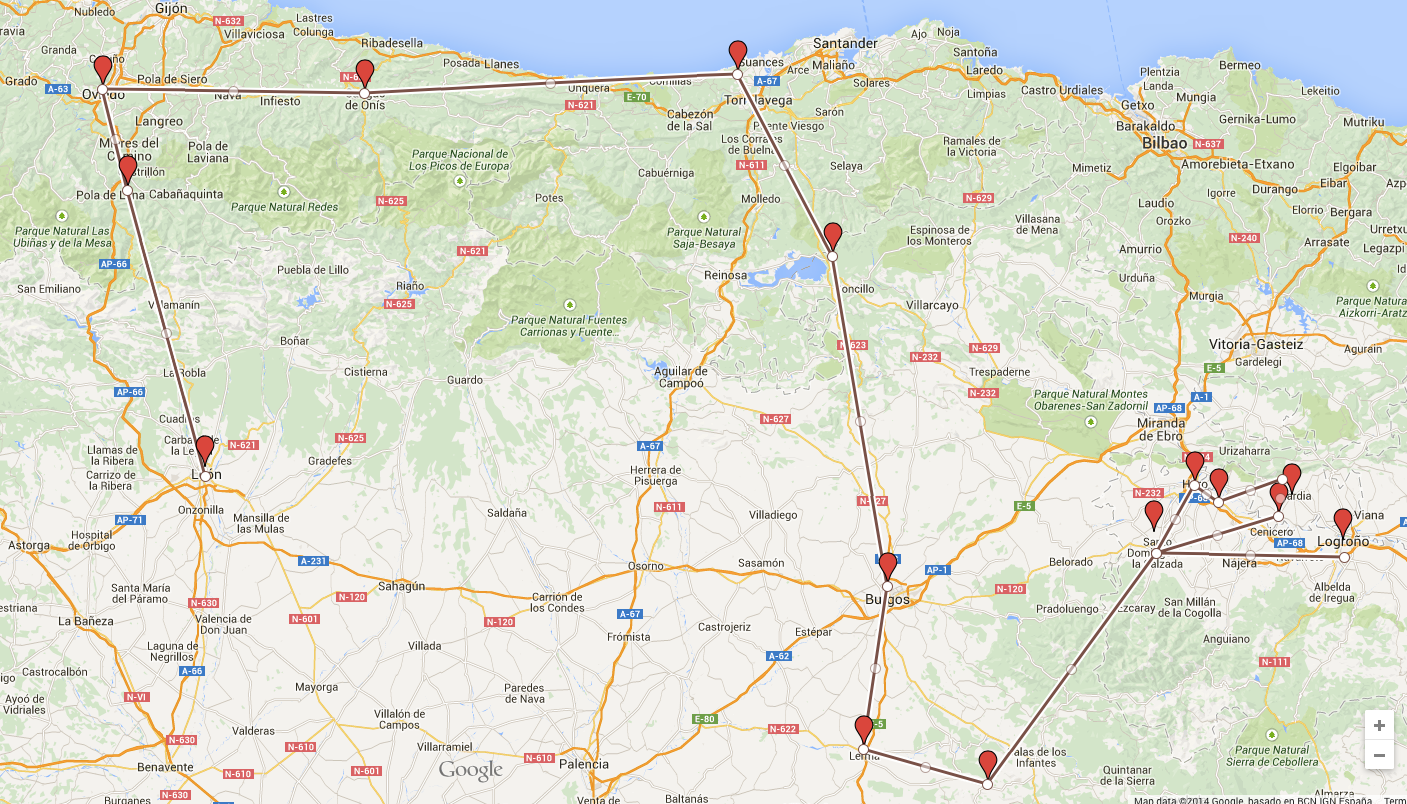
The Route and the Paradores
We started the driving portion of the trip in Logrono on the right-hand side of the map below. Arriving by train from Barcelona in the early evening.
https://www.google.com/maps/d/edit?mid=z1znHUI7zjuY.kOdlBUcMmCgQ
After picking up the rental car and exploring the tapas scene in Logrono, the heart of La Rioja, we drove to our first Parador in Santa Domingo de la Calzada (two nights).
http://www.parador.es/en/paradores/parador-de-santo-domingo-de-la-calzada
Next day we explored La Rioja, visiting Haro, Briones, and La Guardia.
Next day we chose to take a scenic route with many twists and turns and arrived in Santa Domingo de Silos in time to hear the pre-lunch chant. Then on to Lerma to the Parador for two nights.
The following day was spent in Burgos visiting the Cathedral, enjoying a long Sunday lunch and a visit to the monastery nearby in Miraflores.
Next day was our spectacular drive through the Cantabrian mountains to the Altantic coast where we stopped for lunch before arriving to our third Parador in Cangis de Onis at the fringe of the Picos de Europa (three nights).
Cangas de Onis was our base to visit Oviedo and the Picos and enjoy the comfortable Parador. After three nights we drove to Leon for the final Parador, one of the jewels of the Paradores system dating from the 16th century.
After two nights our Parador Fiesta came to an end and we took the train to Madrid.
Spain: Part 2 of 3
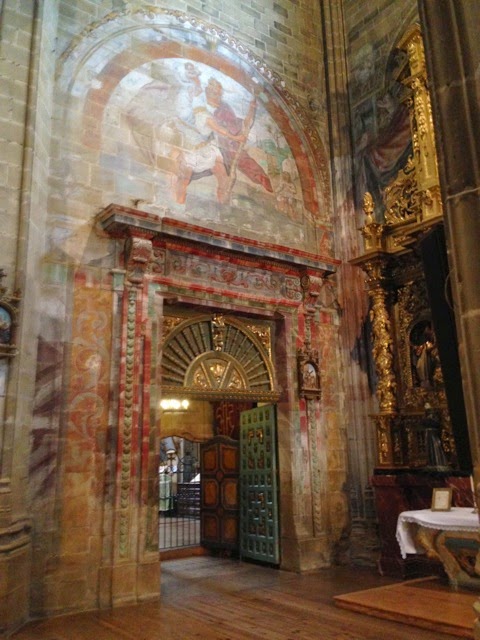
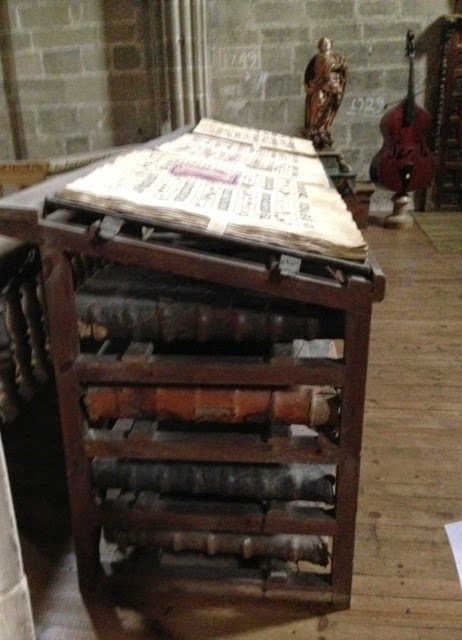
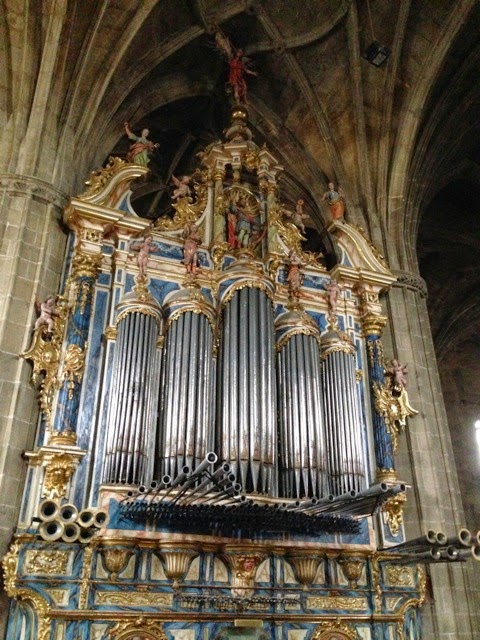
The Parador system in Spain began in nineteen twenty-eight as a way to promote tourism. The government wisely selected mostly ancient buildings to convert into luxury hotels. A few of them are modern. The majority are former monasteries and palaces. We stayed for a few nights in each of these four Paradors: Santo Domingo de la Calzada, Lerma, Canga de Onís and León. They are an hour or two drive from each other in the northern regions. The drive takes you through the verdant Cantabrian Coast and the dramatic Picos de Europa Park. The area is rich in physical evidence of Spanish life in the ninth-Century. Here, Islamic Moors battled with Christians for domination. The Moors were repelled in the eighth-Century, never again to dominate there.Sam and Kathy, know the area well. They led us to and guided us through the significant buildings of that era.From Santo Domingo de la Calzada, we visited the hilltop village of Briones, population eight hundred and fifty-ish. It’s main plaza is a small triangle with a church, a city hall, a few cafés and a small open-air market with a half-dozen vendors. We bought fragrant, crisp, local, green apples with brown splotches. Homely and delicious. We bought figs, too. Then we went in to see the Nuestra Señora de la Asunción Church. Inside, a man, a volunteer, was applying gold leaf to details on the inside of the door. He took note of our appreciation of his church. How could we not marvel at the rare features. When we visit ancient churches, their walls are stone, bare and unpainted. Centuries ago, many of those walls were painted with designs and images in brilliant colors. Through the years the paint has worn away. It still resides in the fine holes in the stone. And scientists are able to detect it and render images of the colorsthat were once there. It is rare to find a church where the paint has not worn away. This was one of those rare churches. The man invited us to see areas off limits to tourists. He led us up wide stone steps, smoothed and uneven from five hundred years of foot steps. In the choir loft, the first thing we saw was a pleated bellows the size of a queen-size bed. Most old organs have been modernized, their hand operated bellows replaced with a machine generated air flow. I presume, though I may be wrong, some one has to physically pump these bellows by hand to operate the organ. Like the paint, that, too, is rare. Also in the loft was a long shelf holding two dozen, or so, handmade books. Bound in leather. With pages, not of paper, but of parchment, animal skin. That type of book is necessarily large, about three feet tall and about twenty inches across. Several were open. We could see the large beautifully formed letters drawn with brilliant colors.Briones is in the province of La Rioja, a major wine area of Spain. The wineries were not appealing, small and artisanal. If that type exists, it is not readily apparent. To my eyes, the wineries were large, industrial, factory operations. One winery building stood out, for better or worse. It looked like a giant heap of fettuccine noodles, but shiny, oversized and multi-colored. It was designed by Frank Gehry. Whereas his Guggenheim Museum in Bilbao, Spain is, in a good way, a bold contrast to every thing in that city, this winery looks conspicuously a fish out of water, a bit of a jester’s hat.
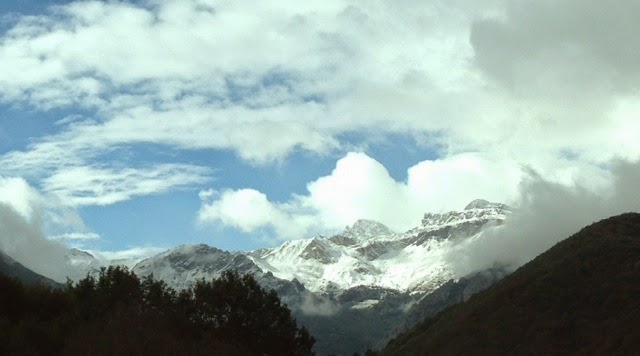
We made our way along the Cantabrian coast. The landscape, as we drove, evolved from hilly vineyards to flat plains, then to stony peaks, then into pastures of lush grass. Not ordinary grass, but a deep, intensely green, plush carpet of grass. And the day was perfect. The sky bright blue. The air autumn crisp. The clouds puffy and luminously white.
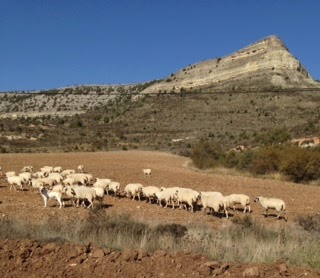
Pushing up out of the greenery were granite peaks. Not hugely tall, but dramatic. Grazing on the pastures were leisurely cows in smallish clusters. Black and white spotted cows. Brown cows. Baby cows. And there were sheep in dark brown and in light beige. Goats, too. I am not certain, but I think they are milked for production of the dozens of local cheeses.
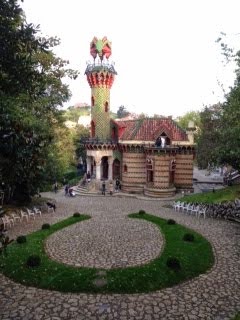
We stopped in the seaside village of Cumillas to see El Capricho, the first house built by Antonio Gaudi in eighteen eighty-five. It is not built with massive curvy stone work like his later work, still it is wildly whimsical and creative, clad in green ceramic tiles that are embossed with large golden sunflower heads and with a very tall round pointed tower poking up from the front door to overlook the sea and the fishing harbor.
In Lerma we spent a few nights in the Duke’s palace on the main plaza. The Duke was a court favorite of King somebody who financed his set of ducal palaces. They dominate the main square in Lerma. Hard to believe our building, overhanging a valley, was someone’s house. It is several floors tall, with towers in each corner, an enormous center courtyard and perhaps one hundred rooms. Ours were in the corner, on the top floor, with an iron balcony overhanging the valley. Wanting a break from eating out, we foraged and had a picnic of jamon Iberico, chorizo, cheeses, chicharron bread and pastry in Sam and Kathy’s room.On the road again, we visited tiny Santillana del Mar, population eleven hundred. The town’s name translates as: “saints” (santi), “plains” (llana) and “ocean” (del mar). It does not have saints, nor is it flat and it is not at the sea. For that reason it is jokingly called La Villa de las Tres Mentiras, The Town of the Three Lies.It consists of idyllic ancient houses separated by winding narrow cobble stone lanes. The town is camera ready, picture perfect. When Sam and Kathy first visited it, twenty-some years ago, they said it looked authentically old. Now, it is somewhat touristy, affluent and maybe a tad jet-set. I imagine when we return in twenty years we will tell people, “you should have seen it back in twenty fourteen.”We had an outstanding meal there at Restaurante Gran Duque. To eat lunch in Spain at one-thirty or two o’clock is to eat early, before the usual lunch time, and it means you have the entire restaurant, the chef and the wait staff to yourself. We had fresh crabs cooked on the grill. And fish, freshly caught, perfectly filleted, sautéed golden crisp outside while remaining moist inside. For dessert, homemade arroz con leche, (rice pudding.) With every meal in Spain we drank wine by the glass. As they call it, Copa de Vino. It is seriously inexpensive at two to five dollars a glass. With few exceptions it was excellent and satisfying.We visited way more churches than I am writing about. Here are a few bits and pieces.
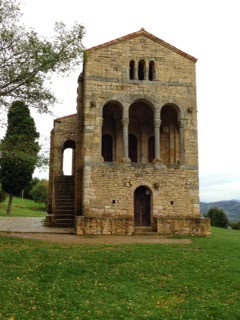
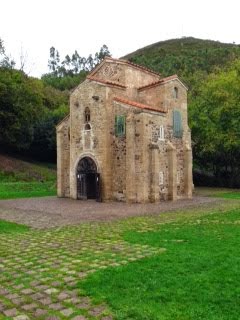
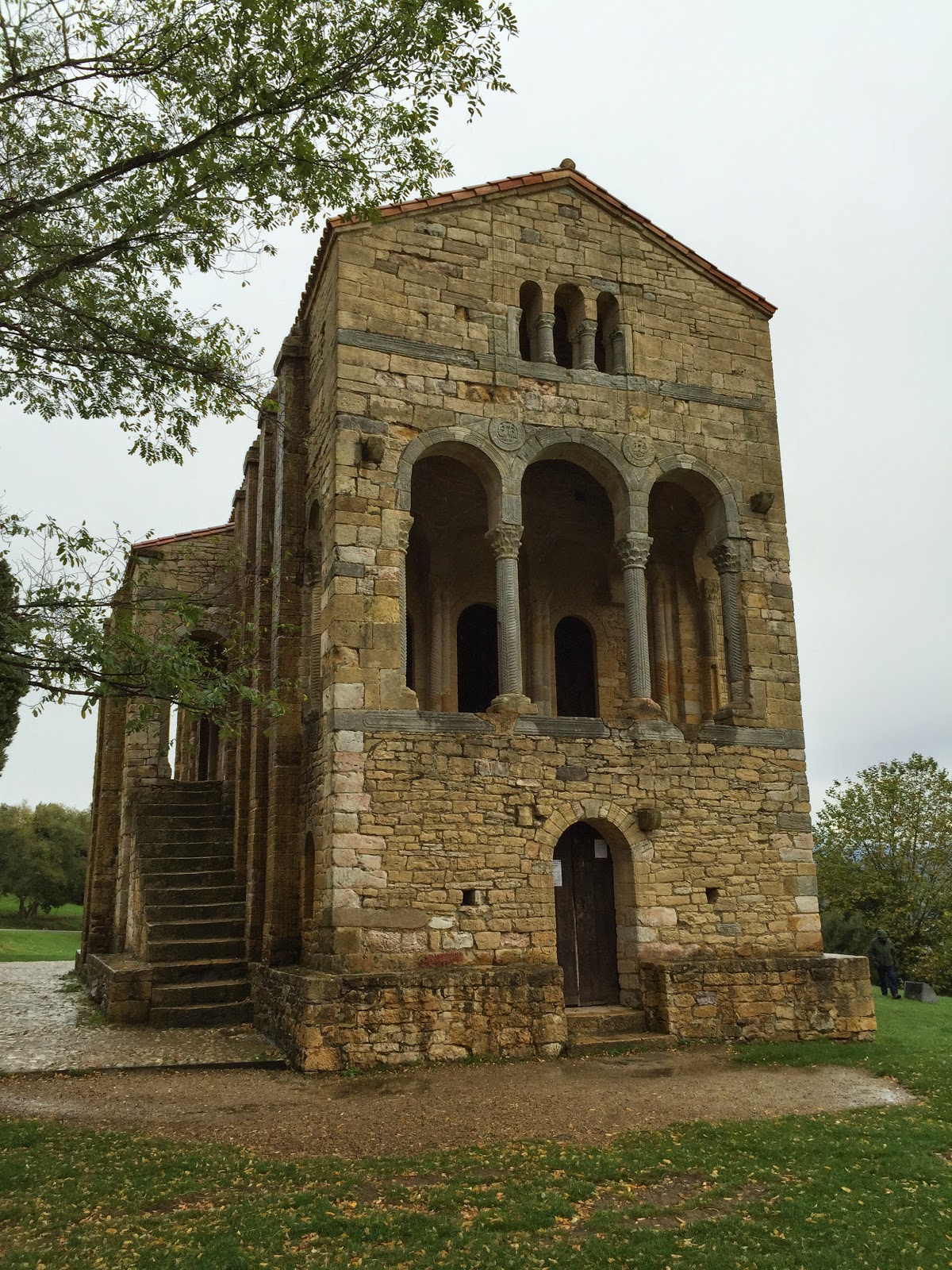
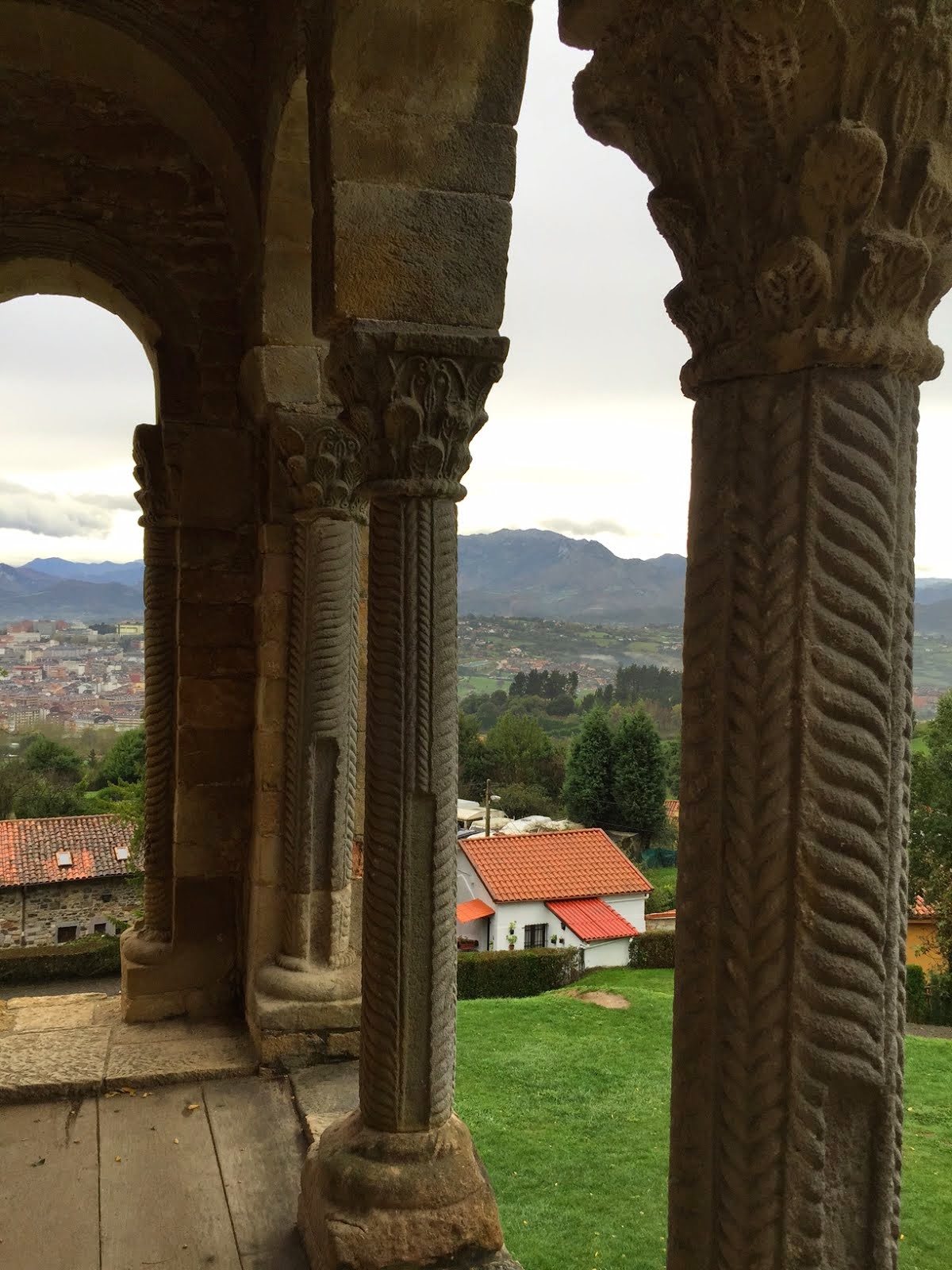
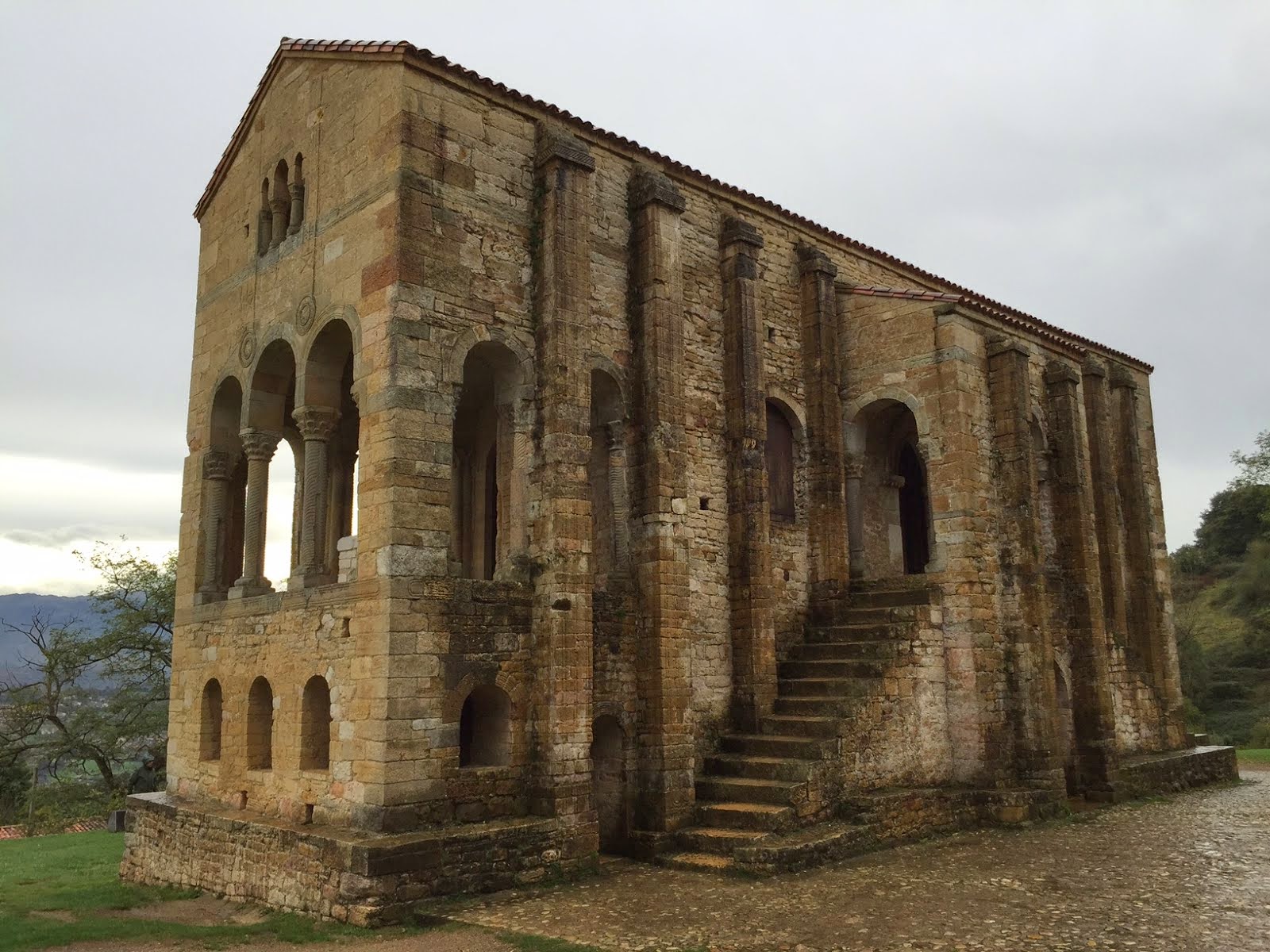
On a morning gray and drizzly we visited, on an Oviedo hillside, the Palacio de Santa Maria del Naranco. Built in the year eight hundred and forty-eight. It was the royal residence
of King Ramiro the First. Some of the oldest buildings still standing are Romanesque style. This building is pre-Romanesque style. There is an altar. On the alter is a stone plaque. The plaque has a statement engraved on it. The uneven writing says, in Latin: Per Famulum Tuum Ranimirum. Principe Gloriosum Cum Paterna Regina Coniuge Renovasti Hoc Habitaculum Nimia. Vetustate Consumptvm Et Pro Eis Aedificasti Hanc Haram Benedictionis Gloriosae. Sanctae Mariae In Locum Hunc Summum Exaudi Eos De Caelorum Habitaculo Tuo Et. (…) Die VIIIIo Kalendas Iulias Era Dccclxxxvia.Which, in English, means: By means of your servant Ramiro, glorious prince, together with his wife Queen Paterna renewed this building consumed by much antiquity, and by means of them built the east altar for the benediction of glorious Saint Maria in this place (…) The ninth day of the calends of July 886 (23 June 848)The compact building, two stories tall, is attractive. Clean lines. Logical distribution of space. Attractive materials. Perhaps, it’s interiors originally were finished with plaster or wood or glass or textiles. But as it is today, bare stone, twelve hundred years later, it could still function well as a dwelling. It was entirely open for us to snoop around. We snooped at our own risk. They trust us not to slip on the wet and worn stone stairs. To not fall off the terraces that are without rails, to not bop our heads in the barrel vaulted cellar that is unlit. Above the cellar is a large, high-ceilinged room with arches at both ends that lead to terraces which have views to the city below. We have to admire the longevity. We have no such things in the United States. We are the New World. We do not have ancient Baroque or Renaissance or Gothic or Romanesque buildings.We saw two other buildings from the same century and in the same style, San Miguel de Lillo and Santa Cristina de Lena. Both beautifully situated and rock solid.
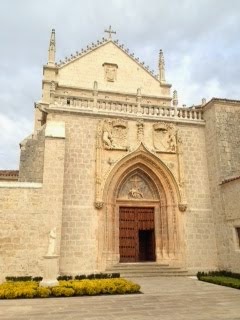
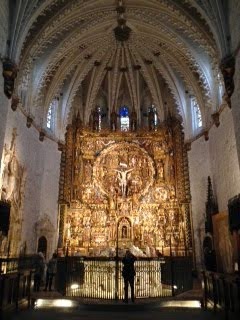
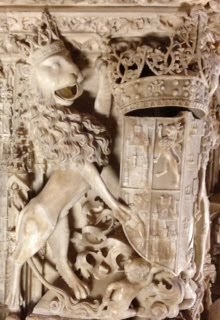
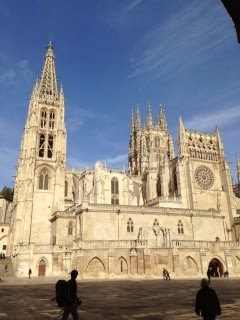
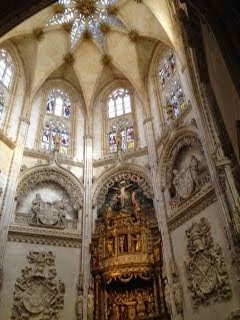
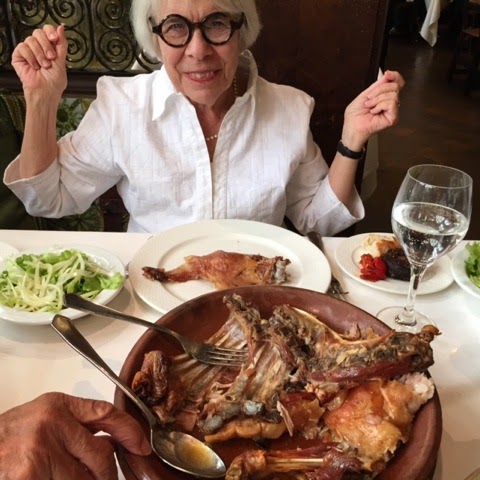
In the VW again, we drove to the Cartuja de Miraflores, a Carthusian monastery, in Burgos.The white-robed monks live in a fifteenth-Century masterpiece of a gothic building. They grow roses. From the petals they extract rose oil. The petals themselves, they compress into beads for the rosaries they make. The building is in outstanding condition. The displays are compelling. Originally, the building was envisioned as a resting place for a royal couple. In fact, the couple occupies a conspicuous and large space in front of the altar. They are Isabella of Portugal and John the Second, King of Castille. Their daughter was the Isabella of “Ferdinand and Isabella”, the Catholics who imposed the Spanish Inquisition (to convert or exile the Muslim and Jewish citizens.) And who sent Christopher Columbus on his fourteen hundred and ninety-two trip to the New World. Their tombs of Isabella’s parents consist of a double wide marble platform ornately carved with scenes from the life of the couple, the history of their land, and with depictions of religious miscellanea. Atop the platform are life size sculptures of the two, laying side by side, at peace, hands crossed, favorite objects surrounding them.Nearby in Burgos we visited the limestone Cathedral of Santa Maria, (the third largest in Spain.)Like many ancient buildings it has been cleaned of it’s centuries of grime and soot. Perhaps it has been a little too cleaned, Sam says. I once had a friend in New York City. He was near seventy years old and wrinkled. One day he decided to have a face lift. But he asked the doctor to leave some wrinkles. He felt he’d look odd with skin entirely unlined and taut at his age. Some of the ancient buildings have been so cleaned, to the Nth degree, they look a little odd for their age. Nonetheless, it is a glorious building with endless features to gaze upon with awe. It is wild to imagine the construction, centuries ago, of these massive churches all done without our modern technology, and the duration of construction continuing for one hundred years or more, so long that the building began in one style and was completed in another, and the people working on them and the architects who did not live to see the completion. Such is the case in Barcelona with the Sagrada Familia Cathedral. It began in eighteen eighty-five. It’s scheduled completion date is around two thousand twenty-five.In Burgos we went to lunch at a jam packed, joyous restaurant, Casa Ojeda. They specialize in Cordero Asado, roast suckling lamb cooked in a large round wood fire oven with a lazy susan cooking surface. (When the meat has revolved three hundred and sixty-five degrees in the oven, it is done.) It was game season, so we also had partridge. And we had venison stew. And there was Morcilla de Burgos. And Lengua Escarlata. Our vegetarian friends would not find the meal interesting. Our carnivore friends would swoon.
Finally, to take in a moment of contemplative music, Kathy led us to Santo Domingo de Silos to hear the Benedictine monks who several years back made a recording. It became the hit record that introduced the general population of the world to Gregorian Chant. There they were. Right before us. The famous monks. In the flesh. Aged flesh. We sat in silence as eighteen of them entered, one by one, a minute apart. Some of them needed that minute because many years have gone by since their hit record and they are slow moving, one was entirely bent over at the waist. A few, a very few were youngish. I thought it was a privilege to hear them. What they chant has a simplicity to it that is soothing because of it’s lack of complexity. They sing daily, several times a day, mostly without listeners. I was appreciative of their disciplined devotion. When it was over, one monk stepped down from the altar into the audience. He looked at us and made a shooing motion. His hands said, we are done, you must go now, so we did.The end of part two of three^^^^^^^^^^^^^^^^^^^^^
Spain: Part 1 of 3
Wes and MarlowSpain Report 1 of 3We are en route home. I thought I would find time to send updates from the road. I did not anticipate that Spain, which we know so well, would fascinate us more than ever. We found the cities–large, small and smaller–so interesting that we wandered and poked our noses into places familiar and unfamiliar. The time flew by. I wrote very little. Here are my make-up updates.
In three installments I will attempt to breeze through some highlights.
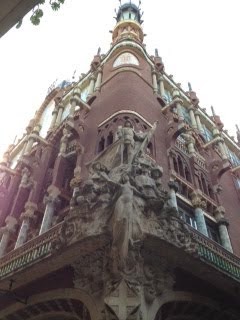
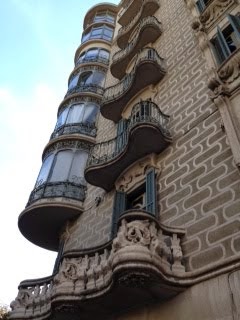
Previously, I mentioned our apartment in Barcelona’s Eixample neighborhood. There, the avenues are promenades shaded by trees and the buildings are spectacular architectural gems.
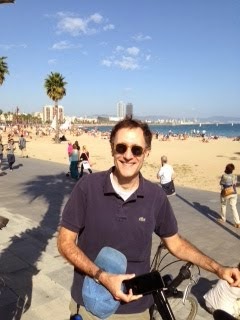
And I mentioned bicycling, for miles, at the waterfront.
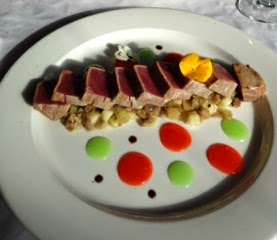
Also at the waterfront, we succumbed to overeating the fascinating, fresh, bold and delicious, whimsical food.
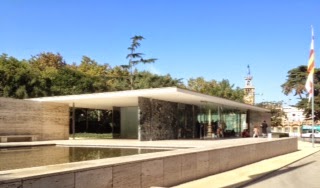
This trip comes during the construction of a garage and guesthouse at home. Our inspiration for it’s design is the Farnsworth House by Mies van der Rohe. We were pleased to see in person, in Barcelona, on a hill, in a park, one of his iconic buildings known as the Barcelona Pavilion. It was Germany’s entry for the World Exposition of 1929. It is free of doors and there is only one central room. We were able to freely walk through it.
After four days in Barcelona, friends, from Santa Fe, New Mexico, arrived and from that point on we were a quartet.
To celebrate their arrival we ate at Siete Puertas. Actually we celebrated their arrival at several places. The first place, Cañete, (recommended by our Barcelona guru) was an oasis of elegance on an inelegant street. There, we sipped Manzanilla sherry from San Lucar de Barrameda, and ate fried eggplant, and shrimp in garlic, and garlic toast smeared with tomato, and dipped spoons into salmorejo, which is akin to gazpacho, but with fewer ingredients: tomatoes, garlic, crustless bread, olive oil and Jerez sherry vinegar, blended into an emulsion. It is thicker than gazpacho, and can be eaten as soup or used to dip things into. Getting back to Siete Puertas. Our travel companion, Sam, first ate there in 1957! At that time, it was one hundred and twenty years old. Today, the experience is much the same as fifty years ago. It turns back the hands of time to an era of old world elegance and a slower pace. It is for us a necessary destination on our Barcelona pilgrimage. We always take a meal or two or three there on each trip. When your bill arrives you are reminded of who else has eaten there. They note, “at your table, ate” Che Guevara, Miro, Salvador Dali, Picasso, King such and such, President so and so. And of literary significance, in one of the rooms, Garcia Lorca first read his poem, A Poet in New York.
Just before the trip, I saw a photo of Picasso wearing espadrille shoes. They looked comfortable. Comfortable shoes are always welcome. Picasso shopped for espadrilles in Barcelona at La Manual Alpargatera. The shop is still there, old, popular and family run. The handmade shoes consist of soles fashioned from of a length of rope, coiled flat, into the contour of a foot. A canvas top is sewn on. And a thin layer of rubber is affixed to the bottom. There is nothing chic or glamorous about the shoes or the store or it’s clerks, but the place is busy with fashionistas and plain folk like me. We bought a couple pair.
We left Barcelona, headed north and west, by train, for our next destination, Santo Domingo de la Calzada, in the province of La Rioja. The train let us off in Logroño. Wes rented a car and took us into town. Just off the Logroño town square (which is ringed with leafy manicured plane trees) we found a circuit of narrow pedestrian streets lined with eateries. One eatery with a grill in the front was cooking large mushroom caps. They smelled good. I asked to see a menu. She said, no menu, all we cook are mushrooms. The street was jammed with similar “one item”
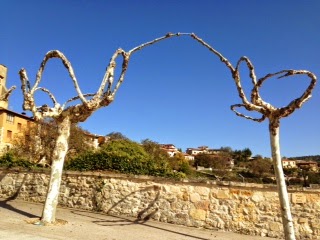
eateries. We had a delicious wine that night. One Euro (US $1.25) a glass. Tasted fresh off the vines, fruity, light, like fresh squeezed grape, but not sweet. We had arrived into the La Rioja region of vineyards and wineries. About the manicured plane trees, they are planted in a row. Select branches from tree one are bent and attached to select branches from tree two. Eventually, they fuse. When the trees are totally leafy they form a continuous uninterrupted canopy of green.From Logroño, we drove forty minutes to Santo Domingo de la Calzada, a walled stone village with a big history. About one thousand years ago there lived a man named Domingo Garcia. All he desired was to do good works. After being rejected by monasteries he struck out alone to make life easier for the pilgrims on the route to Santiago de Compostela.
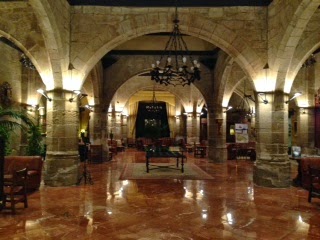
For more than one thousand and one hundred years—since the Christians beat off the Islamic Moors aided by Saint James (Santiago) who appeared, flying on a horse, with a sword—people have walked on pilgrimage to the cathedral in Santiago de Compostela in the north western most part of Spain. Beneath a blindingly gold, larger than life altar, and in a silver casket, are the reputed bones of Saint James. The pilgrims today walk from all over Spain and also from France and Germany. Without question it is an intense personal journey for those who walk. Getting back to Domingo Garcia, his village had a river impeding the route of the pilgrims. To smooth their way he built a bridge. Then to enable them to rest he built a shelter and hospital. That building is now a hotel, the Parador de Santo Domingo de la Calzada where we stayed.
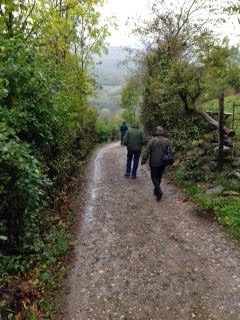
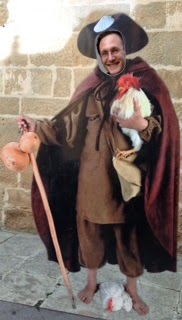
It is a compact building of only two floors tall, but it is built with massive stones. It is more posh and luxurious than in Domingo’s time, but in a way it still serves as a place to rest and recovery on one’s journey. Domingo Garcia, after his death—at age ninety—was sainted. His name was transformed to Santo Domingo. And the Order of the Dominican Friars was created in his name and honor. Here is pilgrim Wesley on the Camino.
Just across the cobblestone lane is a cathedral with Santo Domingo’s tomb. Also, there are a resident chicken and a rooster. In the fourteenth-Century a girl fell in love with a boy. He rejected her. She plotted revenge. She planted a silver object in his pocket then turned him in. He was convicted of theft and hung. His parents, when they went to view the body, found him alive. Santo Domingo, the dead saint, had witnessed the injustice and rescued him. The shocked parents visited a local magistrate at his dinner table. They said, “our son is alive”. To which he replied, “your son is no more alive than this hen and this rooster on my dinner platter”. Immediately, the hen and the rooster stood and danced on the platter. Miracle complete. To honor the miracle, in the cathedral, opposite the tomb of Santo Domingo, high up on an ornate wall, there is a luxury coop with a live hen and a live rooster.
The end of part one.
Churches
After food, visiting several outstanding churches from distinctive time periods was a close second highlight of this trip. One of the benefits of traveling with Sam and Kathy is their ability to pick the best of the best to visit. And once there, to describe the various features that contribute to the uniqueness of these historic places. Here are a few highlights:
CHURCH OF OUR LADY OF THE ASUNCION – Briones
This was an unexpected joy to come across on our day of driving through the vineyards of Rioja. Actually one of the “newer” churches we would visit – dating from the 12th century with major additions in the 17th century. We were fortunate to find the church restorer at work and he was happy to take us up to the organ loft.
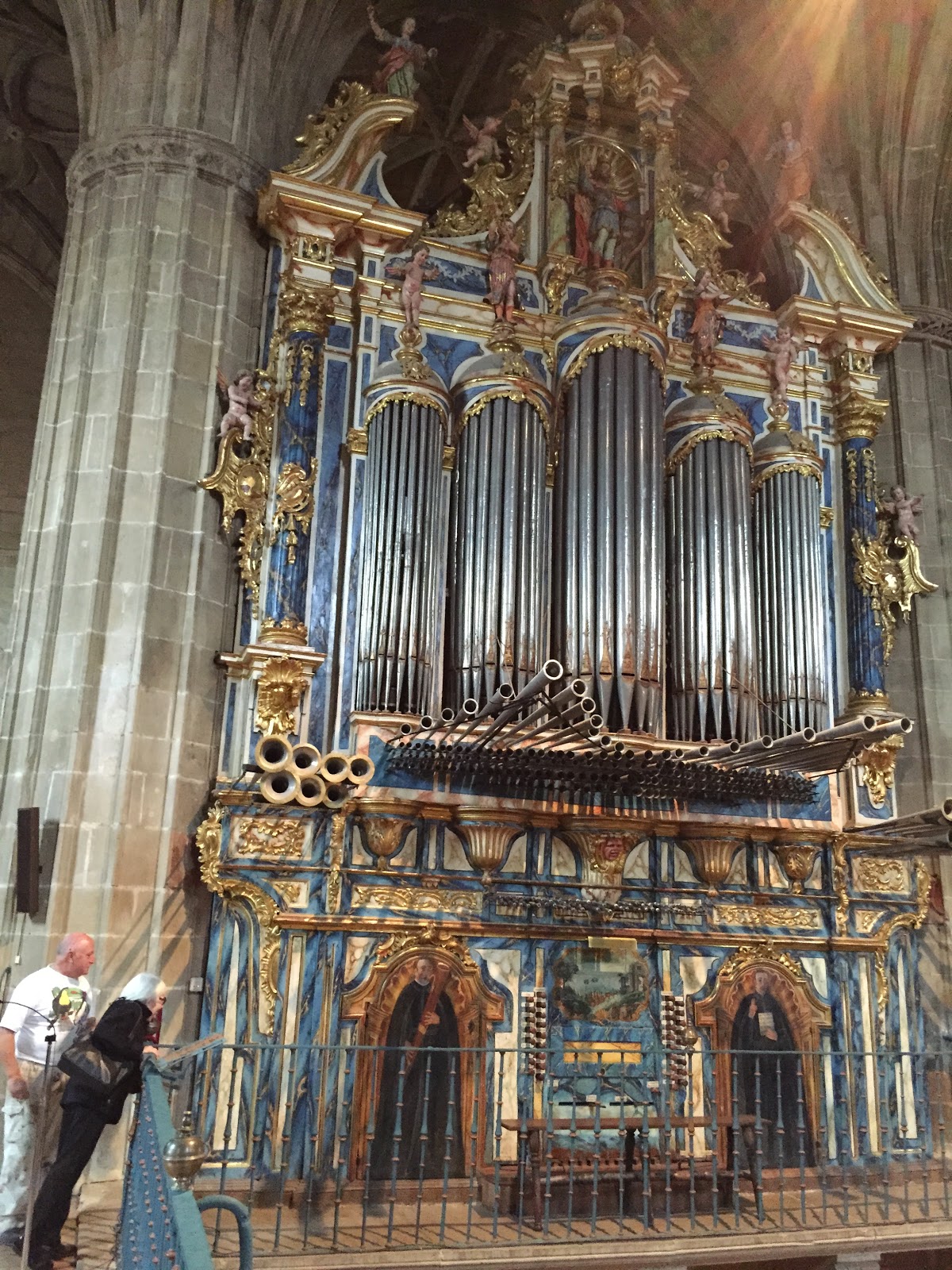 |
| We were not able to hear the “live” organ, but the restorer played several recordings for us. You can imagine how powerful the horns are. The organ was also recently restored. Although Kathy is a harpsichordist, she also plays the organ and has played on several of Europe’s finest organs and was delighted to see this one. |
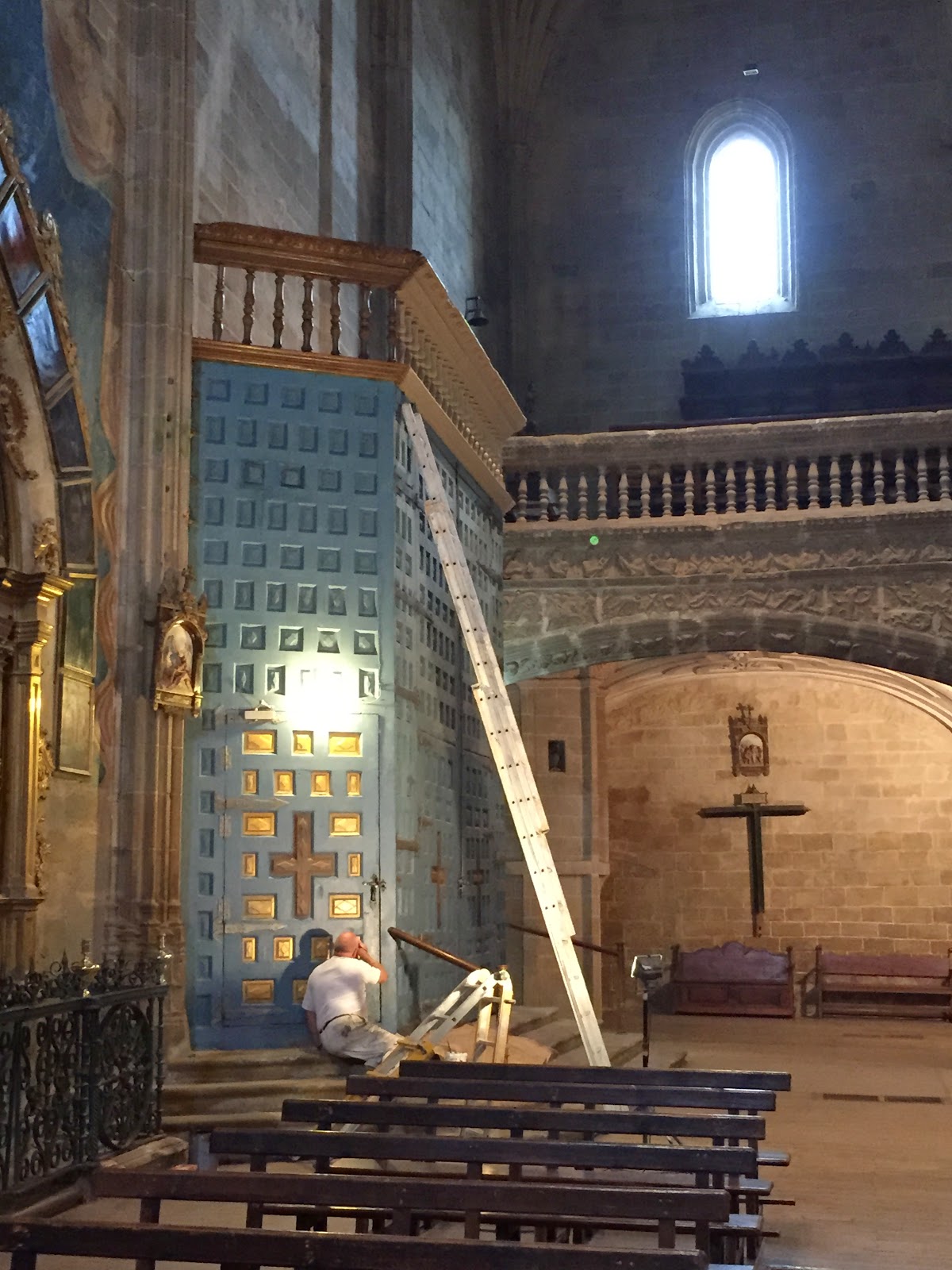 |
| Restoration of gold leaf. This craftsman took us upstairs to the organ loft. |
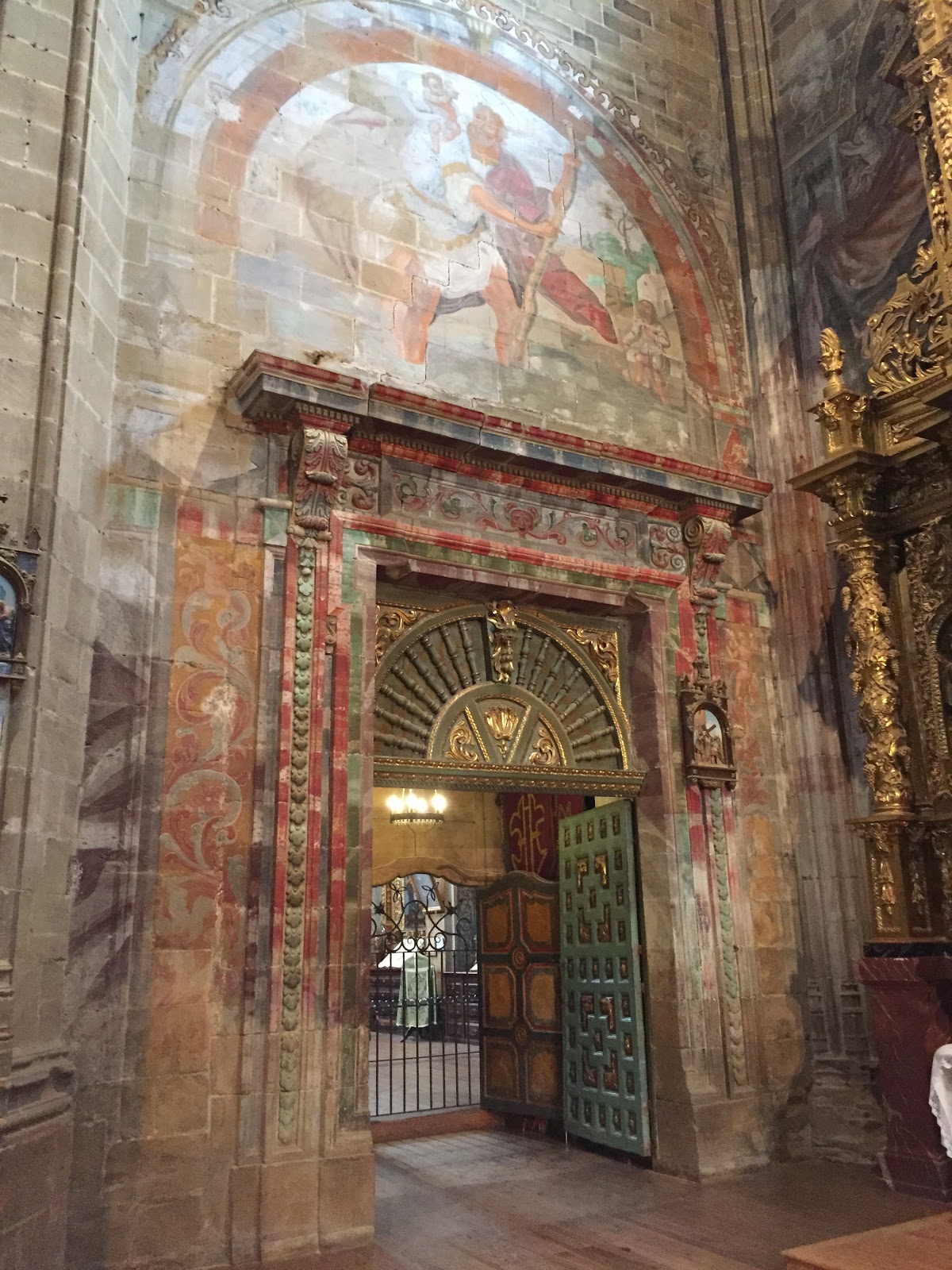 |
| It is unusual to find sizable remnants of the polychrome that used to adorn church walls – especially in this condition. |
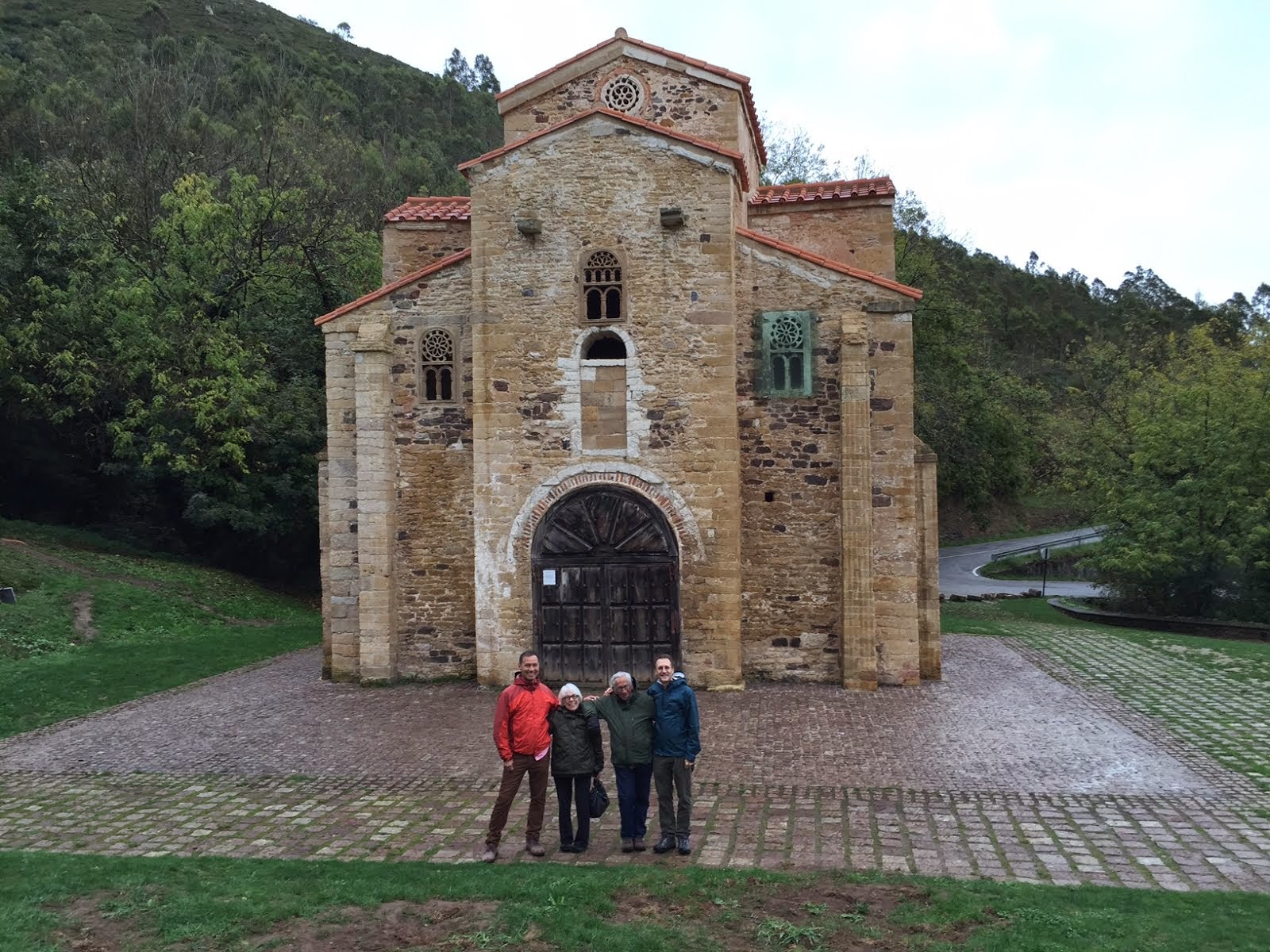
SANTA MARIA DEL NARANCO AND SAN MIGUEL DE LILLO, near Oviedo
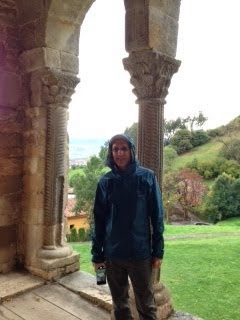
Two pre-romanesque well-preserved structures from the 9th century located in the hills above Oviedo close by each other.
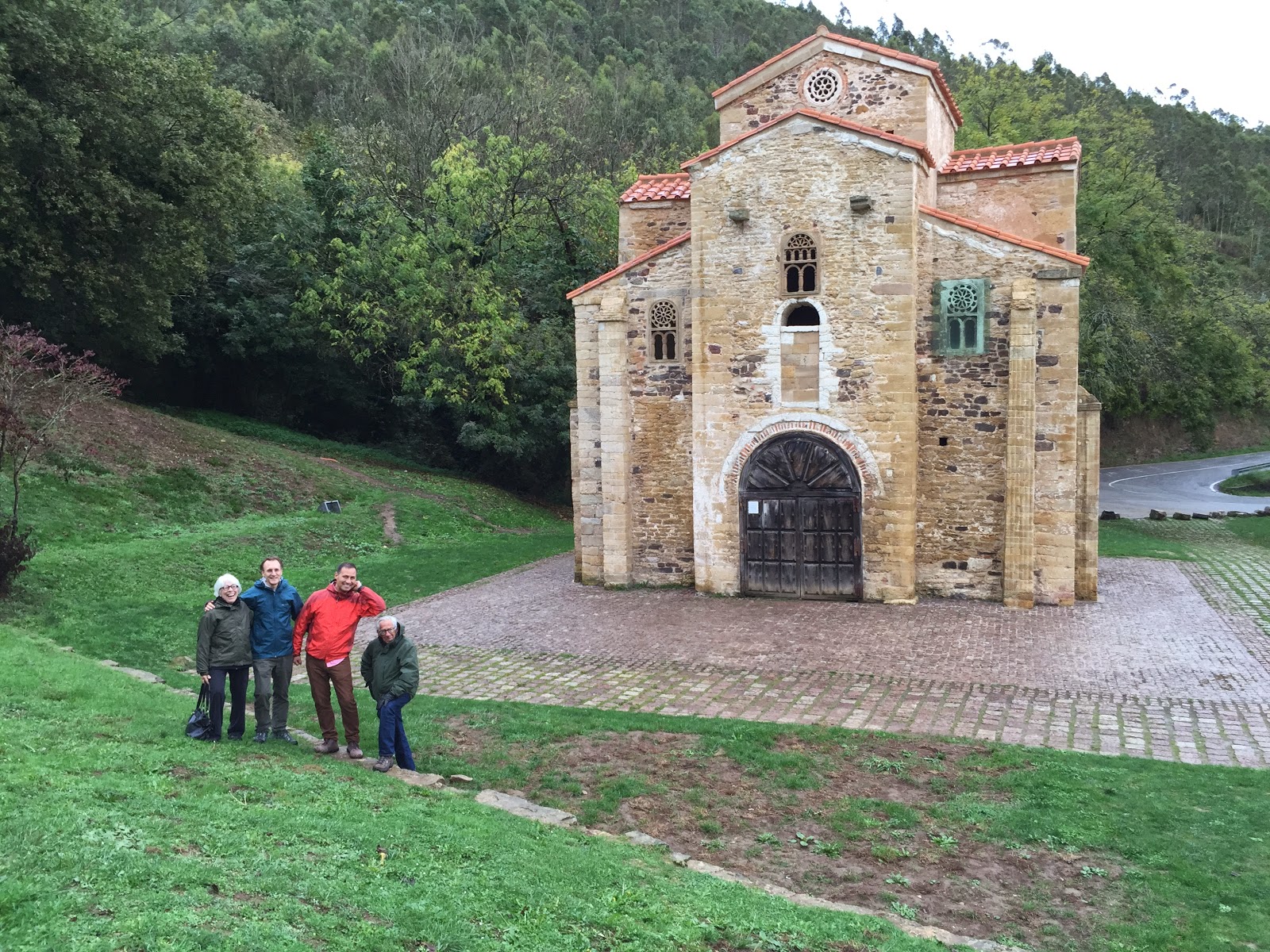 |
| San Miguel de Lillo |
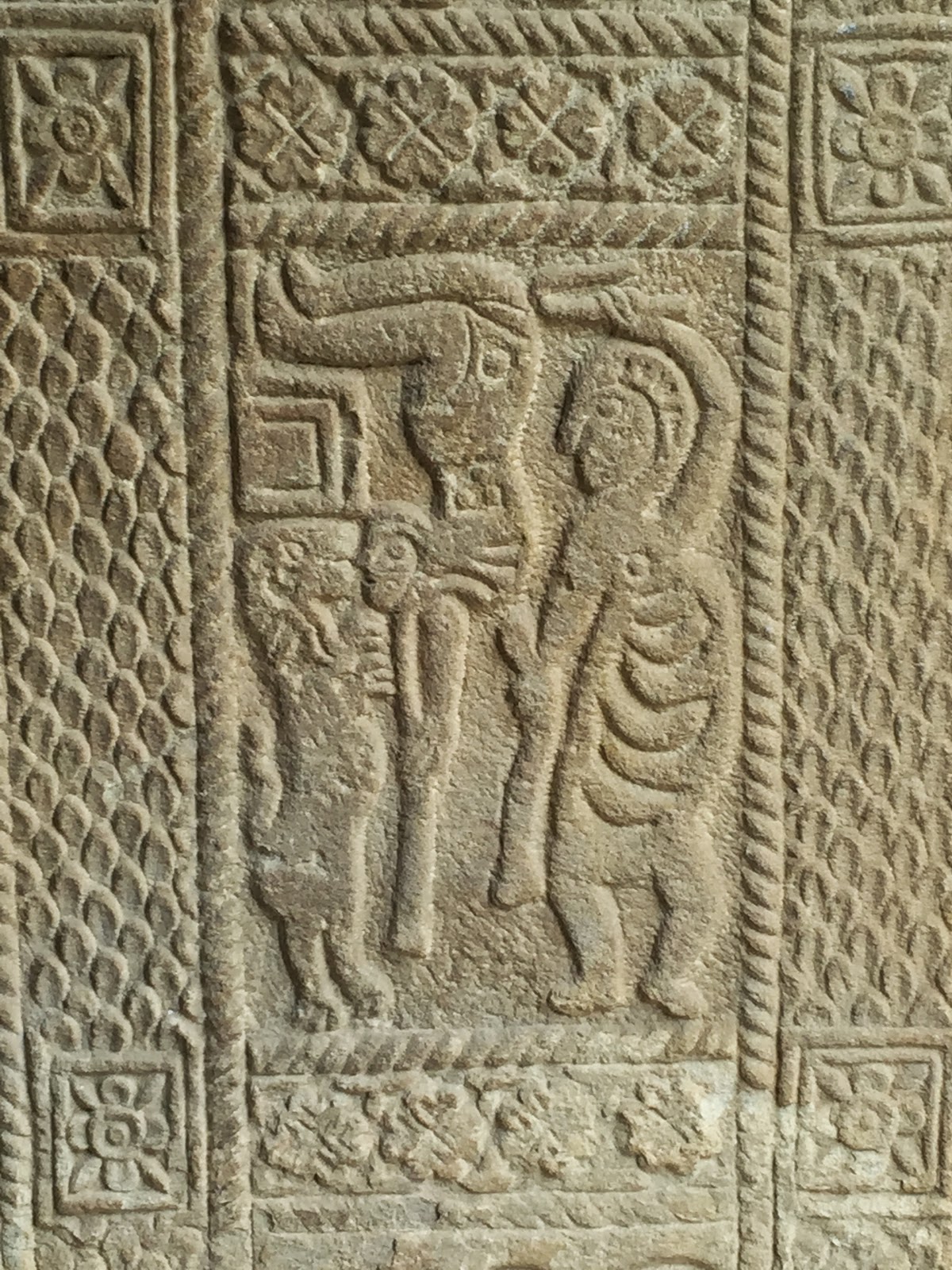 |
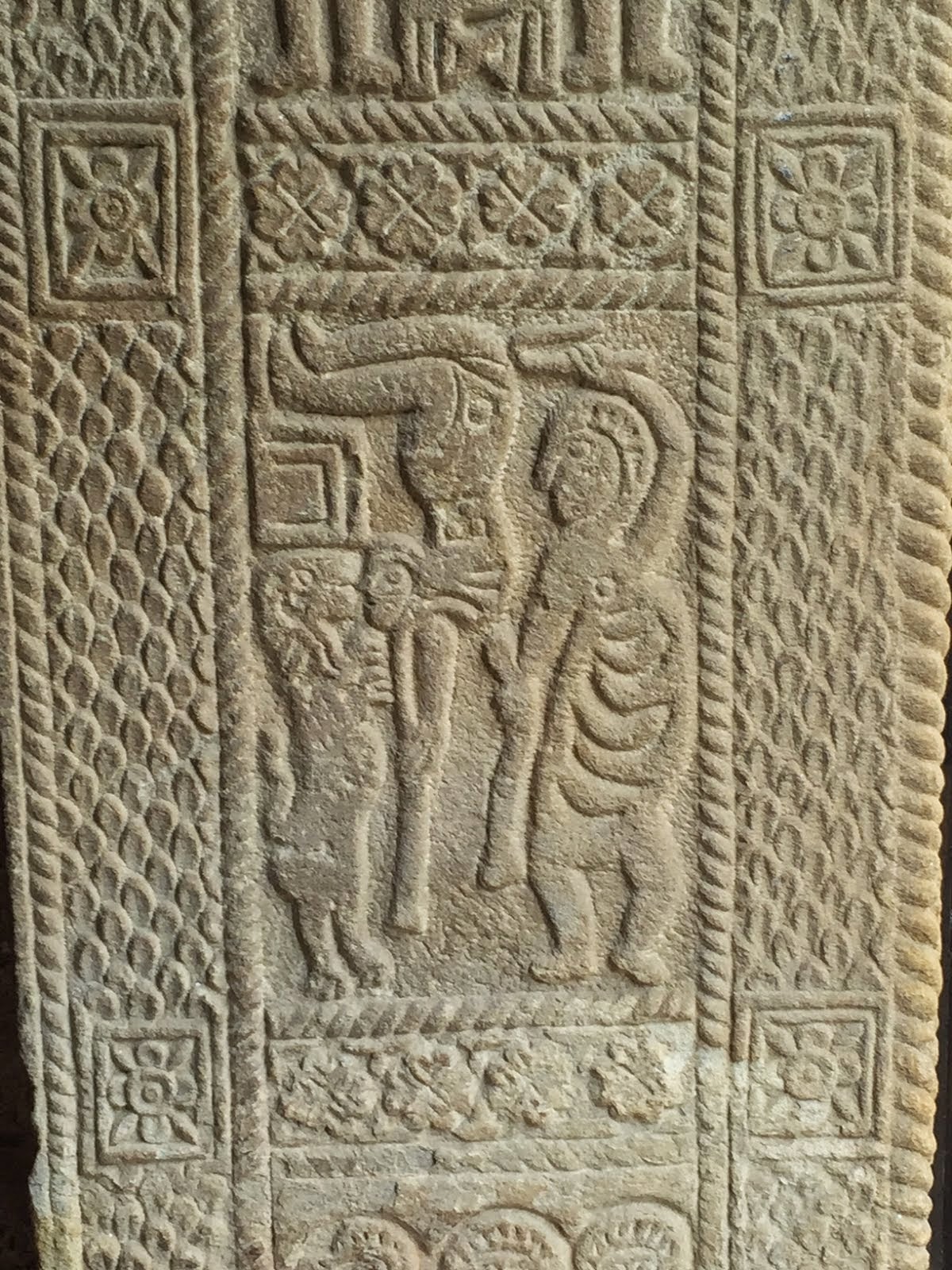
| Detail of acrobats from the 9th century. |
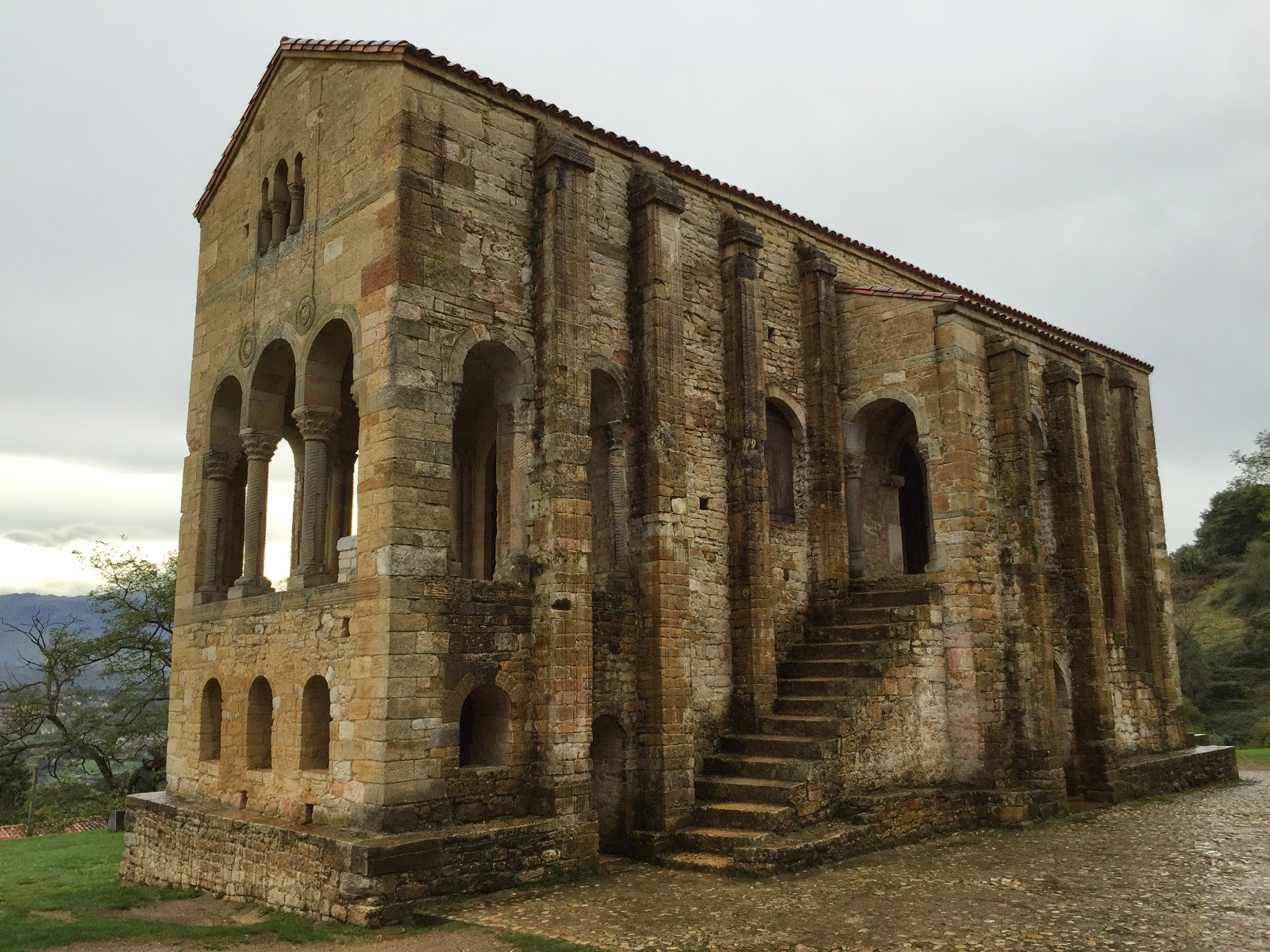 |
| Santa Maria del Naranco. Originally built as a recreation room for a royal palace that no longer is standing. Converted to a church in the 12th century. |
VALDEDIOS, Asturias
Pre-romanesque church from 9th century sited adjacent to a 13th century cistercian church and monastery.
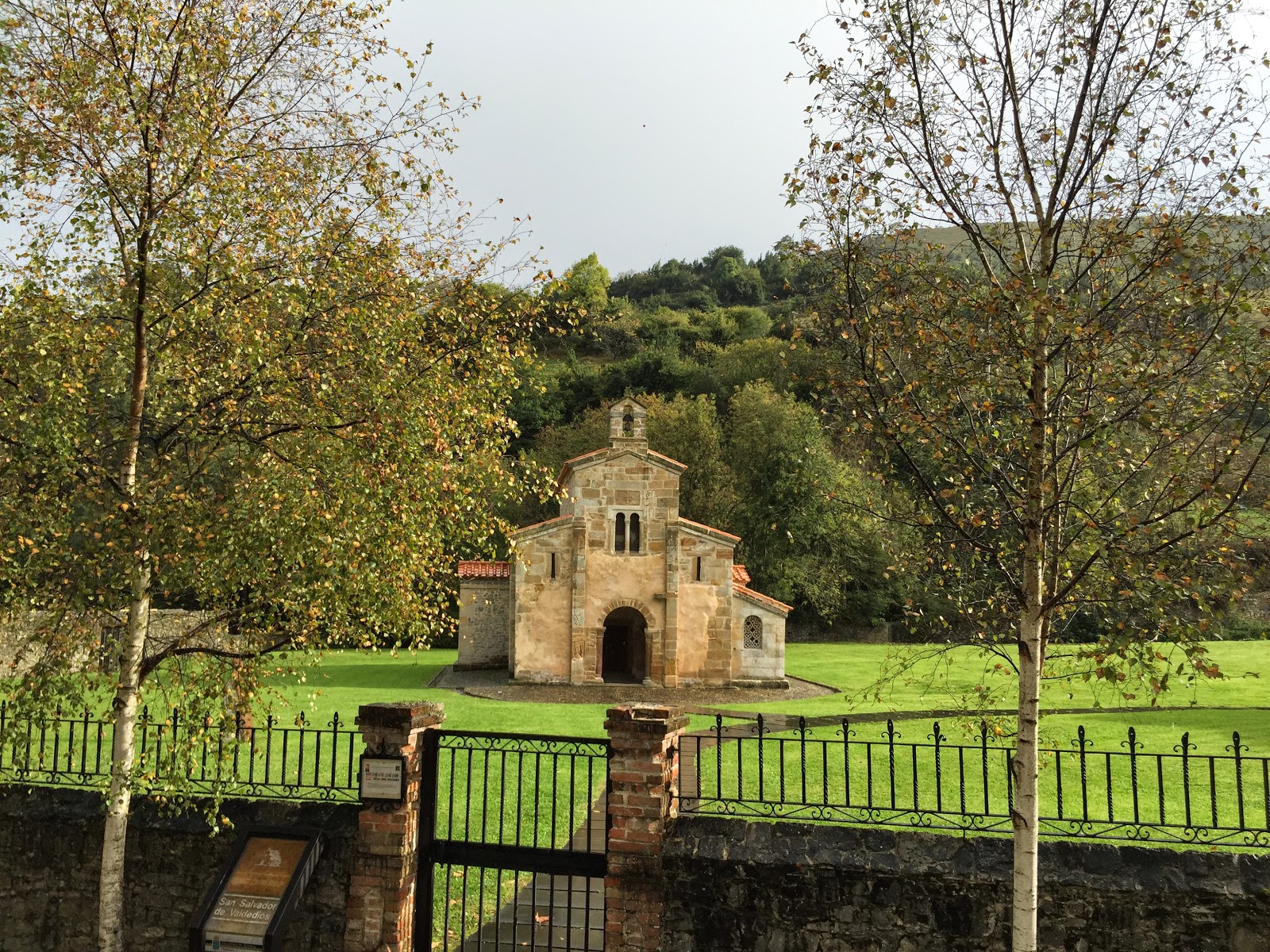 |
| The 9th century church. |
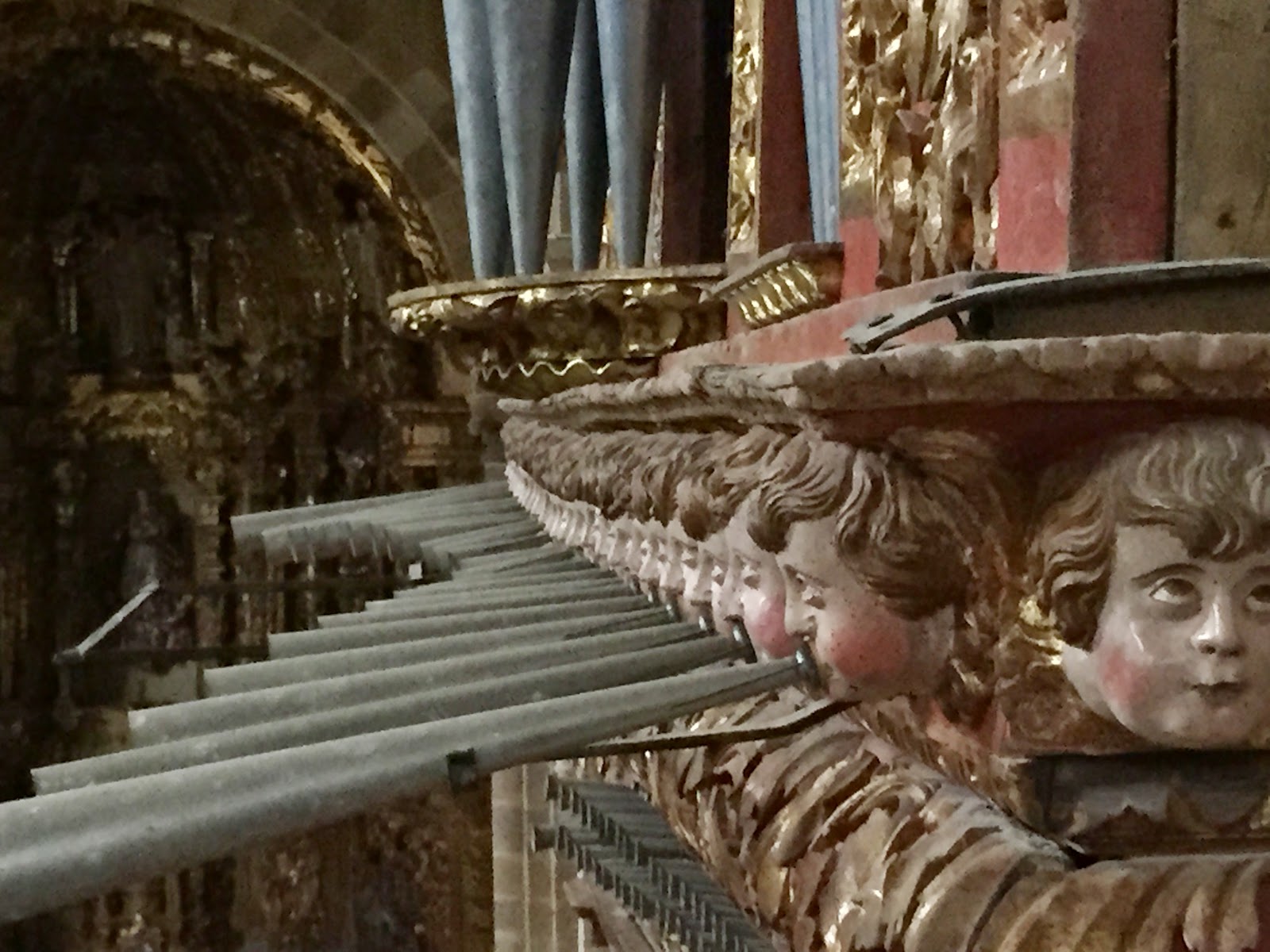 |
| Detail from organ in adjacent church. |
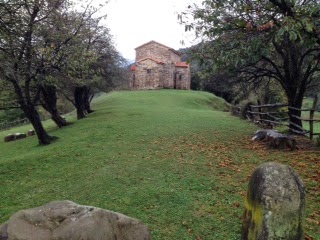
SANTA CHRISTINA DE LENA, between Oviedo and Leon
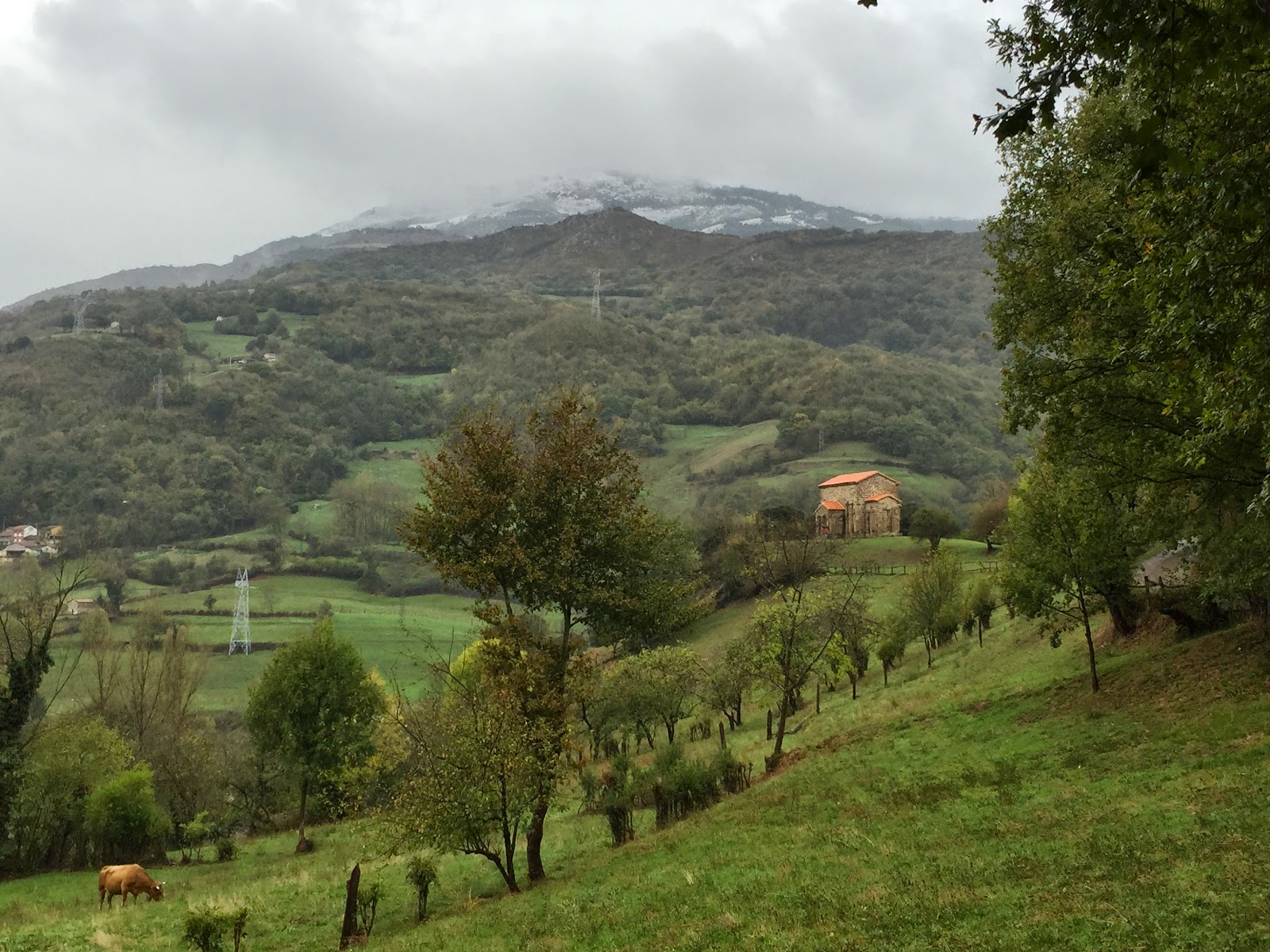 |
| Church off in the distance. |
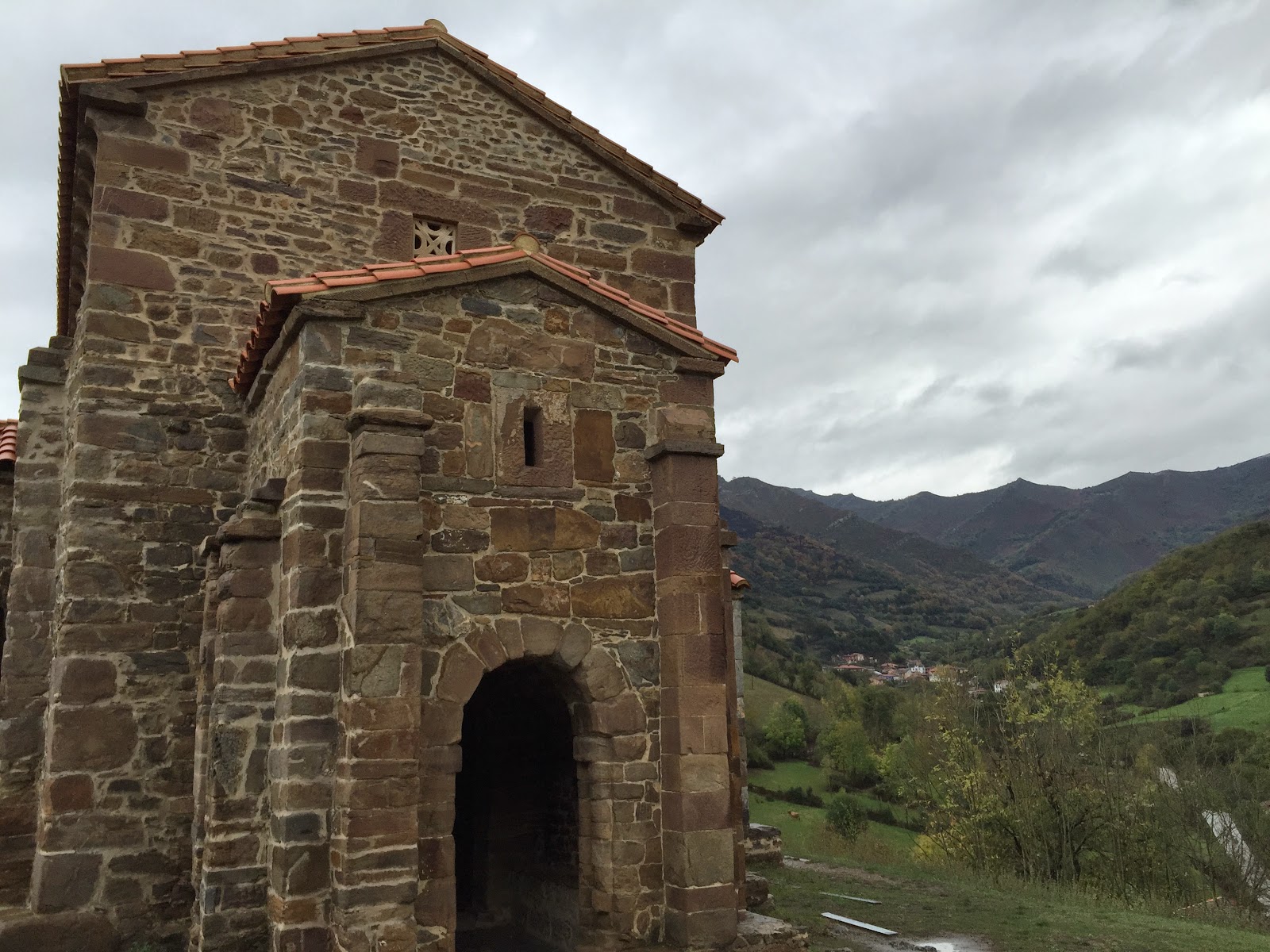 |
| Exceptional condition for a 9th century structure. |
SAN MIGUEL DE ESCALADA, near Leon
Mozarabic church from 10th century.
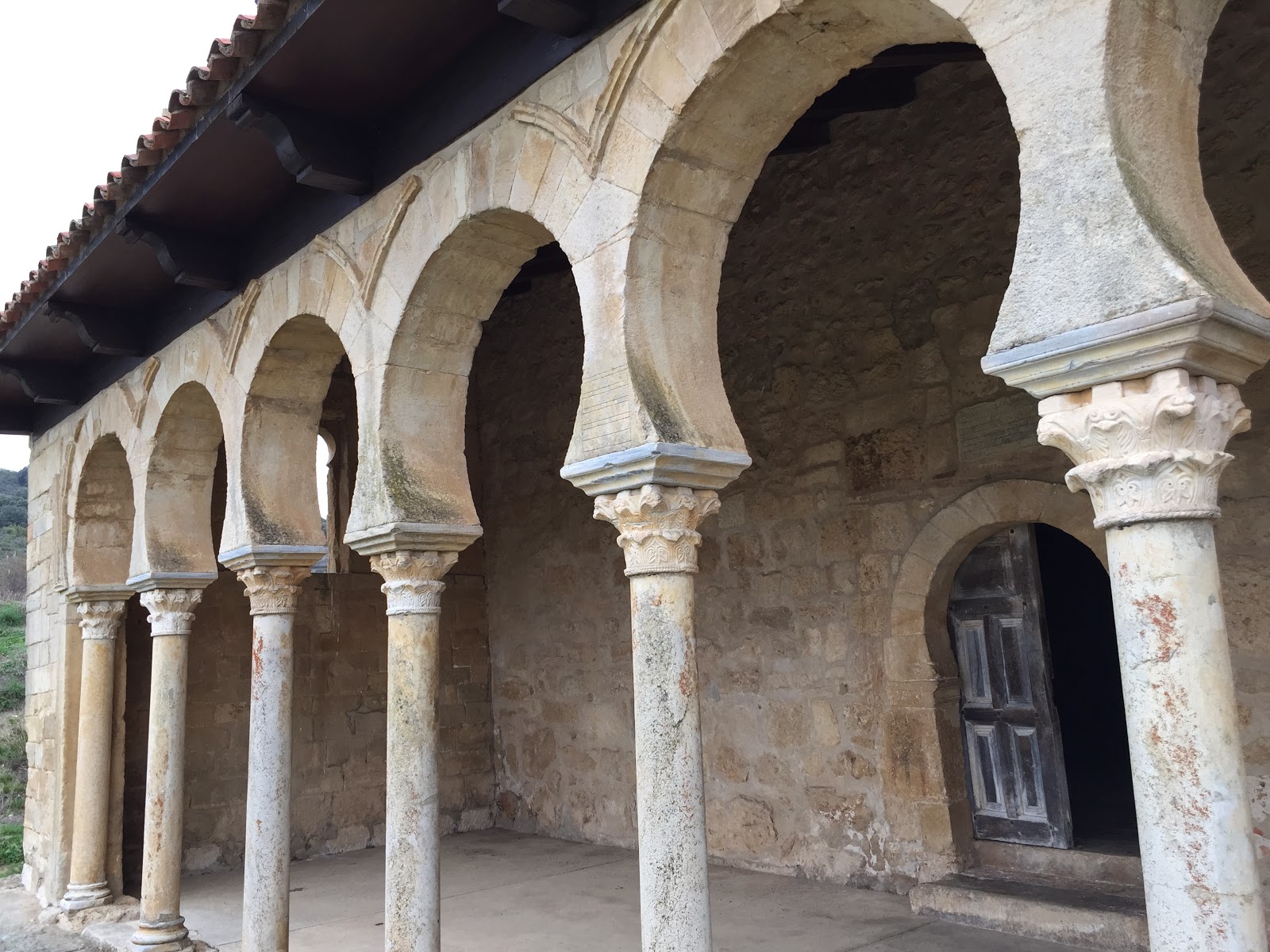 |
| Classic mozarabic arches typical of southern Spain but uncommon in the North. |
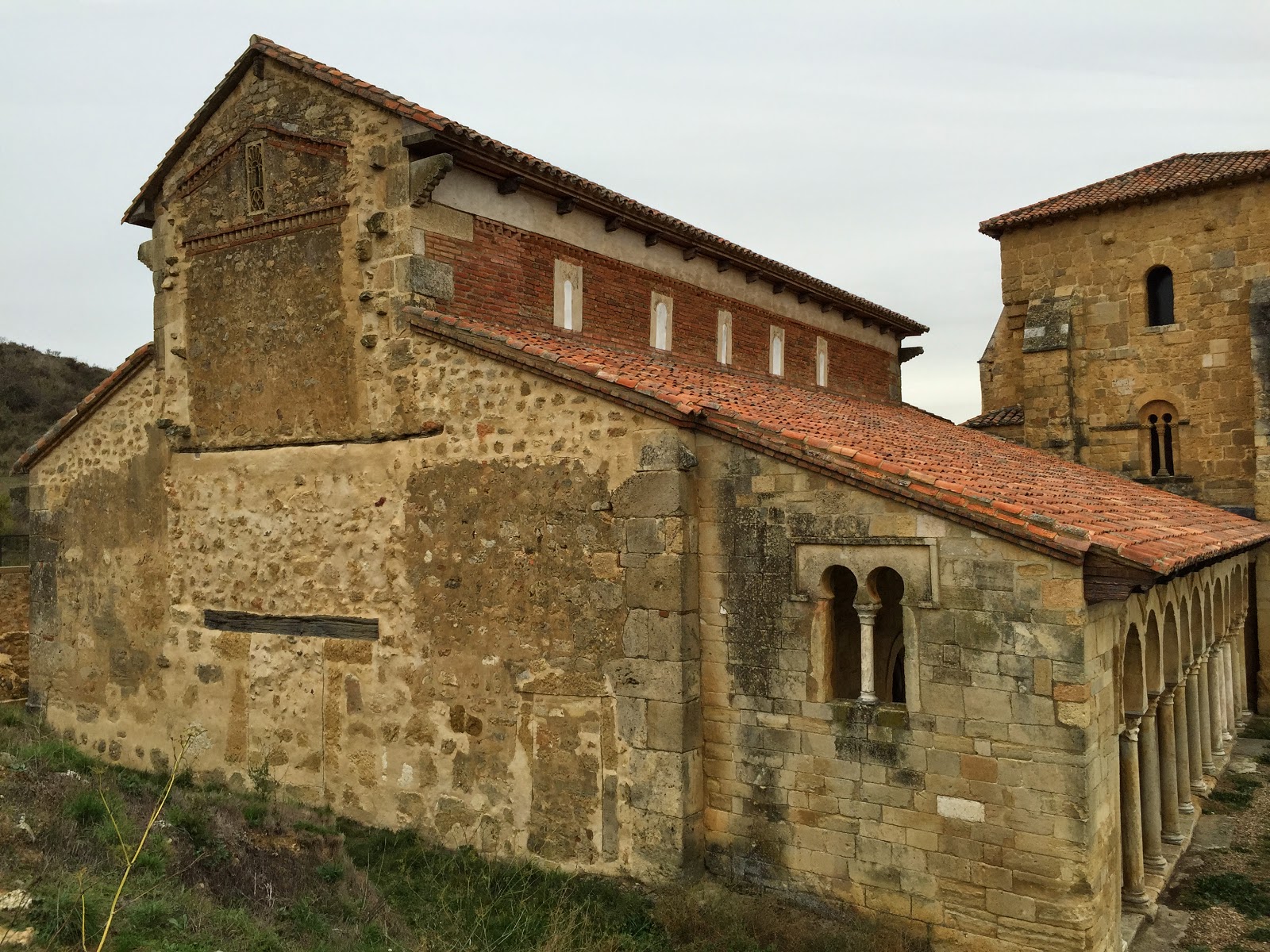 |
| A well preserved structure. |
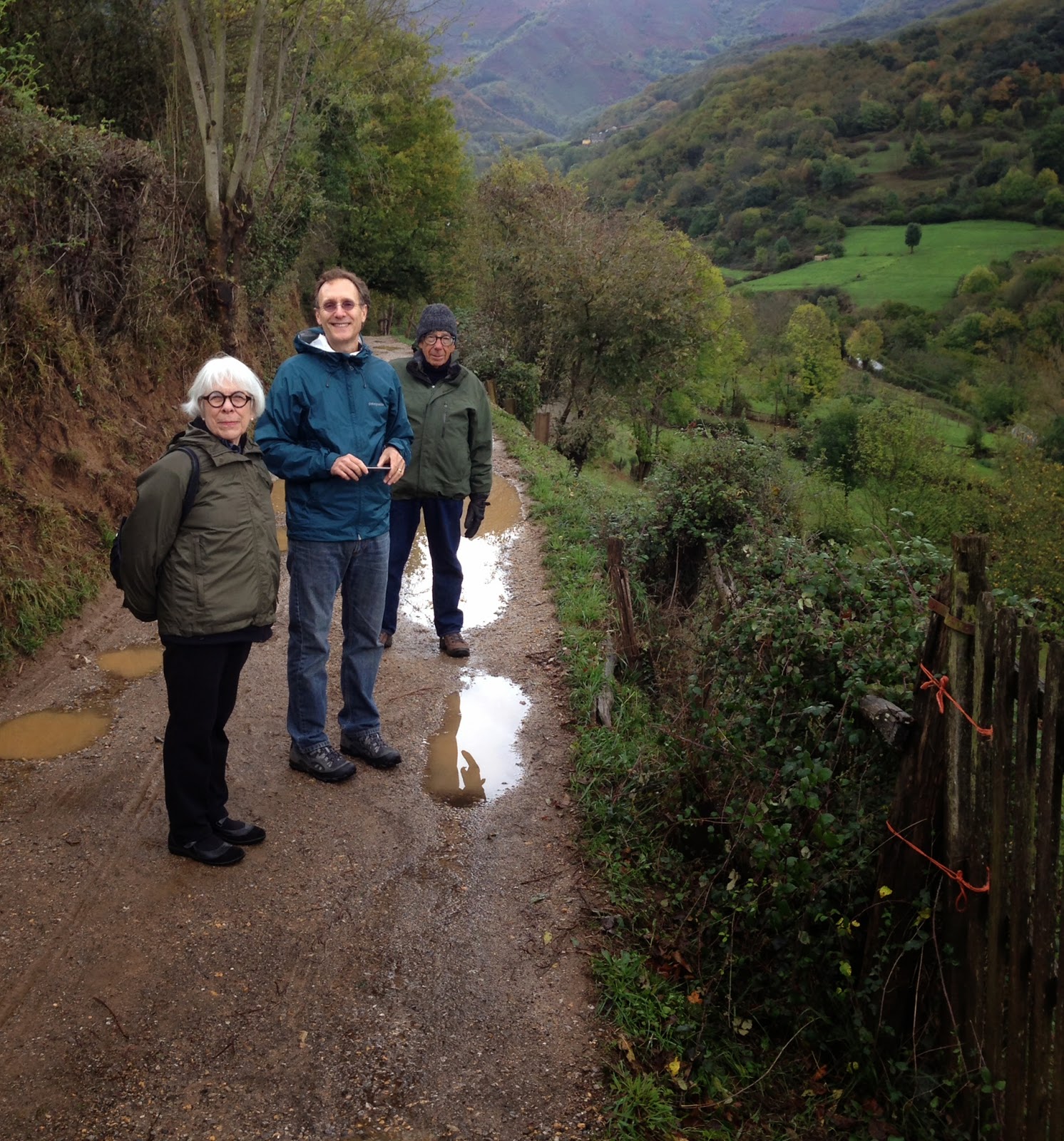 |
| On the trail. |
Cangas de Onís, Asturias
At our inn, over the door way, the date Sixteen-Twenty-Eight is carved into the stone. Above that are two stone coat of arms. The structure was a monastery. It is two floors surrounding a courtyard. It is all in heavy golden stone, burnished dark wood glass and warm lighting with comfortable chairs. Classical music wafts through the inn. Schubert's Trout quintet. Mendelssohn's Hebrides overture. Tchaikovsky's Swan Lake. Mozart string quartet. In addition to local wine, local hard cider is popular here. In the Sidreria (Cider House) in town they make a show of pouring it into your glass from the farthest distance their arms will stretch. We looked forward to our first sip. We expected fruity apple something. What we got was yeasty, acidic, vinegary tang. It tasted alive. The life in it fairly overwhelmed the nose. I am certain, had we grown up here drinking it, it would have tasted delicious.
Cangas de Onís is nestled in the Picos mountains. They are stony topped, forested in the middle and down below are carpeted in lush green grass—they get a lot of rain—with cows and sheep and goats lounging, living a good life of slow pasturing.
The Sella river snakes through these parts. (Sella is pronounced Say-Yah). The narrow two lane road snakes beside it and passes through tiny villages that end as quickly as they began. Little stone houses, some cozy with smoking chimneys. Others barely standing with heavy red tile roofs sagging into their old aging wood beams. There are bridges, impressive stone bridges, some are two thousand years old, the newer ones are eight hundred years old. Built to last.
We are near the center of Spain's north coast which is on the Bay of Biscay and the Atlantic Ocean. What tourists there are are Spanish. Where as Barcelona was international, here we are immersed in the sea of intense Spanish culture.
At this moment we are driving the above mentioned narrow lanes, passing the villages, admiring the cows, en route to old churches built one thousand two hundred years ago. How many generations have passed since they were built? And probably in some nearby village there are folks whose great-great-great ancestors were part of that church community.
Wes and Marlow
3 November 2014
Canvas de Onís, Asturias, Spain
Photos of two spectacular Romanesque churches from the 9th century outside Oviedo.
 Wes & Marlow Travel Blog