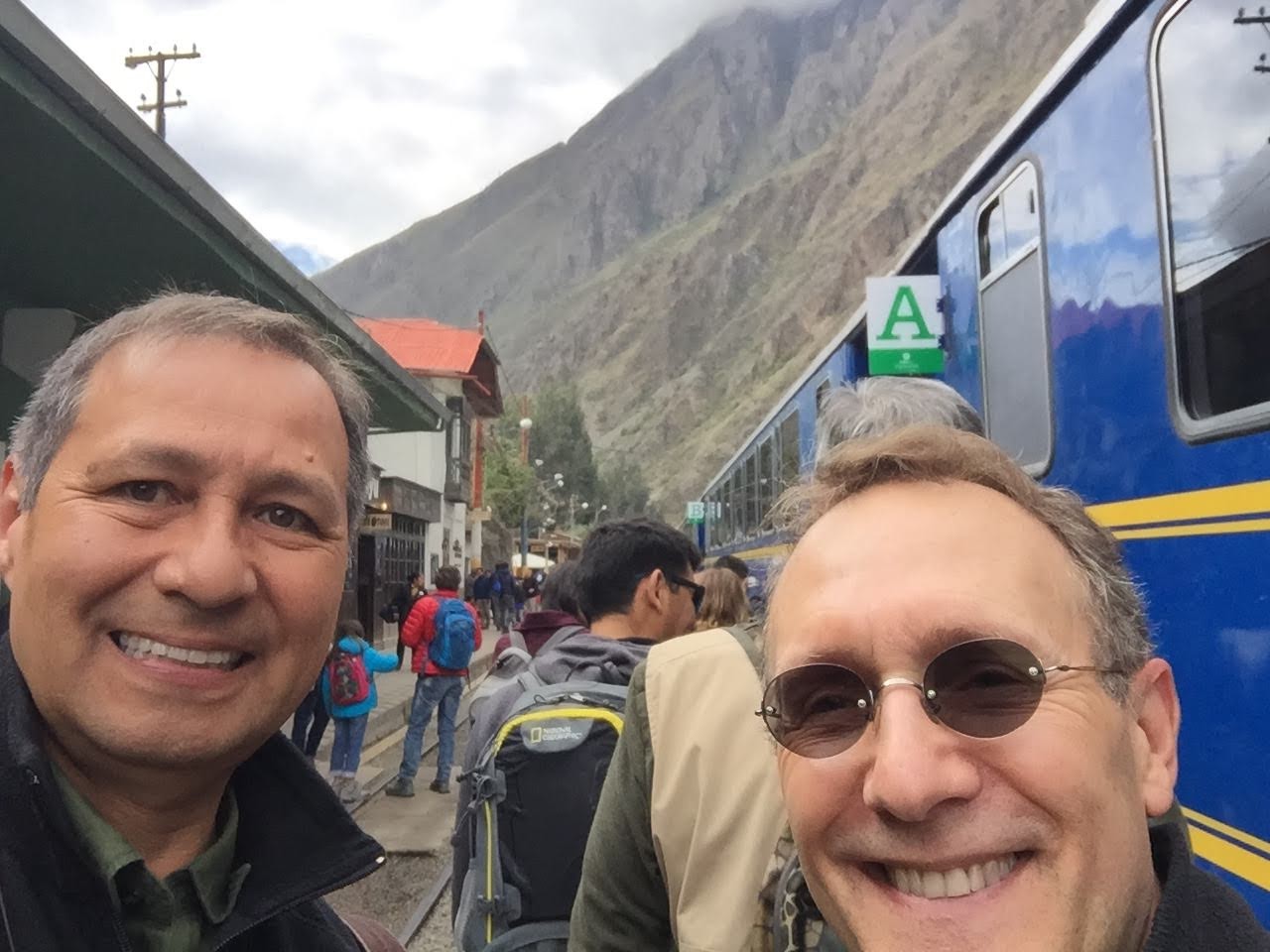
Then we boarded the train to move onward to Machu Picchu. Our train followed the Urubamba River. At times, it seemed a placid river. Then huge boulders appeared and the water was a powerful eroding force. The train cars were the panoramic type with windows that curve up and over the roof. The terrain transformed from dry to tropical. As it did, the trees began to show signs of wild orchids. Eventually, the trees were dense with orchids whose spores landed on the branches and made a home. The area was home to many animals. We did not see them in the wild, but they would have been pumas, condors, and snakes. After two hours, we arrived into Aguas Calientes. It was my impression it is built on the confluence of powerful rivers. Once, it must have been a village in it’s own right. Now, since about 1920, it is entirely a transit point. We disembarked the train and boarded a Mercedes Benz 30-seat passenger bus.
In the early 1900’s, an expedition from Yale University and National Geographic, lead by Hiram Bingham, arrived at Machu Picchu. Machu Picchu was never really lost, so it did not need discovering. It was a specific residential compound built for a king and the intellectuals. It began far down at the river with terraces. The stone work of the terraces is extremely precise. The terraces climb the mountain like stairs for giants. At the top they spread into stone apartments with pitched-roofs of reeds. The apartments are mostly inter-connected and form something akin to an ascending hill-top condominium project. And overlooking the dwellings are two peaks, ??? Picchu and ??? Picchu. The area is one where everywhere your eyes falls are hundreds of peaks. But these two rise from the stone apartments and overlook them. Atop the two peaks are more terraces.
The Machu Picchu compound was built over one hundred years. It was then occupied for less than one hundred years, concluding around 1540. From then until Hiram Bingham’s arrival it became a squatter’s paradise. The squatters, though, did not maintain it well. The local guides credit Hiram Bingham with the preservation of Machu Picchu. Bingham made many photographs. They show the site was fairly well intact. Now, UNESCO is involved. Preservation, conservation, improvements and site management are dictated by their rules.
Throughout the Andes, everywhere you look there are terraces on the mountains. They are remarkable for the precision of the stone work. It turns out, what lays behind the facade of the stonework is wildly sophisticated. To begin building a terrace, push back the earth, build your stone wall, then push the dirt back up to the wall. You could simply pile stones, squirt mortar in the spaces and hope for the best. The Incas ground the intersecting stones so the sides which would touch were perfectly smooth and flush. To make them more secure they interlocked the stones by carving them into mortise and tenon formations. That element is not at all visible to us. When it came time to push the earth back up to the new wall, the new fill was put in in layers. From the bottom up, it was big stones, gravel, sand then rich black earth with grass and crops on top. The rich black earth was imported from the Amazon jungle. Barefoot Incan runners carried it in in sacks on their backs. The sophisticated, labor intensive, brilliantly designed end result looks to our eyes like “a nice terrace”.
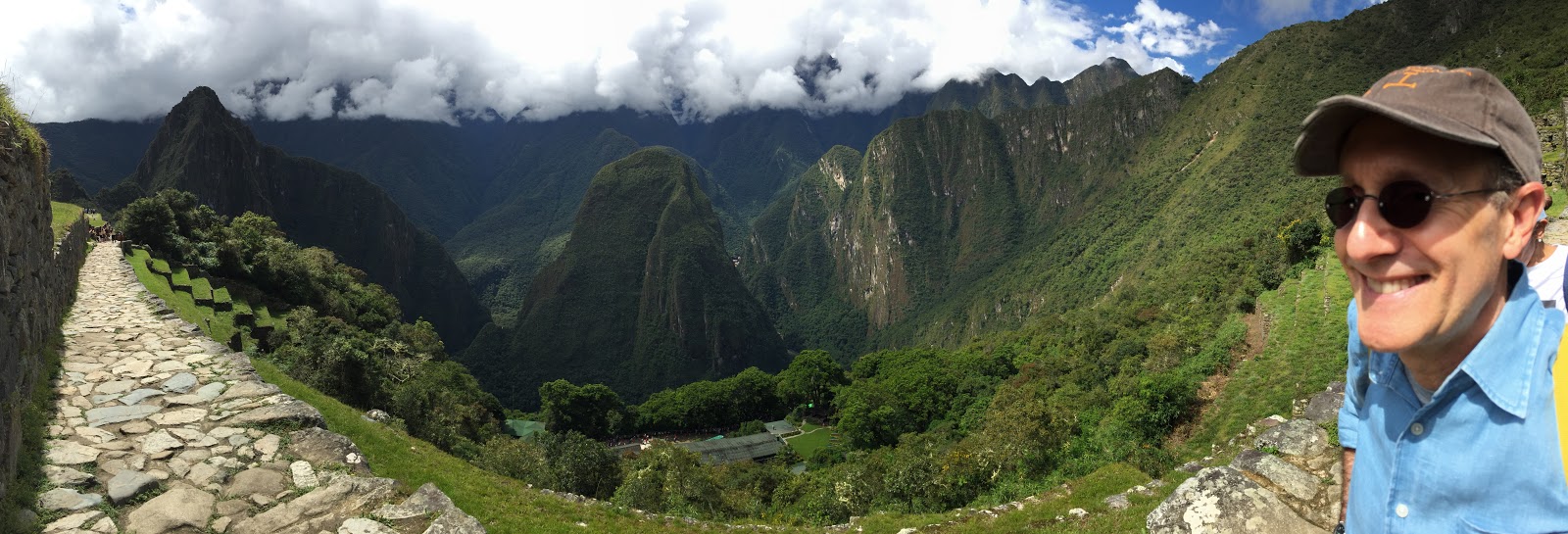
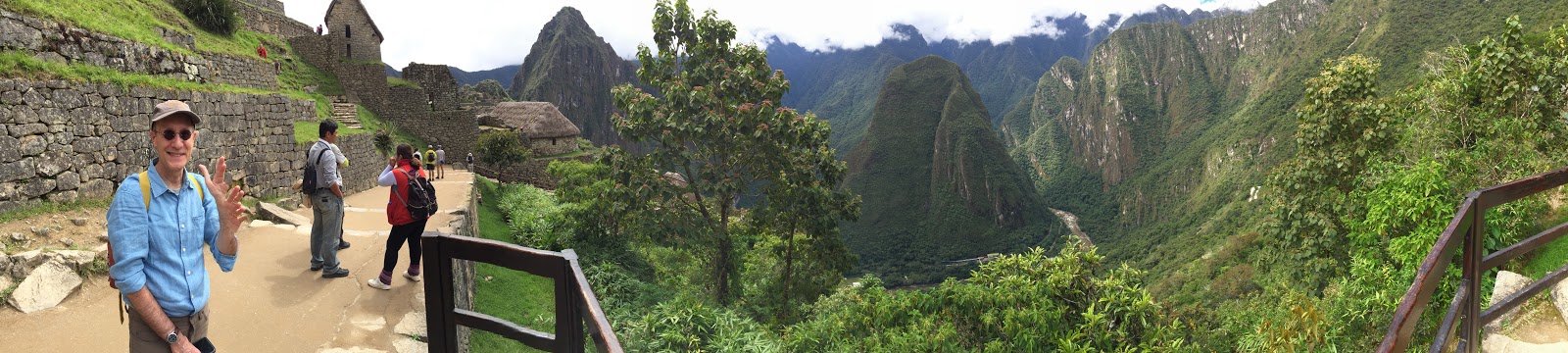
We stayed overnight at the Machu Picchu site. There is one hotel, only one. It is the Belmond Sanctuary Lodge. It is outstanding. Outside it’s main doors the Mercedes Benz 30-seat busses arrive continuously. The make the thirty minute drive, from Aguas Calientes, up the narrow zig-zag road. The bus is not the only way to arrive in Machu Picchu. Some people walk for four-days on a narrow stony trail to arrive. Some carry their possessions in a back pack. Others hire Incans to carry their heavy load. We huff and puff. The Incans glide like floating on air while carrying someone’s deckchair, air mattress, Evian and Pelligrino water and Egyptian cotton towel. It felt very “elite” to not hike in and to stay on-site in luxury, but I was never, since childhood, a trekker. As a little boy, everyone walked faster than I. I always stopped to look at a flower, an interesting group of clouds, or to close my eyes and listen to the wind. Also I was unsure footed. I was the kid who would fall up the stairs. Elite suits me fine.
From our room, we walked almost directly into the park. Everything is uphill, but after only a few dozen stairs, you can be at a magnificent vista point where if that is all you were to see you would feel you had seen the enduring magnificence which humans are capable of.
 Wes & Marlow Travel Blog